
FAQ Ecoclima Luxembourg
Most frequently asked questions about renewable energy in Luxembourg
With self consumption, you use part of the electricity you produce and only export the surplus. With full export, all production is sent to the grid.
The right choice mainly depends on your usage (being home during the day, EV, heat pump) and whether you prioritize profitability or simplicity.
The surplus is exported to the grid and can be paid according to the applicable conditions. The goal is often to increase self consumption (smart control, EV charger, hot water, heat pump) before sending too many kWh to the grid.
In most cases, no. True independence requires a lot of storage and a very constrained system sizing, especially in winter.
The most realistic approach is a grid connected system optimized to maximize self consumption.
The principle is simple: if you are eligible, the subsidy can be deducted directly from the final invoice by the installer instead of waiting for the payment later.
This mechanism mainly aims to simplify the cash flow of the project for households and co ownerships.
Yes, in some cases. In general, the battery is considered only if it is installed together with a solar PV system (or depending on the conditions of the current scheme).
The right sizing mainly depends on your evening and night consumption and on your average surplus.
It depends on the municipality and the building. The safest is to check with the local administration whether a building permit is required.
In practice, we guide you through the steps, but if a permit is needed, it is often submitted by the owner.
Yes, often. Even if your consumption drops, there are usually fixed charges. And you will still use grid power at night or in winter.
The goal is to strongly reduce the variable part and improve the self consumption rate.
Depending on the setup and the rules in force, metering can change (including smart meters). In some cases, the connection can be possible without a dedicated meter under specific conditions.
We check the right scenario for your project and the grid operator requirements.
A regular visual check and production monitoring are often enough. Cleaning can be useful depending on the environment (pollen, dust, flat roof), but it is not always necessary.
For planned maintenance, the frequency is typically every few years.
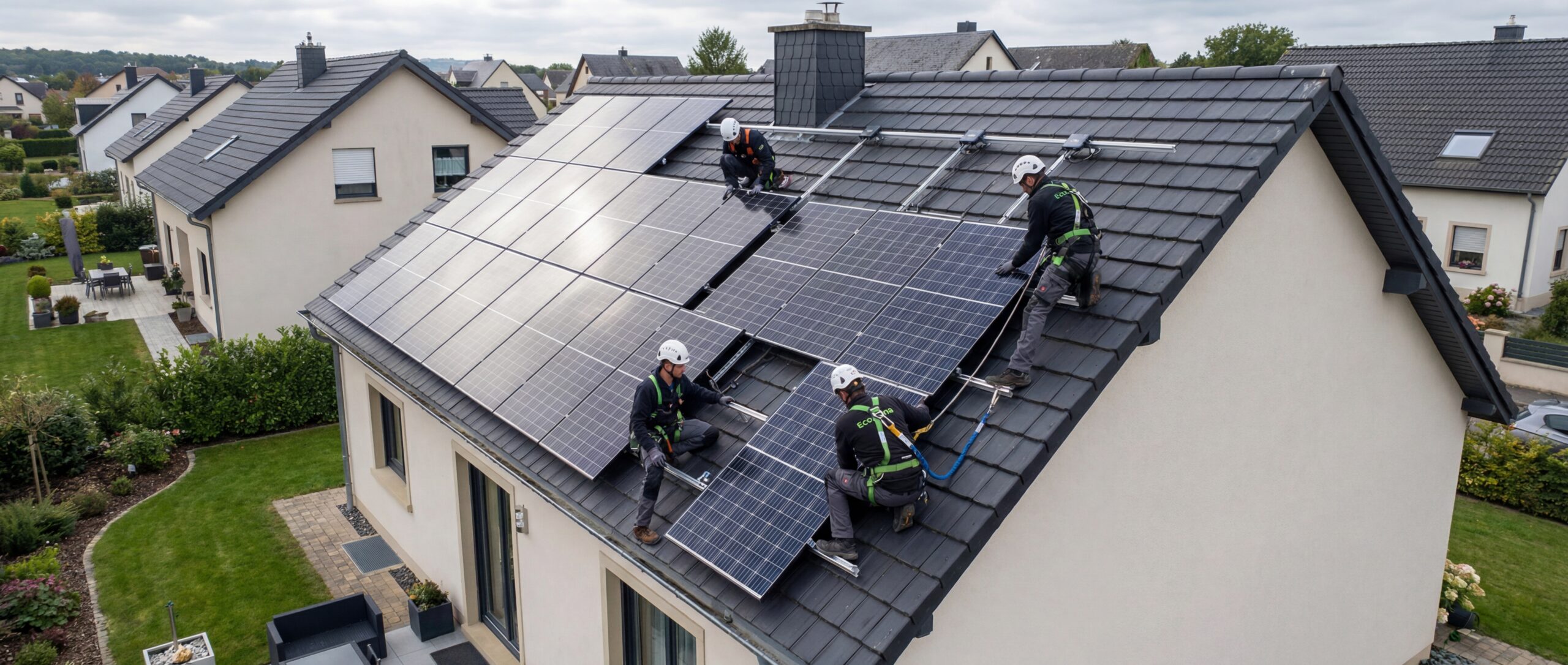
Once the project is validated and the logistics are set, the roof installation is often completed in 1 to 2 days, then come commissioning and grid validation steps.
The overall timeline mainly depends on admin steps and schedules (roofing, electrician, grid).
Air to water heats the heating water (radiators or underfloor) and often domestic hot water. Air to air heats and cools the air via indoor units, but does not produce hot water.
Geothermal is very efficient but heavier to implement (drilling, permits, budget).
In most cases yes, but performance depends on insulation, the type of emitters (radiators, underfloor), and the required supply temperature.
The key point is proper sizing (capacity, hydraulics, settings) to avoid an oversized unit or one that runs at too high temperature.
Yes in many cases. Ideally, radiators are sized to work at lower temperatures.
We check compatibility by looking at the existing system and the building needs.
Noise is a common topic. You must comply with municipal requirements and the rules related to sound level at the property line.
There is a dedicated calculation tool (Schallrechner) used to verify compliance with the applicable threshold.
Often, you need to check with the municipality (placement, exterior appearance, sound mitigation). For some solutions (for example geothermal), additional permits can apply.
We tell you what to verify during the study to avoid delays after ordering.
Yes, depending on the system. An air to air heat pump naturally provides cooling. An air to water heat pump can cool if the installation is designed for it (underfloor, fan coils, settings).
Yes, because you can self consume part of the heat pump electricity, especially in mid season. With smart control, you can improve results even more.
COP is a value at a specific operating point. SCOP is a seasonal average. Real performance depends on the building, supply temperatures, and settings.
That is why sizing and commissioning matter as much as the equipment itself.
It depends on the type (air to water, hybrid, geothermal) and the condition of the existing system. In renovation, installation can be done in a few days, followed by commissioning and fine tuning.
For regular charging, a dedicated charger is the safest and most comfortable solution (dedicated protections, stable power, smart features).
A reinforced socket can help occasionally, but it remains slower and less suitable for daily use.
At home, 7.4 kW is often enough for overnight charging. 11 kW can be relevant if you drive a lot or want more flexibility.
The choice also depends on your electrical supply (single phase or three phase) and on the vehicle.
Not necessarily. 7.4 kW works very well on single phase if your installation allows it. 11 kW is generally linked to three phase.
We check the panel, the subscription, and the available capacity before confirming the power level.
Yes in some cases. Depending on the power and configuration, a declaration may be required with the grid operator.
We validate this point before installation to stay compliant.
In Luxembourg, some chargers must be compatible with grid control requirements, especially above certain power thresholds.
In practice, it pushes toward installing a smart grid ready charger when required.
Yes, if the charger and the measurement system support it. Charging adapts to production to maximize self consumption.
This is one of the most requested optimizations for PV plus EV projects.
Cost varies with the charger model, power level, cable distance, and the condition of the electrical panel. The charger itself usually falls within a wide range, plus installation.
The best approach is to validate the technical solution before comparing prices only.
Yes, with an outdoor rated charger (appropriate protection rating) and a clean installation (mounting, protections, cable routing).
We prioritize a practical and discreet location with a sensible cable length.
Often half a day to one day, depending on cable distance, protections to add, and access to the panel.
It stores part of your daytime surplus to use in the evening and at night. Result: you increase self consumption and reduce electricity bought from the grid.
It increases your autonomy, but it does not make you independent all year. In winter, production is lower, so the battery charges less.
A realistic goal is to smooth your consumption and optimize self consumption.
Depending on the scheme in force, the battery is generally considered when installed in combination with a solar PV system and in self consumption mode.
And within the pre financing framework, the battery is typically included only if it is installed together with the solar PV system.
Sizing is mainly based on your evening and night consumption and on your average solar surplus. A battery that is too large can be under used.
The best choice is the one that matches your real usage, not a standard value.
Not automatically. For backup power, you need a dedicated backup configuration (equipment, wiring, priority circuits, safety).
If you need this, we plan it from the design stage.
Often yes, but it depends on the inverter and the architecture. There are several approaches (AC coupled, hybrid).
We check compatibility before proposing a solution.
If the building is poorly insulated, insulation is often the best first step. It reduces heating demand, then the heat pump can be sized smaller.
For solar, it is very profitable if you have sufficient electricity use. The order therefore depends on your profile.
Yes in many cases for incentives linked to energy renovation: you must obtain a prior approval before starting, then submit the payment request after the works.
This is key, because starting too early can block eligibility.
Depending on the measure and the scheme, energy advice can be required, with verification steps before and during the works.
We clearly tell you what applies to your case from the start.
Often: roof or attic first, then facades, then floors depending on the configuration. The best ratio depends on the building.
The goal is to reduce losses where they are most significant.
In general, costs linked to installing the insulation (labor and necessary works) are considered eligible, subject to the scheme conditions.
We document the works properly and keep the right documents for the application.
Yes. Efficiency and durability criteria can apply (performance, type of insulation, fastening).
We choose solutions that meet the requirements and suit your building.
Yes, it is possible. Some bonuses and incentives can be linked to performance improvement and can apply in steps depending on how the project evolves.
The most important is to keep overall coherence (thermal bridges, ventilation, humidity).
No results.
Try another keyword, or switch section.
Need advice for your project in Luxembourg?
Solar PV, heat pump, EV charger or battery: the Ecoclima team supports you from A to Z, with a clear assessment and practical answers.