
Air-air or air-water heat pump in Luxembourg: which one should you choose for your project in 2026?
Air to air or air to water heat pump in Luxembourg: this is a much more important question than it seems in 2026. Many homeowners look for a “heat pump” without immediately realising that they are actually comparing two very different technical approaches. One heats or cools the air in certain rooms. The other heats water for central heating and, depending on the project, domestic hot water.
At Ecoclima, this is exactly where a proper assessment begins. The real issue is not “which unit should I choose?”, but which system architecture matches your home, your existing setup and your actual objective. A house with radiators, an apartment that needs summer cooling, a gas or oil boiler replacement, or a project designed to benefit from 2026 subsidies: in each case, the right answer is not the same.

Key takeaways in 30 seconds
- An air to air heat pump works like a reversible split air conditioning system: it heats and cools the air in the rooms.
- An air to water heat pump heats water to supply a central heating system and, depending on the project, domestic hot water.
- If your goal is to replace a boiler while keeping radiators or underfloor heating, the most coherent choice is generally an air to water heat pump.
- If your priority is summer comfort, localised heating and a room by room solution, an air to air heat pump may be the right approach.
- The Klimabonus 2026 subsidies published on Guichet.lu mainly detail air to water heat pumps, non fossil hybrid systems and geothermal systems.
- With radiators, a heat pump can also work in renovation, but the flow temperature remains a decisive point.
- In Luxembourg, you also need to consider noise, mandatory inspection, meters, hydraulic balancing and the overall consistency of the project.
Contents
- Why this topic is becoming central in Luxembourg
- The real difference between air to air and air to water
- When an air to air heat pump makes sense
- When an air to water heat pump is the right choice
- Radiators, renovation and flow temperature
- 2026 subsidies: what the Luxembourg framework really changes
- Noise, compliance and mandatory inspection
- How to make the right decision for your home
- Why choose Ecoclima
- FAQ
Why this topic is becoming central in Luxembourg
In 2026, the heat pump topic is clearer than before in Luxembourg, but also more demanding. The official Klimabonus 2026 subsidy framework is more structured, the technical conditions are explicit, and since 19 September 2025, heat pump installations are subject to a mandatory inspection after installation. In other words, the market is becoming more mature, and approximate projects are becoming easier to identify.
For a homeowner, this changes how projects should be compared. It is no longer enough to ask “how much does a heat pump cost?”. You need to look at the type of heat pump, the real objective, the existing system, the available subsidies and the site constraints.
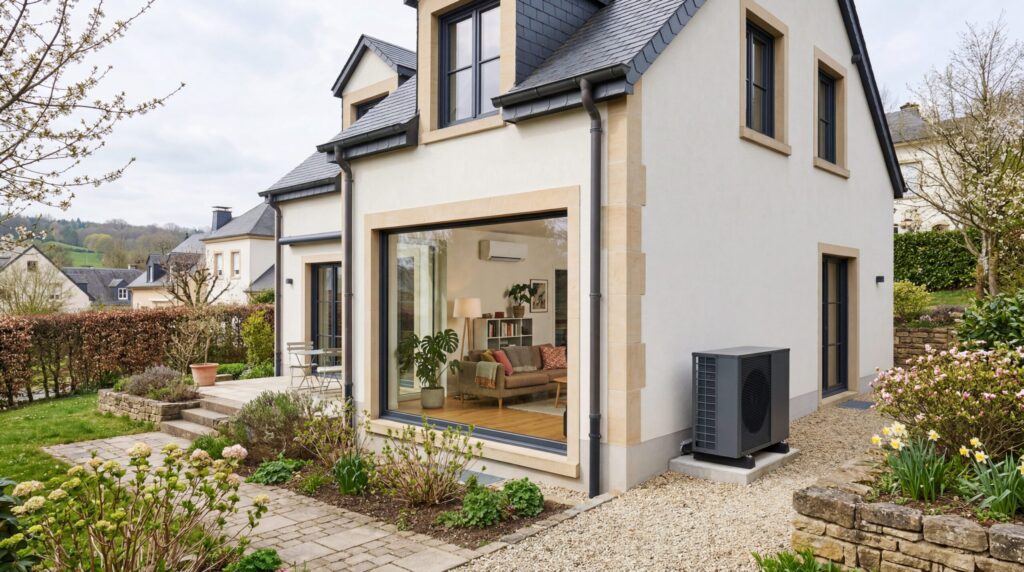
Useful official links:
Guichet.lu: Klimabonus 2026 for technical installations
Klima-Agence: installing a heat pump in an existing building
Klima-Agence: common myths and misconceptions about heat pumps
Klima-Agence: mandatory heat pump inspection
Guichet.lu: Klimabonus 2026 for technical installations
Klima-Agence: installing a heat pump in an existing building
Klima-Agence: common myths and misconceptions about heat pumps
Klima-Agence: mandatory heat pump inspection
The real difference between air to air and air to water
The main difference is simple. An air to air heat pump heats or cools air directly in the rooms. This is the logic of reversible split air conditioning. An air to water heat pump, by contrast, heats water to supply a central heating system, such as radiators or underfloor heating.
On site, this changes everything: heat distribution, summer comfort, domestic hot water production, compatibility with the existing system, subsidies, noise…
| Compared point | Air to air heat pump | Air to water heat pump |
|---|---|---|
| Distributed energy | Warm or cool air in the rooms | Hot water in a heating circuit |
| Main use | Room by room comfort, localised heating, cooling | Central heating, renovation, boiler replacement |
| Domestic hot water | No in the standard split logic | Yes, depending on the project configuration |
| Summer comfort | Very good | Possible depending on the system, but this is not its main purpose |
| Typical project | Apartment, living area, office, backup heating or targeted comfort | House with radiators or underfloor heating, full heating project |
| 2026 subsidy framework | Not specifically detailed as such on the official Klimabonus 2026 page | Yes, the official framework is clearly detailed |
When an air to air heat pump makes sense
An air to air heat pump is consistent if your real need is to heat and cool certain rooms, improve summer comfort, or add a reversible solution without rebuilding an entire hydraulic network. It is often a good choice in an apartment, an extension, a living room heavily exposed to heat, or a home where the main need is not to rebuild the full central heating system.
The strength of this technology is its flexibility. The response is fast, localised and particularly relevant when summer overheating becomes a real issue. In Luxembourg, with increasingly sensitive summers in some homes, this argument matters more and more.
However, one point must be clear: an air to air heat pump does not naturally fulfil the same role as an air to water heat pump in a full boiler replacement project for a house with an existing central heating system. These two families therefore do not answer the same question.
When an air to water heat pump is the right choice
An air to water heat pump generally becomes the right choice when you want to move away from gas or oil, keep a central heating system, continue using your radiators or underfloor heating, and build a project that is clearly compatible with the subsidy framework published on Guichet.lu.
It is also the technology that best matches the most commercially qualified demand: replacing a boiler with a more modern solution, more coherent from an energy perspective and better integrated into a renovation project. In this case, the installer’s job is not just to fit a unit. The system must be sized, the flow temperature must be checked, the emitters must be analysed, noise must be anticipated, and the whole file must be structured properly.
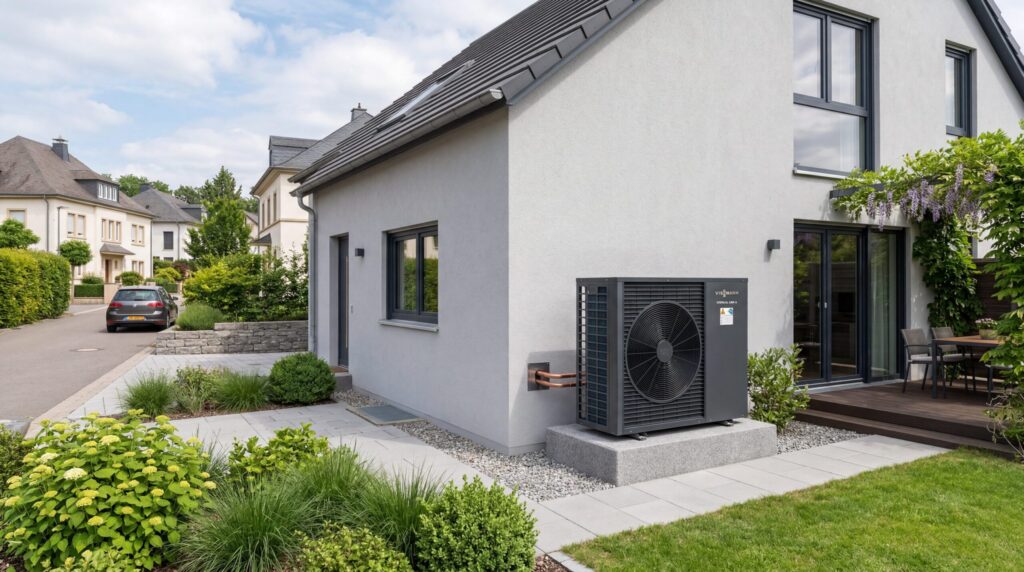
The right reflex
If your initial question sounds like one of these, you are probably in an air to water logic:
- Can my gas or oil boiler be replaced by a heat pump?
- Are my radiators compatible?
- Can I benefit from Klimabonus 2026 subsidies?
- How can I also produce domestic hot water?
Radiators, renovation and flow temperature
This is often where the project is decided. Many homeowners still think that a heat pump is only suitable for new homes with underfloor heating. That is not what Klima-Agence says. In an existing building, standard radiators can also work, provided the flow temperature is considered properly. The useful reference point is clear: aim for a maximum of 55°C.
The lower this temperature is, the more efficient the system becomes. This does not mean that “radiators = no”. It means that the project must be assessed seriously: radiator size and settings, insulation, real room by room demand, and the behaviour of the home during cold periods. In some cases, a partial upgrade of the emitters can significantly improve the overall consistency.
| Situation | Correct reading | What Ecoclima must check |
|---|---|---|
| House with underfloor heating | Generally favourable context | Sizing, DHW, noise, subsidies |
| House with standard radiators | Also possible in renovation | Flow temperature, emitter output, real comfort |
| Old boiler still in place | Potentially very interesting project | Full replacement scenario or transitional hybrid scenario |
| Apartment without a suitable hydraulic network | Often more logical as air to air depending on the need | Summer comfort, localised heating, unit placement |
2026 subsidies: what the Luxembourg framework really changes
The official 2026 framework strongly changes the economic reading of the project. On Guichet.lu, subsidies are clearly detailed for air to water heat pumps, non fossil hybrid heat pumps and geothermal heat pumps. For an existing dwelling, an air to water heat pump can reach up to €10,000 for a single family house when replacing a fossil boiler or existing direct electric heating, and €6,000 without such a replacement.
The framework also includes useful additions: up to €2,000 for adapting the existing heat distribution system in a single family house, €2,000 for replacing an oil boiler in a water protection zone, and €1,500 for the removal, neutralisation and recycling of an oil tank. This is exactly why a serious assessment is more useful than a simple equipment price.
For an air to air heat pump, the correct wording is the following: this type of system does not appear as such on the official Klimabonus 2026 page detailing technical heating subsidies. If the project depends heavily on published state subsidies, then the air to water logic fits much more clearly within the official framework.
Noise, compliance and mandatory inspection
A good heat pump project in Luxembourg should not be judged only by the commercial brochure. Compliance must also be considered. For air to water and hybrid air to water heat pumps, Guichet.lu details precise acoustic thresholds for the outdoor unit: 48 dB(A) up to 5 kW, 51 dB(A) between 5 and 12 kW, and 55 dB(A) above that. If these thresholds are not met, the noise level at the boundary of the nearest neighbouring buildable plot must not exceed 40 dB(A), with prior acoustic calculation.
The official framework also imposes specific technical points: an electricity meter, a heat meter, hydraulic balancing, and in existing buildings a 30 l / kW thermal buffer tank, except for heat pumps with variable speed or variable output.
Finally, since 19 September 2025, heat pump installations have been subject to a mandatory inspection carried out by the Chambre des Métiers. This step verifies safety, proper operation, sizing and the actual suitability of the installation for the house.
A key point that is often overlooked:
A serious heat pump quote in Luxembourg should not simply mention a brand or an output. It should already include a logic of noise, outdoor unit positioning, flow temperature, emitter compatibility and compliance with the official framework.
A serious heat pump quote in Luxembourg should not simply mention a brand or an output. It should already include a logic of noise, outdoor unit positioning, flow temperature, emitter compatibility and compliance with the official framework.
How to make the right decision for your home
The right method is not to compare two keywords. You need to start from the real home.
- Do you mainly want to cool in summer and heat certain rooms? Start by looking at the air to air logic.
- Do you want to replace a boiler and keep central heating? Start by looking at the air to water logic.
- Do you have radiators? Do not jump to conclusions too quickly. The flow temperature and the real behaviour of the house must be analysed.
- Are you relying heavily on 2026 subsidies? Here again, the air to water logic is much more clearly structured.
| Your situation | Most likely direction | Why |
|---|---|---|
| House with a gas or oil boiler to replace | Air to water heat pump | Central heating, subsidies, renovation |
| Apartment with a strong need for summer comfort | Air to air heat pump | Cooling and localised heating |
| House with radiators and uncertainty about compatibility | Air to water assessment as priority | Compatibility depends on the real system, not on an assumption |
| Project focused on one room or one living area | Air to air heat pump | Localised, fast and reversible response |
Why choose Ecoclima

At Ecoclima, we deliberately avoid the most common mistake in this type of project: choosing a technology before reading the system as a whole. Our role is to determine whether your real need matches an air to air or air to water logic, and then build a project that is technically consistent, financially clear and properly executed.
In concrete terms, we first analyse your home, your emitters, your winter and summer objective, your current system, the installation constraints, the available subsidies and the overall level of consistency. This system based reading is what prevents quotes that look attractive on paper but are weak in reality.
Unsure between an air to air and an air to water heat pump in Luxembourg?
The most useful approach is to start from your real home: radiators or not, existing boiler, summer comfort, domestic hot water, noise, subsidies and installation constraints. At Ecoclima, we help you compare the right scenarios before you sign.
Go further based on your project
- Air to water heat pumps in Luxembourg
- Reversible air conditioning in Luxembourg
- Heat pumps in Luxembourg in 2026: subsidies, radiators, renovation and mistakes to avoid
- Our references in Luxembourg
- Get a free quote
FAQ: air to air or air to water heat pump in Luxembourg
Is an air to air heat pump the same as reversible air conditioning?
Yes. In residential use, an air to air heat pump follows the logic of reversible split air conditioning: it heats and cools the air in the rooms.
Can an air to water heat pump work with radiators?
Yes, in many cases. The key point is not only the presence of radiators, but the required flow temperature and the overall consistency of the system. The useful benchmark remains a maximum of 55°C.
Which heat pump should I choose to replace a gas or oil boiler?
In the majority of residential projects with existing central heating, the most coherent logic is the air to water heat pump, because it integrates with the heating network and the official subsidy framework.
Do the 2026 subsidies also clearly cover air to air systems?
The Klimabonus 2026 framework published on Guichet.lu mainly details air to water heat pumps, non fossil hybrid systems and geothermal systems. If your project depends heavily on published subsidies, the air to water route fits much more clearly within this framework.
Should the noise of an air to water heat pump be checked before installation?
Yes. Noise must be assessed from the quotation stage, including the outdoor unit location, the applicable thresholds and, if required, an acoustic calculation.
Is there a mandatory inspection for heat pumps in Luxembourg?
Yes. Since 19 September 2025, heat pump installations have been subject to a mandatory inspection after installation.
The right heat pump choice starts with a clear reading of the home
Air to air, air to water, radiators, existing boiler, noise, subsidies, summer comfort: everything must be read as a system. That is what helps avoid a project that looks attractive on the surface but is poorly calibrated underneath.