Solar self-consumption in Luxembourg: how can you genuinely reduce your electricity bill in 2026?
Generating solar electricity alone does not guarantee a major reduction in your bill. For a photovoltaic project to perform effectively, a sufficient share of the electricity produced must be consumed when it is available.
Updated in June 2026Reading time: approximately 15 minutesLuxembourg
Two systems with the same capacity can generate the same amount of electricity over a year while delivering very different savings. A household that runs appliances, heats water or charges an electric car during solar production hours makes better use of its output than a home that is almost empty during the day.
In this guide, you will learn how to distinguish self-consumption from energy independence, calculate the value of the kWh used on site, assess whether a battery is worthwhile and identify the actions that genuinely reduce electricity purchases from the grid.
In summary
Photovoltaic panels generate most of their electricity during the day.
Using one kWh directly avoids purchasing one kWh from the supplier.
Electricity that is not consumed immediately can be stored or fed into the grid.
The reduction in the electricity bill mainly depends on when the home uses energy.
A battery can increase self-consumption, but it is not automatically cost-effective.
What is photovoltaic self-consumption?
Self-consumption means using part of the electricity generated by solar panels directly within the building. The home naturally gives priority to this locally produced electricity before drawing any additional power required from the grid.
Generation, direct consumption and surplus electricity
When the panels are generating electricity, it first supplies the appliances operating at that moment: refrigerator, ventilation, computers, household appliances, water heater, heat pump or EV charger. If generation exceeds immediate demand, the excess can charge a battery. Once the battery is full, or when no storage system is installed, the remaining surplus is fed into the grid.
1Solar panelsGeneration during daylight hours.
2HomeActive appliances use the solar electricity first.
3BatterySurplus electricity can be stored for later use.
4GridThe remaining surplus is fed into the grid and measured separately.
5Grid supplyThe grid provides the additional electricity required at night or during periods of low solar generation.
The bidirectional meter separately records the electricity drawn from the grid and the electricity fed into it. Creos therefore distinguishes between a self-consumer, who uses part of their own production, and a producer who feeds all generated electricity into the grid.
Self-consumption rate and energy independence rate
These two indicators answer different questions. Confusing them often leads to an overestimation of a system’s performance.
Self-consumption rate
This measures the share of solar electricity generated that is used in the home.
Solar electricity consumed on site ÷ total photovoltaic generation × 100
Energy independence rate
This measures the share of the home’s electricity needs covered by solar power.
Solar electricity consumed on site ÷ total household electricity consumption × 100
Simple example
A system generates 5,000 kWh per year. The household directly uses 2,000 kWh of solar electricity and consumes 4,000 kWh in total.
Self-consumption rate: 2,000 ÷ 5,000 = 40%.
Energy independence rate: 2,000 ÷ 4,000 = 50%.
The household therefore consumes 40% of its solar generation on site, while solar power covers 50% of its annual electricity needs.
Why does self-consumption reduce the electricity bill?
The value of a directly consumed kWh
A solar kWh consumed when it is generated replaces a kWh that would otherwise have been purchased from the supplier. Its value therefore corresponds to the avoided cost of that quantity of electricity, depending on the supply contract and the variable components of the bill.
This explains why a well-managed system can be more attractive than a larger installation that feeds most of its generation into the grid. Producing more increases the number of kWh generated, but not necessarily their average economic value.
The value of surplus electricity fed into the grid
Electricity that is not consumed is not automatically wasted. It can be fed into the grid and remunerated under the applicable scheme and contract. However, the value of this surplus is not universal.
There are guaranteed feed-in schemes as well as variable contracts linked to market prices. The applicable conditions must be checked in the contract that is actually signed rather than reduced to a single tariff presented as valid for every household.
What solar panels do not remove from the bill
A photovoltaic system reduces electricity purchases, but it does not automatically eliminate the entire bill. The home will generally continue to rely on the grid at night, during winter, in poor weather or whenever several appliances consume more than the solar system is producing at that moment.
Night-time consumption not covered by a battery.
Electricity purchased during periods of low winter generation.
Fixed charges and certain grid-related components.
Applicable fees and taxes, depending on the contract.
Consumption peaks that exceed the available solar output.
The right objective: reduce the number of kWh purchased and make better use of every kWh generated, rather than promising to eliminate the electricity bill entirely.
How can the savings generated by self-consumption be calculated?
A robust calculation must separate two sources of value: electricity purchases avoided through self-consumption and any income generated by surplus electricity fed into the grid.
The four required data points
1
Estimated annual generation
This depends on the installed capacity in kWp, orientation, tilt, shading and overall system performance.
2
Share consumed on site
This must be estimated from the home’s hourly consumption profile, not only from its annual electricity use.
3
Avoided purchase price
This is the value of each kWh the household no longer purchases from its supplier.
4
Feed-in tariff
This is the tariff under the contract that actually applies to the kWh fed into the grid.
Feed-in income = kWh fed into the grid × applicable feed-in tariff
Gross annual benefit = purchase savings + feed-in income
This gross annual benefit is not yet a complete profitability calculation. The next step is to account for the system’s net cost after subsidies, the gradual decline in output, conversion and storage losses, any maintenance costs and future changes in electricity prices.
Transparent calculation example
Consider an illustrative scenario with annual generation of 5,200 kWh, of which 1,560 kWh is self-consumed. The surplus therefore amounts to 3,640 kWh. To demonstrate the method only, we use an avoided purchase price of €0.25 per kWh and a surplus remuneration rate of €0.05 per kWh.
€390Avoided purchases 1,560 × €0.25
€182Feed-in income 3,640 × €0.05
€572Gross annual benefit in this scenario
Important: these tariffs are illustrative assumptions. They must be replaced with the prices shown on the household’s electricity bill and feed-in contract.
Three simulations for Luxembourg households
The following table compares three electricity consumption profiles. These are not client case studies or guaranteed performance figures. The scenarios use the same illustrative price assumptions: €0.25 per avoided kWh and €0.05 per kWh fed into the grid.
Profile
Annual consumption
Solar generation
Share self-consumed
Calculated energy independence
Illustrative gross benefit
Standard home Solar panels only
4,500 kWh
5,200 kWh
30%, or 1,560 kWh
35%
Approximately €572/year
Home with battery Solar panels and storage
4,500 kWh
5,200 kWh
60%, or 3,120 kWh
69%
Approximately €884/year, excluding the battery’s cost and losses
Electrified home Smart-controlled loads
8,000 kWh
7,500 kWh
50%, or 3,750 kWh
47%
Approximately €1,125/year
These simulations explain the method. They do not replace a study based on the customer’s actual consumption, roof and energy contracts.
What self-consumption rate can realistically be achieved?
There is no single rate that applies to every home. The result depends on the installed capacity, household habits, whether a battery is present and the ability to shift certain loads.
With solar panels only
Without a battery, self-consumption mainly relies on the home’s base load and electricity use between morning and late afternoon. Working from home, a smart-controlled water heater or appliances scheduled during the day can improve the result without major investment.
With a battery
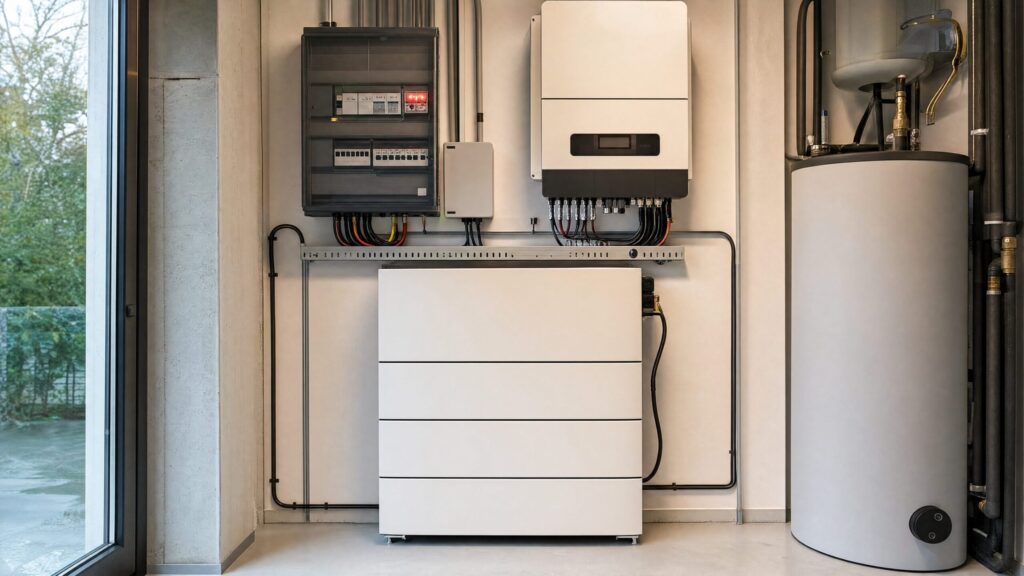
A battery shifts part of the electricity generated around midday to the evening or night. It generally increases the amount of solar electricity used on site, but its capacity must remain consistent with the surplus actually available and the home’s night-time consumption.
With an electric car or a heat pump
A major electrical load does not automatically improve self-consumption. A car charged exclusively at night uses very little solar electricity directly. Likewise, a heat pump consumes most during the colder months, when photovoltaic generation is lower.
The potential increases when EV charging, water heating or certain heat-pump cycles are controlled during solar production periods. To understand this mismatch, read our guide to the electrical appliances best aligned with solar generation.
Why aiming for 100% is not necessarily cost-effective
Achieving almost complete energy independence would require covering nights, heavily overcast days and winter periods. This may require more panels and a large battery, even though this additional equipment would not operate at full capacity throughout the year.
Beyond a certain point, each additional euro invested therefore delivers a smaller benefit. Our article on how to correctly size a photovoltaic system explains why the largest installation is not always the most profitable.
Solutions should be assessed in order of economic priority. Before adding equipment, first identify what can be improved through scheduling and smart control of the appliances already installed.
1. Shift electricity use to daytime hours
Running the washing machine, dishwasher or tumble dryer during solar production hours is often the simplest action. The aim is not to start every appliance at exactly midday, but to stagger cycles so that consumption remains close to the power being generated.
2. Heat water during solar production
A hot-water cylinder can convert part of the solar electricity into heat stored for later use. A timer, relay or surplus management system can start heating at the most appropriate time.
3. Charge the electric car at the right time
Charging at a fixed time does not necessarily account for the weather or household consumption. A charger capable of adjusting its power according to the available solar surplus can further reduce electricity drawn from the grid. You can also discover ourEV charger installation service in Luxembourg.
4. Use an energy management system
An energy management system monitors generation, consumption, battery state of charge and controllable appliances. It can prioritise the water heater, battery or electric car according to predefined rules.
5. Add a battery only when it is justified
A battery should be considered after direct electricity use has been optimised. It becomes relevant when a regular daytime surplus is available and the household consumes enough electricity in the evening to use the stored energy.
6. Size the system according to the household profile
The study must account for the current situation and planned changes: an electric vehicle, heat pump, air conditioning, electric water heater, home extension or a change in the number of occupants.
7. Monitor the data after commissioning
A monitoring application makes it possible to compare generation, grid feed-in, grid purchases and battery cycles. After a few weeks, real data may reveal an appliance that is poorly scheduled, EV charging that starts too late or a storage system that is not being used enough.
Action
Relative cost
Effort
Potential impact
Priority
Schedule appliances during the day
Very low
Low
Moderate
Quick win
Schedule the water heater
Low
Low to medium
Moderate to high
Quick win
Smart-control the EV charger
Medium
Medium
High if the vehicle is present
Medium term
Install an energy management system
Medium
Medium
High in an electrified home
Medium term
Add a suitably sized battery
High
Medium
Variable depending on the profile
Requires assessment
Is a battery essential for reducing the electricity bill?
No. It is entirely possible to self-consume solar electricity without a battery. Storage provides greater flexibility, but it also adds cost, conversion losses and capacity that must actually be used.
A battery is relevant when…
the home consumes a significant amount of electricity in the evening;
a regular surplus is available during the day;
the capacity matches both generation and demand;
the stored energy is used frequently;
the net cost remains consistent with the expected benefit.
A battery is less relevant when…
the household already uses a large amount of electricity during the day;
the system generates little surplus electricity;
the proposed capacity is oversized;
the project is focused solely on achieving the fastest financial return;
consumption habits can be optimised without storage.
The 2026 Klimabonus scheme provides financial support for storage combined with a self-consumption photovoltaic system, subject to the applicable conditions. Prefinancing may apply to a new system with a battery, but not to a battery added on its own to an existing photovoltaic installation.
What happens to solar electricity that is not consumed?
Feeding surplus electricity into the grid
When generation exceeds immediate consumption and the battery can no longer absorb energy, the surplus is fed into the grid. The meter records this quantity separately from the electricity drawn from the grid.
Electricity feed-in contract
Remuneration depends on the selected scheme, the project date and the contract signed. A guaranteed arrangement or a variable market-linked valuation may apply. The conditions must be checked with the relevant grid operator and supplier before validating a financial simulation.
Electricity sharing
Surplus electricity can also be used through collective self-consumption or an energy community. These models make it possible to share locally generated electricity between several consumers, for example within a residential building, between several buildings or among a group of participants.
Klima-Agence presents the different electricity-sharing models available in Luxembourg. However, this subject requires a separate study because the rules, participants and metering of energy flows differ from standard individual self-consumption.
How Ecoclima sizes a self-consumption project
A coherent project does not begin with the choice of a solar panel or battery. It starts with an analysis of the building, electricity consumption and future uses. The objective is to design a system in which all components work together.
Consumption analysis
We review the available electricity bills over a twelve-month period, annual consumption, the split between daytime and evening use, base load and seasonal variations. When hourly data is available, it enables a much more accurate analysis than an annual total alone.
Building analysis
The available surface area is only an initial indicator. Orientation, tilt, shaded areas, different roof sections, the condition of the electrical panel, connection capacity and site constraints all directly influence the selected solution.
Accounting for future uses
A system designed to operate for fifteen or twenty years must anticipate the gradual electrification of the home. An EV charger, heat pump, air-conditioning system, water heater or extension can significantly change the consumption curve.
The combination of solar panels and a heat pump must take into account the mismatch between high winter consumption and greater solar generation in spring and summer.
Assessment of several scenarios
Rather than presenting a single configuration as the obvious choice, it is more useful to compare several options.
Scenario assessed
Main question
Objective
Solar panels only
What share can be consumed directly?
Limit the initial cost
Solar panels with scheduling
Which loads can be shifted?
Improve self-consumption at low cost
Solar panels with battery
How much surplus can be usefully stored?
Shift energy use to the evening
Solar panels with a smart-controlled EV charger
Is the vehicle present during solar production?
Use surplus electricity for mobility
System prepared for future uses
What new needs will arise in the coming years?
Avoid a system that quickly becomes unsuitable
Mistakes that reduce the profitability of self-consumption
1
Confusing self-consumption with energy independence
A high result for one indicator does not guarantee a high result for the other.
2
Installing the maximum number of panels
High generation may mainly increase a surplus that has a lower economic value.
3
Choosing an oversized battery
Capacity that is rarely used increases the cost without creating equivalent value.
4
Using appliances only in the evening
Without a battery, evening appliances are still mainly powered by the grid.
5
Accepting an opaque simulation
A result that does not explain the tariffs, generation assumptions and consumption profile is difficult to verify.
6
Believing the electricity bill will disappear
Nights, winter periods, fixed charges and consumption peaks must still be taken into account.
Which administrative steps are required in Luxembourg?
Administrative preparation must be integrated into the project from the outset. Depending on the building, grid operator and selected scheme, several steps may be required.
Carry out the technical assessment and system sizing.
Check any requirements imposed by the municipality.
Submit the grid connection application to the grid operator.
Plan for separate metering of electricity drawn from and fed into the grid.
Select the applicable scheme and feed-in contract.
Install, inspect and commission the system.
Submit the subsidy application or follow the prefinancing procedure.
Creos manages grid connection and metering procedures on its network, among other responsibilities. For eligible projects, prefinancing allows a registered installer to deduct the Klimabonus directly from the final invoice instead of waiting for the subsidy to be paid after completion of the work.
Frequently asked questions about photovoltaic self-consumption
Can solar electricity be self-consumed without a battery?
Yes. Solar generation directly supplies appliances operating during the day. A battery is mainly used to shift part of the surplus to the evening or night.
What is the difference between self-consumption and energy independence?
Self-consumption measures the share of solar generation used on site. Energy independence measures the share of total electricity consumption covered by solar power.
What self-consumption rate can be achieved?
There is no universal rate. The result depends on the installed capacity, hourly consumption profile, controllable appliances and whether a battery is installed.
Is surplus photovoltaic electricity wasted?
No. It can be stored, fed into the grid, remunerated under a contract or shared through a collective model.
Does a battery always reduce the electricity bill further?
It can reduce electricity purchases when it stores surplus energy that will genuinely be used later. However, its financial value depends on its cost, capacity, losses and the number of useful cycles.
Can an electric car be charged using solar panels?
Yes. The result is better when the car is present during the day and the charger adjusts its output to the available solar surplus.
Does a heat pump improve self-consumption?
It can increase the amount of electricity consumption covered by solar power during certain periods. However, its main demand remains in winter, when photovoltaic generation is lower.
Do the solar panels and battery work during a power cut?
Not automatically. A standard inverter shuts down when the grid fails. Backup power requires a compatible inverter, an isolation device and a system designed for this function.
Reducing the electricity bill starts with the consumption profile
Photovoltaic self-consumption does not depend solely on the number of panels. It depends on the home’s ability to use electricity when it is generated. Appliance scheduling, smart control of the water heater or EV charger, and appropriate system sizing should therefore be assessed before adding a battery.
A personalised study makes it possible to compare several scenarios, identify the assumptions used and design a system that suits both the home’s current situation and its future needs.
Assess your home’s self-consumption potential
Ecoclima analyses your electricity consumption, roof, equipment and future needs to compare solar panels alone, smart control, battery storage and EV charging.