
Heat Pump in Luxembourg in 2026: Grants, renovation, radiators and what to check before installing
Installing a heat pump in Luxembourg can be a very smart decision in 2026, but not under just any conditions. The right project is not simply about “replacing the boiler with a heat pump.” You need to look at the actual house, the radiators, the flow temperature, the grants, the administrative steps, and the quality of the system sizing.
This guide gets straight to the point. The goal is simple: to help you understand what really matters before signing, with a clear, local, and practical perspective. If you are looking for a concrete article about a heat pump for renovation in Luxembourg, with the real points to watch and not just theory, you are in the right place.
What to remember in 30 seconds
- A heat pump is not only for new-build homes. In renovation projects too, it can be a very coherent solution if the property and the system are properly assessed.
- The real issue is not just the age of the house, but the flow temperature, the radiators, the insulation, and the overall consistency of the system.
- With radiators, a heat pump can work. The right mindset is not “radiators = no,” but “under what conditions will the system remain efficient and comfortable?”
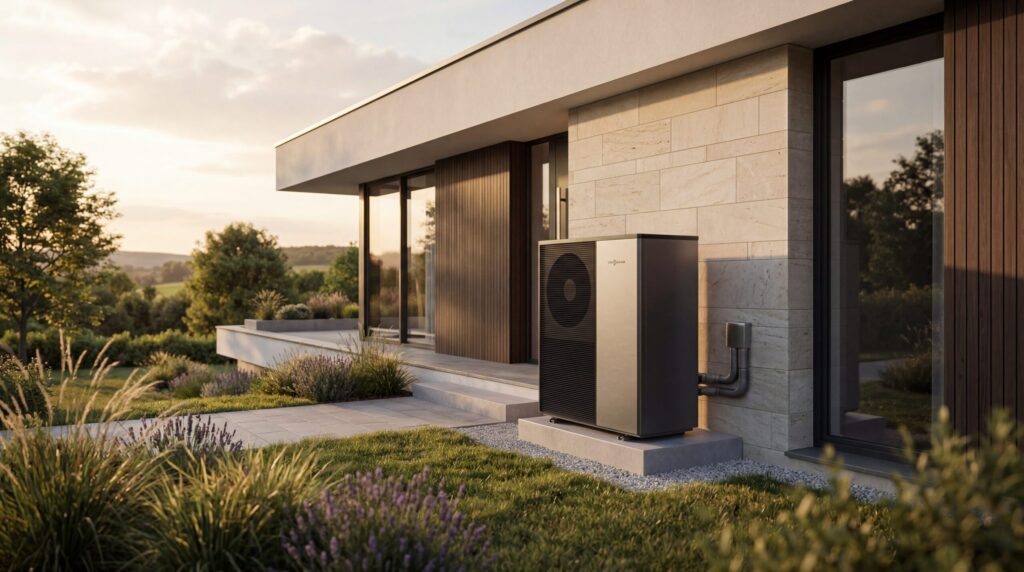
- Noise must be addressed from the study phase, especially for an air-to-water heat pump. The location of the outdoor unit matters just as much as the choice of machine.
- Klimabonus 2026 grants can significantly change the net cost of the project, especially in renovation when replacing a fossil-fuel boiler.
- The right installer does not just sell a machine. They structure a complete project, with technical assessment, administrative support, and a true system-based approach.
Contents
- What changes in 2026
- Heat pump in renovation: the real question
- Older house and radiators: what really causes issues
- Which type of heat pump to choose
- 2026 grants and subsidies
- Noise, neighbours and positioning
- Steps you should not overlook
- How to assess whether your home is ready
- How to choose the right installer
- FAQ
What changes in 2026
In 2026, the topic of a heat pump in Luxembourg is becoming clearer for homeowners for three main reasons:
- Klimabonus 2026 grants provide a clearer framework regarding amounts and conditions;
- renovation with a heat pump is better understood, including in existing homes with radiators;
- acoustic and technical requirements are more structured, which leaves less room for poorly prepared projects.
In concrete terms, the market is becoming more professional. Clients no longer want just a price. They want to understand how much they will actually pay, what they can realistically expect from the system, whether their home is truly suitable, and whether the installation will remain consistent in the long term.
This is exactly where a lot of content remains too weak. It explains the basic principle of a heat pump, but it does a poor job of answering the real question for Luxembourg homeowners: “does this really make sense for my home?”
Useful official links:
Klimabonus 2026 on Guichet.lu
Installing a heat pump in an existing building
Common myths and misconceptions about heat pumps
Schallrechner for acoustic calculation
Klimabonus 2026 on Guichet.lu
Installing a heat pump in an existing building
Common myths and misconceptions about heat pumps
Schallrechner for acoustic calculation
Heat pump in renovation: the real question
Many homeowners start with the wrong question: “Is a heat pump possible in my home?” In practice, that is not precise enough. In many cases, the answer is yes. But the real question is more like this:
Will a heat pump actually be coherent, efficient, and comfortable in my home in Luxembourg, without multiplying technical compromises?
A heat pump never works in isolation. It works together with a building, a heating network, emitters, controls, an outdoor installation setup, and the actual insulation level. That is why a good project should not be judged only on a brand, a power rating, or a listed price.
A good installer must therefore analyse at minimum the logic of the house, the thermal needs, the flow temperature, the available space for the outdoor unit, neighbourhood constraints, and the economic consistency of the project after grants.
| What many people focus on | What really needs to be assessed | Why it is decisive |
|---|---|---|
| The price of the machine | The total project cost, including grants and any required adaptations | A quotation that looks cheaper on paper may be less coherent in reality. |
| The advertised output | The actual compatibility with the house and the existing emitters | The right project is not decided only by the number of kW. |
| The sales pitch | The quality of the study, the explanation of the limits, and administrative clarity | A well-designed heat pump is a system project, not an impulse purchase. |
Older house and radiators: what really causes issues
This is probably the most important point for most searches around “heat pump renovation Luxembourg”. Many homeowners still believe that if they have an older house or radiators, the project is almost automatically a poor one. That is far too simplistic.
What really causes problems is not the age of the building. It is mainly three things: a house that loses heat too quickly, a heating network that constantly requires very hot water, and a study that does not seriously assess the reality of the existing property.
In practice, an older house with a decent building envelope and good radiators can sometimes be a better candidate than a newer house with poor hydraulic design. On the other hand, a very energy-hungry house with small radiators and high temperature requirements can turn a good technology into a poor project.
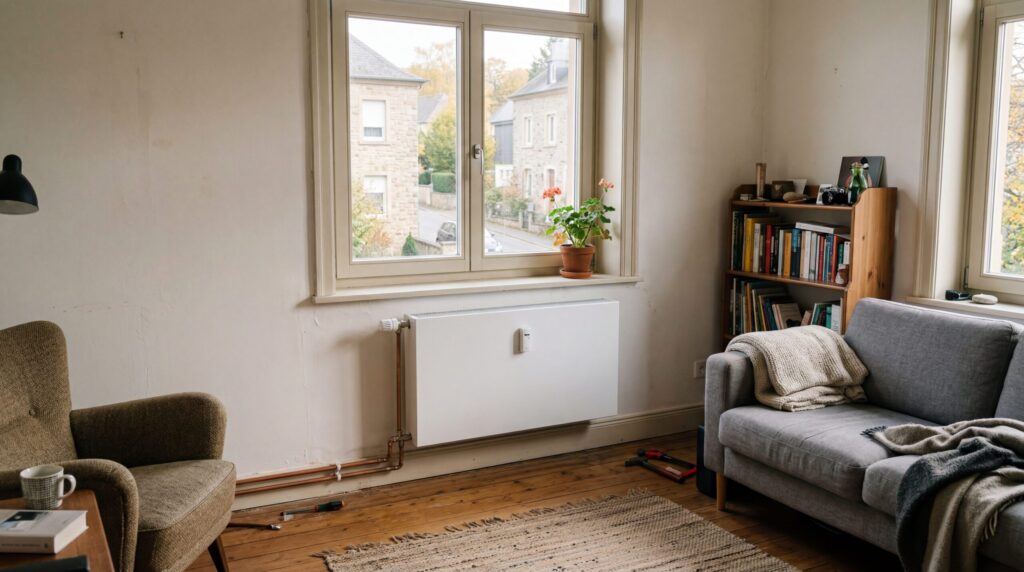
The key point is simple: a heat pump is more efficient when the required flow temperature is low. That is why underfloor heating is optimal. But that does not mean radiators are excluded. What really matters is checking whether the system can remain coherent within a suitable temperature range.
| Starting situation | Correct reading of the project | Level of attention required |
|---|---|---|
| Well-insulated house with underfloor heating | A very natural setup for a heat pump, with low flow temperature and good comfort. | Low if the sizing is handled properly. |
| Existing house with large radiators | Often a relevant project, provided the flow temperature and room-by-room consistency are checked. | Medium. |
| Older house with small radiators and high heat losses | Sometimes possible, but rarely without thinking about the building envelope or certain emitters. | High. |
| House with frequent need for very high temperatures | The project must be studied more carefully, or even approached in stages. | High. |
The right logic is: under what conditions can the house be heated properly with a coherent flow temperature?
Which type of heat pump to choose
In Luxembourg, most residential projects are built around the air-to-water heat pump, which often remains the most natural choice in renovation. Ground-source heating can offer a very strong technical logic, but it requires more constraints in terms of land and permits. In some cases, a hybrid approach can also make sense as a transitional step.
| Type of system | When it makes sense | Main advantages | Point to watch |
|---|---|---|---|
| Air-to-water heat pump | Very often the most natural solution for a detached house, especially in renovation. | Simpler implementation, usually clearer investment cost, often well suited to residential projects. | Noise, outdoor positioning, quality of the study. |
| Ground-source heat pump | Very relevant if the land, budget, and permits allow it. | Excellent operating stability and strong long-term technical logic. | Drilling, land constraints, feasibility, and permits must be validated early. |
| Hybrid system | Can serve as a transition in an existing building that is not yet fully ready for a 100% heat pump switch. | Allows progress without blocking the entire energy renovation project. | Should be designed as a logical step, not as a permanent patch. |
The right system is therefore not the one that looks the most impressive in a brochure. It is the one that integrates best with your home, your land, your usage, and your renovation path.
2026 grants and subsidies for a heat pump in Luxembourg
For a heat pump in Luxembourg in 2026, grants can significantly change the net cost of the project. That is why you should never compare gross prices only. You need to look at the real scenario: type of home, type of heat pump, whether or not an old fossil-fuel boiler is being replaced, and any additional support available.
For an existing single-family home, the difference between a project involving the replacement of an old fossil-fuel boiler and a project without that replacement can be significant. This is something that should be understood very early, even before comparing two quotations.
| Common case in 2026 | Indicative grant | Useful interpretation |
|---|---|---|
| Air-to-water heat pump in an existing home with replacement of a fossil-fuel boiler or direct electric heating | €10,000 | This is the most common case in residential renovation. |
| Air-to-water heat pump in an existing home without this replacement | €6,000 | The starting scenario genuinely changes the amount of support received. |
| Ground-source heat pump in a single-family home with replacement | €12,000 | Very attractive on paper, but land feasibility remains decisive. |
| Ground-source heat pump without replacement of a fossil-fuel boiler or direct electric heating | €8,000 | The amount remains high, but must be considered within the total project cost. |
| Adaptation of the existing heat distribution system | Maximum €2,000 | Very useful when the network or certain emitters require targeted adaptation. |
| Removal, neutralisation, and recycling of the oil tank | €1,500 | Often overlooked in quick comparisons, even though it affects the net cost. |
Some municipalities may also offer additional grants. Once again, the right reflex is to think in terms of net project cost, not just catalogue price.
Want to know whether your home is really ready for a heat pump?
The simplest approach is to start from your actual home, your radiators, your current system, and your concrete objective. We can guide you toward a clear study, including technical assessment, grants, and installation constraints in Luxembourg.
Steps you should not overlook
A heat pump installation is not limited to the equipment. The administrative and technical framework also matters, and this is often where homeowners underestimate the real complexity of the project.
Before moving forward, you need in particular to check the logic of municipal permits, the requirements linked to eligibility, the constraints of the existing system, and the overall quality of the project file preparation.
- check whether a municipal permit is required;
- integrate the logic of hydraulic balancing;
- plan for the technical elements linked to installation compliance;
- avoid discovering too late the inspection and administrative justification points.
In practice, under the 2026 framework, several points are structuring: electricity meter, heat meter, hydraulic balancing, and in the case of an existing residential building, a 30 l/kW thermal buffer tank except in the case of heat pumps with speed or power modulation.
Another often overlooked point: the company commissioning the heat pump must submit an inspection request to the Building Inspection and Acceptance Service of the Chamber of Trades within one month following commissioning.
How to assess whether your home is ready
Even before requesting a final quotation, you can already make an initial healthy assessment of your project. It is not a full audit, but it is an excellent starting point to avoid rushed decisions.
- Is your home already reasonably insulated?
- Does your current heating system operate at a very high temperature, or only in certain rooms?
- Are your radiators properly sized, or do you already feel that some of them are underperforming?
- Do you have a coherent outdoor area for the unit, without creating an acoustic conflict?
- Do you want a complete replacement right away, or a project that fits into a broader renovation plan?
- Should your project be considered on its own, or also together with electricity, solar panels, or other household uses?
The less clear your answers are, the more you should avoid standardised quotations. In that case, the value is not in the speed of the offer, but in the quality of the analysis.
How to choose the right installer?
A good heat pump installer in Luxembourg should not only know how to fit a machine. Above all, they must be able to say whether the project is relevant, under what conditions, and with what possible adjustments.
- Is the sizing coherent with your home?
- Is the logic around radiators, flow temperature, and comfort clearly explained?
- Is the topic of noise and outdoor positioning taken seriously?
- Are the grants, technical requirements, and administrative side clearly explained?
- Is the quotation readable and coherent, or simply appealing on the surface?
At Ecoclima, we support you from start to finish, from analysing your home and designing the project to handling the administrative steps and commissioning the installation. The goal is simple: to offer you a clear, coherent, and properly sized project, with no grey areas.
Going further depending on your project
The right heat pump project starts with a clear study
House, radiators, grants, noise, positioning, administrative steps: everything must be read as a system. That is what helps avoid an appealing but poorly designed quotation, and move forward with a project that is truly coherent for your home in Luxembourg.
The most common questions about heat pumps in luxembourg
Can a heat pump work with radiators in Luxembourg?
Yes. The key point is not the presence of radiators in itself, but the required flow temperature and the real ability of the emitters to heat the home properly under good conditions.
Is an older house automatically a poor candidate?
No. An older house can be a very good candidate if the project is properly assessed. The issue is not the age of the building, but its thermal and hydraulic coherence with a heat pump.
Is underfloor heating absolutely necessary?
No. Underfloor heating is optimal, but it is not an absolute requirement. Radiators can also work, provided the system remains coherent and properly sized.
Are there still grants for a heat pump in 2026?
Yes. Klimabonus 2026 grants do exist, with different amounts depending on the type of heat pump, the type of dwelling, and the replacement situation of the existing system.
What should you check before signing?
The overall coherence of the project: house, radiators, flow temperature, noise, positioning, grants, technical requirements, and the real quality of the support being offered.