
Discharge power vs storage capacity: What matters most for solar batteries in Luxembourg
In the current energy context, more and more households in Luxembourg are choosing to install photovoltaic systems with battery storage. To make the right choice, two essential concepts must be understood: discharge power (kW) and storage capacity (kWh). These two characteristics are often confused, yet each plays a key role in the performance and suitability of your solar installation.
Failing to distinguish between them can lead to poor system sizing. A battery with a high capacity but low discharge power may not be able to supply your most energy-demanding appliances. Conversely, a very powerful battery with low capacity will only last a short time.
What is storage capacity (kWh)?
Storage capacity represents the total amount of energy a battery can store. It is expressed in kilowatt-hours (kWh). The higher this value, the more electricity the battery can store from your panels for later use (night-time, cloudy weather).
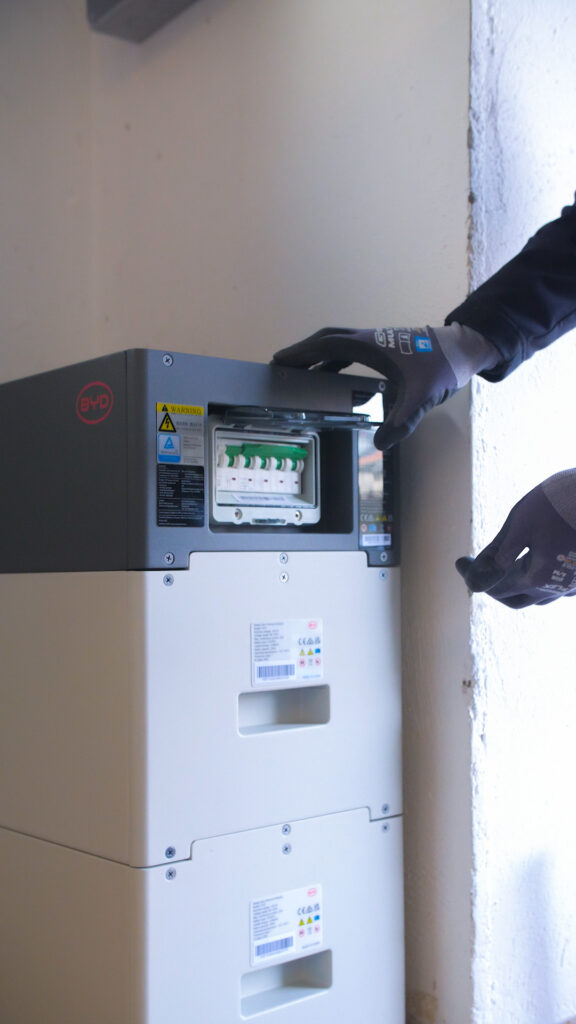
Concrete example
A 10 kWh battery can theoretically provide:
- 10 kW for 1 hour
- 1 kW for 10 hours
This capacity makes it possible to cover household needs during periods without solar production, such as in the evening or during several days of cloudy weather. It increases self-consumption and reduces dependence on the public grid.
Good to know: the “usable” capacity is often lower than the nominal capacity. A 10 kWh lithium battery may offer 8 to 9 kWh usable. This is due to discharge limits designed to protect the system’s lifetime.
Why Is This Important in Luxembourg?
With long winters, frequent cloudy weather, and higher electricity use in the evening, it is essential to have a battery capable of storing enough energy produced during the day. For an average household consuming around 8 kWh per evening, a battery of at least 10 kWh is a relevant choice.
What Is Discharge Power (kW)?
Discharge power refers to the amount of energy a battery can deliver at a given moment. It is expressed in kilowatts (kW). This determines which and how many devices the battery can power simultaneously.
Concrete Example
A battery with 5 kW of continuous discharge power can supply:
- An induction cooktop (2.5 kW)
- A dishwasher (2 kW)
- A computer (0.5 kW)
However, it will not be able to run a more demanding appliance such as a 7 kW EV charger on its own.
There is also the notion of peak power: some batteries can deliver a short burst of higher power for a few seconds or minutes. This is useful for devices with high start-up loads, such as heat pumps or compressors.
In Luxembourg, many households use heat pumps, hot water tanks, and some adopt electric vehicles. These appliances require significant instant power. Without sufficient discharge capability, even a full battery will not be enough to cover these loads.
Difference Between kWh and kW: Overview
| Characteristic | Capacity (kWh) | Power (kW) |
|---|---|---|
| Definition | Amount of stored energy | Energy delivered at a given instant |
| Unit | kWh (kilowatt-hour) | kW (kilowatt) |
| Role | Autonomy (how long) | Performance (which devices, how many) |
| Example | 10 kWh for 10 hours at 1 kW | 5 kW to power several appliances |
Why Are These Two Parameters Essential?
- Capacity gives you autonomy: essential to get through the night or cloudy days.
- Power gives you immediate availability: crucial for energy-intensive appliances.
A good battery sizing balances both. A 10 kWh battery with a discharge power of 3 kW to 5 kW is often an effective compromise for a typical household.
Subsidies and Tax Benefits in Luxembourg
- Reduced VAT at 3% for photovoltaic systems with storage
- Klimabonus: 50% of the battery’s pre-tax price is subsidized
Eligibility Conditions
To qualify for the subsidy, the following limits apply:
- Maximum PV power: 10 kWp installed
- Maximum subsidisable battery capacity: 1.5 kWh per installed kWp
More infos : Guichet.lu, Klima-Agence, MyEnergy.lu
Réponses claires aux questions fréquentes :
kWh (kilowatt-hour) shows how much energy can be stored, while kW (kilowatt) shows how much energy can be delivered at any given moment. One gives autonomy, the other gives power.
Yes, but only if the discharge power is high enough. A 7 kW charger requires a battery that can deliver at least that much continuously.
Description for this block. Use this space for describing your block. Any text will do. Description for this block. You can use this space for describing your block.
Both are important. Capacity without sufficient power limits what you can run. Ideally, choose a battery that offers a good balance between the two.
On average, a 5 to 10 kWh battery with 3 to 5 kW of power is suitable for a standard household. Adjust according to your consumption and appliances. More info on this topic here!
Yes. The Klimabonus program limits the subsidised capacity to 1.5 kWh per kWp of installed solar panels. But there is also an absolute limit: the subsidised battery must have a capacity between a minimum of 4 kWh and a maximum of 12 kWh, regardless of your photovoltaic system size.
Conclusion
For a high-performance solar installation in Luxembourg, it is essential to understand the difference between storage capacity (kWh) and discharge power (kW). Both parameters must be balanced to ensure reliable autonomy and comfortable day-to-day use.
At Ecoclima, we help you define the ideal sizing for your solar system with battery storage, based on your real consumption needs. We select equipment that meets local subsidy requirements and is optimised for Luxembourg’s climate conditions.
Request your personalised photovoltaic quote in Luxembourg.
Have a question? Feel free to contact us..