
Solar Panels and Heat Pumps in Luxembourg: How to Size Them Properly Without Overpaying (and Why Winter Changes Everything)
If you are searching for “solar panels heat pump Luxembourg”, there is a good chance you already have a clear idea in mind: significantly reducing your bills, and perhaps even aiming for a form of energy independence. On paper, it makes sense: a heat pump (HP) replaces gas or oil, and photovoltaics generate clean, local electricity. But in real life, many projects get one key point wrong: the seasonal mismatch.
In Luxembourg, as in most Central European climates, the heat pump mainly consumes electricity in winter, precisely when photovoltaics produce the least. The result: solar can cover a large share of everyday electrical uses, especially with a battery. On the other hand, trying to cover “all winter heating” using only PV and a short-term battery often leads to costly oversizing for limited gains.
In this Ecoclima guide, we explain simply:
- Why a house can achieve very strong autonomy for standard electrical uses, but much less for heating
- What a battery really changes (and what it cannot do)
- A pragmatic sizing method to avoid “paying full price for winter”
- The subsidy options in Luxembourg (Klimabonus, pre-financing, self-consumption vs injection)
- Concrete examples, a comparison table, and a practical FAQ
Key takeaway right away: A battery compensates for a shift of a few hours. Heating, on the other hand, creates a gap of several months between solar production and actual demand. That is why winter autonomy remains limited, even with a battery.
1) The 3 concepts to understand: self-consumption, self-sufficiency rate, surplus
Before talking about sizing, we need to agree on the terms. Discussions often go in all directions because three different indicators are mixed together.
Self-consumption: using what you produce at the right time
Self-consumption is the share of solar electricity that you use directly in your home (or through a battery) rather than injecting it into the grid. The more you self-consume, the more your PV system “works for you” instead of becoming surplus.
In Luxembourg, this is an important topic because the subsidy framework generally distinguishes between the “self-consumption” approach and the “injection” approach, with different logics (higher subsidy vs guaranteed feed-in tariff, depending on the period and scheme). For official and up-to-date information, the easiest reference remains the Klima-Agence simulator and the Guichet.lu pages.
Self-sufficiency rate: how much of your consumption is covered by solar
The self-sufficiency rate (often called self-sufficiency or SSR in the literature) answers a simple question: out of 100 kWh you consume, how many come from your PV system (directly or via battery)?
This is not the same as saying “I produced as much as I consumed over the year.” Producing a lot in summer does not help you get through a winter consumption peak if you cannot shift it seasonally.
Surplus: your PV system produces more than you consume
Surplus is the electricity produced when your house does not need it (or when the battery is full). It is then injected into the grid. Depending on the type of contract, you may be paid through a feed-in tariff, or through a buyback contract with a supplier. In all cases, surplus does not have the same value as the electricity you avoid buying, which explains why oversizing PV “to cover winter” can lead to disappointing economic returns.
Useful official links:
- Klima-Agence: photovoltaic steps, self-consumption and injection (general framework)
- Guichet.lu: pre-financing for photovoltaic installations
- Guichet.lu: renewable electricity production and feed-in tariff contracts
2) Why “PV + heat pump” does not mean autonomy: the problem is winter
A heat pump is very efficient for heating: it produces several kWh of heat for 1 kWh of electricity consumed, depending on the conditions. But it has an immediate effect on your electrical profile: it shifts a large part of your “heating” energy use toward electricity. And that electricity is mainly consumed when it is cold.
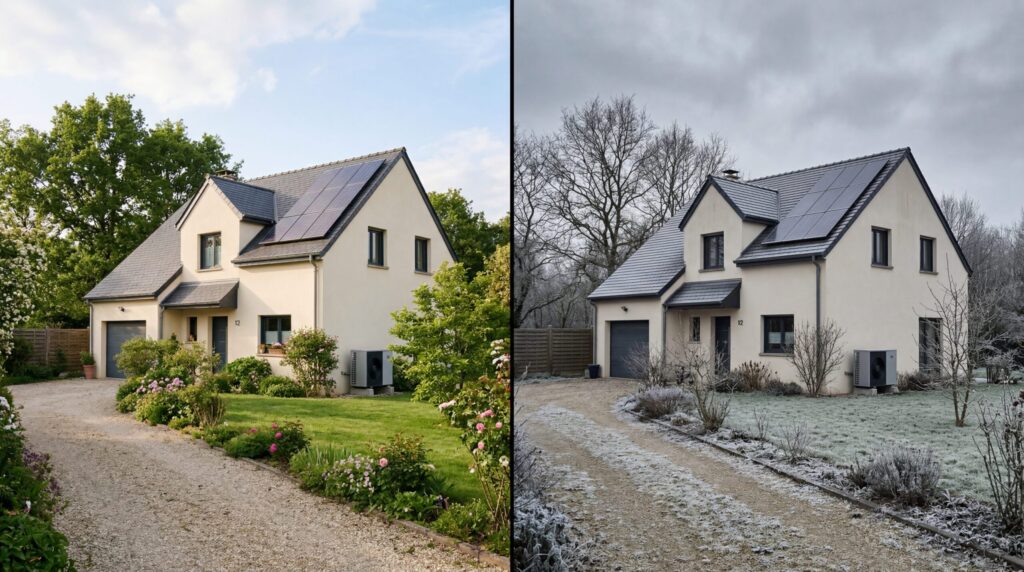
Photovoltaics do the opposite: they produce a lot when the days are long, the sun is higher, and temperatures are often better. Over a year, it is a great technology. But in winter, production drops precisely when your heat pump consumes the most. This seasonal mismatch creates a “physical” limit to autonomy.
A simple mental picture
Think of two curves:
- The PV production curve: high in spring and summer, lower in winter.
- The heat pump consumption curve: low in summer, high in winter.
The more these two curves overlap, the more self-consumption and autonomy increase. But when they overlap very little, which is the typical case for a heat pump in winter, you can increase PV as much as you want: you will mostly produce more… at the wrong time.
Important: a battery helps a lot with the daily shift (midday to evening). It helps very little with the seasonal shift (summer to winter). This guide is specifically here to avoid sizing mistakes linked to that point.
![Figure 2: Heat Pump Dynamics. (a) Winter mismatch depresses maximum SSR to ≈ 25%. (b) Even with batteries, the HP solar fraction is structurally limited to ≈ 35% [3], as batteries cannot bridge the seasonal gap.](https://ecoclima.lu/wp-content/uploads/2026/03/Graph-1024x351.jpg)
3) Realistic ceilings: PV alone, PV + battery, and the special case of the heat pump
In practice, autonomy does not increase linearly with PV size. There are ceilings, with smaller and smaller gains as you oversize the system.
Ceiling 1: PV without battery, autonomy saturates quickly
In a “standard” house without a heat pump, PV without a battery increases autonomy, then eventually hits a ceiling. The reason is simple: part of the production happens when you are not consuming at the same time (during the workday, midday peaks, etc.). Without storage or control, you inject a significant share into the grid.
Order of magnitude: saturation is often observed around 40% to 45% autonomy, even if PV size continues to increase.
Ceiling 2: PV + battery, high autonomy can be reached for “base” uses
With a properly sized home battery, the logic changes: you store part of the midday surplus to consume it in the evening. You therefore increase both self-consumption and autonomy, especially for standard uses (lighting, cooking, appliances, IT, etc.).
Order of magnitude: for a house’s base loads, PV + battery can often reach high autonomy, often in a 70% to 80% range under good conditions (roof, sizing, consumption profile, and control strategy).
Ceiling 3: heat pump, winter imposes a structural limit
With a heat pump, the logic “PV + battery = very high autonomy” does not translate directly. Why? Because a large share of heating consumption is concentrated in winter. Even if you add a battery, you cannot store several months of energy. The result: “heating autonomy” remains significantly lower.
Orders of magnitude from literature and meta-analyses for Central European climates:
- For a heat pump, PV alone often plateaus around 25% autonomy (winter deficit).
- Even with a battery, the “solar” share of heating is often limited to around 30% to 40%, because the battery cannot bridge the seasonal mismatch.
This point is counter-intuitive for many people. The instinct is: “I install more panels, I add more battery, and I become autonomous.” In reality, beyond a certain threshold, you mainly pay to produce more energy in summer, not to cover winter better.
To go further (sources):
- Quoilin et al. (Applied Energy, 2016): PV, batteries and the asymptotic behavior of self-consumption
- HTW Berlin (Tjaden et al.): residential load profiles, including homes with heat pumps
- Fischer and Madani (2017): flexibility and control of heat pumps in power grids
- Luthander et al. (2015): review of PV self-consumption and key levers (storage, control)
4) The right question to ask: what share of the heat pump is really “addressable” by solar?
Most sizing mistakes come from one confusion: PV is sized to cover the total annual consumption (house + heat pump), as if every kWh had the same “value” and the same probability of occurring at the right time. But that is not the case.
In practice, a heat pump’s consumption has two main components:
- The more “addressable” part: domestic hot water (DHW), mid-season, mild days, periods when PV is still producing reasonably well.
- The less “addressable” part: deep winter, long cold spells, high demand on days when PV produces very little.
A pragmatic approach is therefore to avoid treating heat pump consumption “1 for 1” in PV sizing. Instead, a coefficient is applied to the “addressable” part to avoid paying too much for PV capacity that will mostly overproduce outside the useful season.
The simple rule (heuristic): base load + 50% of the heat pump
Here is a simple method, easy to explain, and very useful to frame a project before quotation:
Recommended PV size (kWp) ≈ (Base consumption + 0.5 × Heat pump electrical consumption) / 1000
The 0.5 coefficient varies depending on insulation level, domestic hot water habits, and winter severity. It can go down toward 0.4 in an unfavorable case, or up toward 0.6 in a very well-insulated one.
The goal is not to create an “absolute truth.” The goal is to protect against a classic trap: adding 100% of heat pump consumption into the PV calculation and ending up with a system that is too large, too expensive, and massively injects in summer.
5) Concrete example (Luxembourg): how it works with simple numbers
Let us take a deliberately simple example, just to understand the order of magnitude. (In real life, the system is adjusted depending on the roof, orientation, shading, inverter type, consumption profile, etc.)
Example 1: house without heat pump
- “Base” consumption: 4,500 kWh/year
- Heat pump: no
- Simple sizing: 4,500 / 1000 = 4.5 kWp
In this case, PV + battery can provide high autonomy for base uses, because the battery handles the midday-to-evening shift well.
Example 2: house with heat pump (base consumption + electric heating)
- “Base” consumption: 4,500 kWh/year
- Heat pump electrical consumption: 5,000 kWh/year
- “Naive net-zero” sizing: (4,500 + 5,000) / 1000 = 9.5 kWp
- Pragmatic sizing: (4,500 + 0.5 × 5,000) / 1000 = (4,500 + 2,500) / 1000 = 7.0 kWp
The difference is huge: 9.5 kWp vs 7.0 kWp. In many homes, 7 kWp is the point where PV covers the base load very well plus an “addressable” share of the heat pump, without excessive overproduction in summer.
Then the battery becomes a separate decision:
- If the goal is to maximize self-consumption and reduce evening grid purchases, the battery makes sense.
- If the goal is to cover “heating in the middle of winter,” the battery alone will not be enough. You have to accept a grid share, or rethink the approach (insulation, control, thermal storage, etc.).
6) Comparison table: which combination should you choose depending on your goal?
| Option | Realistic goal | What it really improves | Limits to be aware of | Who it is best suited for |
|---|---|---|---|---|
| PV only | Reduce the bill, first step | Very effective on daytime consumption, simple and profitable | Autonomy quickly plateaus without storage or control | Optimized budget, home with daytime consumption (remote work, equipment) |
| PV + battery | Maximize self-consumption, smooth evening/night use | Strongly increases autonomy for base uses | Does not solve the summer/winter issue, battery = hours, not seasons | Households that want to consume their PV in the evening, reduce grid use, prepare for a future EV |
| PV + heat pump | Decarbonize heating, reduce the overall bill | Very good over the year, especially in mid-season | Heating autonomy remains limited in deep winter | Gas/oil replacement, progressive energy renovation |
| PV + heat pump + battery | Self-consume more, gain more energy comfort | Very good on base load + “addressable” share of the heat pump | Does not make you autonomous for winter heating | Complete projects, focus on bill stability and long-term optimization |
| PV + heat pump + control (DHW, schedules, EV) | Get the maximum without oversizing | Improves self-consumption without necessarily adding more hardware | Depends on the house (DHW tank, habits, compatibility) | Those who want to optimize intelligently while keeping the budget under control |
7) Luxembourg 2026: subsidies, pre-financing, self-consumption vs injection
The subsidy framework evolves, and there is often confusion between “grant,” “feed-in tariff,” “buyback contract,” and “pre-financing.” The most important thing to remember is that there are different logics depending on whether you prioritize:
- Self-consumption: you consume as much as possible at home, and inject the surplus according to a buyback contract.
- Injection: you inject a significant share, or all, into the grid, with a specific contractual framework and, depending on the period, a guaranteed tariff.
For official, up-to-date information tailored to your situation (house, co-ownership, power, date, etc.), here are the useful links:
- Official subsidy simulator (Klima-Agence)
- Guichet.lu: Klimabonus (2022 scheme and detailed information)
- Klima-Agence: understanding pre-financing
- Guichet.lu: PV pre-financing (principle and conditions)
At Ecoclima, we can help you choose the strategy that best matches your goal: reducing the remaining out-of-pocket cost, maximizing self-consumption, or securing an injection framework depending on your project. In all cases, the most useful step is to start from a realistic sizing approach (base load + addressable share of the heat pump) and adjust from there.
Useful Ecoclima page: Solar subsidies in Luxembourg (Ecoclima)
8) How to increase self-consumption without oversizing PV
Good news: even if winter imposes a limit, there are many practical ways to increase the share of PV you actually consume. Very often, that is smarter than adding 3 kWp “just in case.”
Lever 1: schedule “flexible” loads during the day
- Dishwasher, washing machine, dryer
- Pool pump (if relevant)
- Dehumidifier, CMV, ventilation
Nothing revolutionary, but the cumulative impact can be real. The goal is simple: consume more when your PV is producing.
Lever 2: domestic hot water (DHW) and thermal storage
Domestic hot water is often one of the best “addressable” loads. If you can heat your tank in the middle of the day, you improve self-consumption. This is a thermal storage logic: you store heat rather than electricity.
Lever 3: smart heat pump control (within comfort limits)
Depending on the configuration (building inertia, underfloor heating, buffer tank), part of the heat pump operation can sometimes be shifted toward PV production hours. Be careful: the goal is not to reduce comfort or run the heat pump under the wrong conditions. It is a fine adjustment that must be done properly.
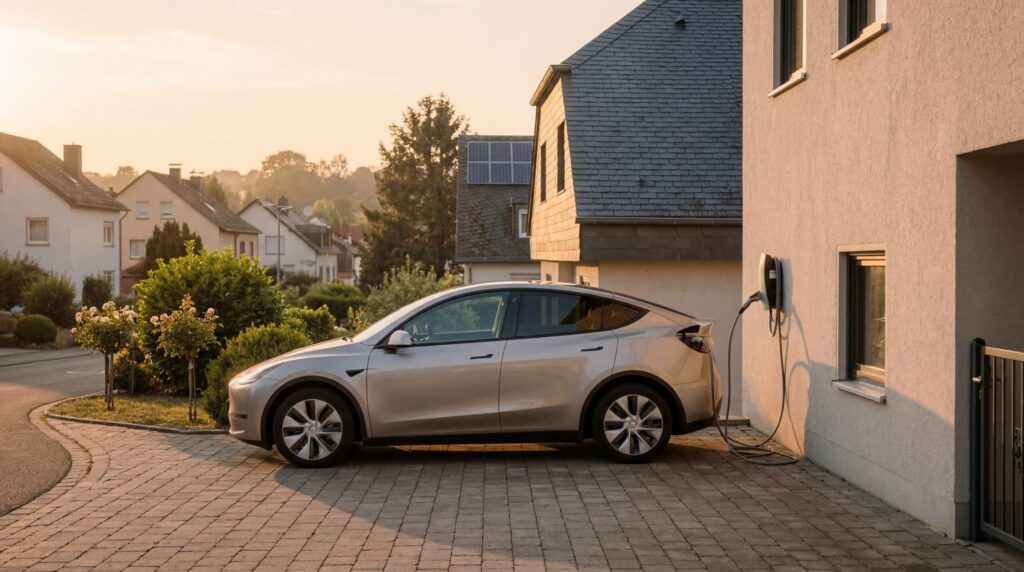
Lever 4: charging station and electric vehicle
If you have, or plan to get, an electric vehicle, daytime charging is a major self-consumption lever. In that case, PV naturally “finds” a significant load at the right time, which improves the value of your production.
9) Common mistakes we see in the field
Mistake 1: aiming for 100% heating autonomy using only PV + battery
In our climate, winter makes this goal very expensive. You end up buying a large PV system that overproduces in summer, and a large battery that is still incapable of storing “months” of energy.
Mistake 2: sizing “by annual kWh” without looking at the seasons
Two houses can have the same annual consumption and a very different result, depending on the heat pump share, hot water habits, and daytime consumption. The profile matters as much as the total.
Mistake 3: underestimating the role of control
Many gains come from load control and overall system coherence (inverter, battery, DHW, charger, monitoring), not just from “adding more panels.”
Clear answers to the most common questions
For a grid-connected house, aiming for 100% autonomy at all times is rarely rational. For base uses, you can aim very high with a good setup. On the other hand, if you add a heat pump (heating), winter imposes a structural limit. You can reduce the bill enormously, but a grid share will remain during cold periods.
Mainly to consume the daytime surplus in the evening and at night. It is very effective for the “midday to evening” shift. It is not a tool for storing summer energy for winter.
Because your house consumes less in summer, while your PV produces a lot. Without a battery, control, or flexible loads (EV, DHW), the surplus goes to the grid. That is why sizing and a self-consumption strategy matter.
A simple method is to start from (base consumption + 50% of heat pump consumption) / 1000 to get an order of magnitude in kWp, then refine it with a site study (roof, shading, orientation, power levels, battery options, control).
Yes, there is an official pre-financing mechanism for photovoltaic subsidies, which means you do not have to advance the full amount of the subsidy and it can be deducted directly from the final invoice, subject to conditions. discover it here
Conclusion: the right sizing is the one that respects the reality of winter
In Luxembourg, combining solar panels and a heat pump is an excellent approach, but it must be sized intelligently. The key is to understand that:
- PV + battery can provide very strong autonomy for base electrical uses.
- The heat pump is a winter load, so part of it will remain structurally dependent on the grid.
- Oversizing to “compensate for winter” can be expensive and mainly produce at the wrong time.
- A simple method is to take the base load + part of the heat pump (addressable load), then optimize with control and options.
Need clear sizing for your home in Luxembourg?
At Ecoclima, we help you choose a coherent strategy (self-consumption, injection, battery, control) and size your system without overpaying. You can contact us, or go through our “Subsidies” page to frame the grants and pre-financing.
Sources and useful links
- Klima-Agence: self-consumption vs injection (general framework)
- Klima-Agence: official subsidy simulator
- Guichet.lu: PV pre-financing
- Guichet.lu: renewable electricity production and injection contracts
- Quoilin et al., Applied Energy (2016)
- HTW Berlin (Tjaden et al.): load profiles, including heat pumps
- Fischer and Madani (2017): review of heat pumps and smart grids
- Luthander et al. (2015): review of PV self-consumption, storage and control