
How to size a photovoltaic system in Luxembourg: self-consumption, export surplus, and the value of kWh.
In Luxembourg, residential solar remains a relevant solution. But out in the field, one question keeps coming back: how many panels do you need to install for it to stay profitable?
Many homeowners still think that “the more kWp you install, the more you earn”. In reality, beyond a certain threshold, each additional panel brings in less. This is what we call diminishing returns.
In this article, we explain the economic logic behind this phenomenon, and how to think about smart system sizing: self-consumption, surplus, the value of kWh, and best practices observed in Luxembourg.
Point 1 : Not all kWh have the same value
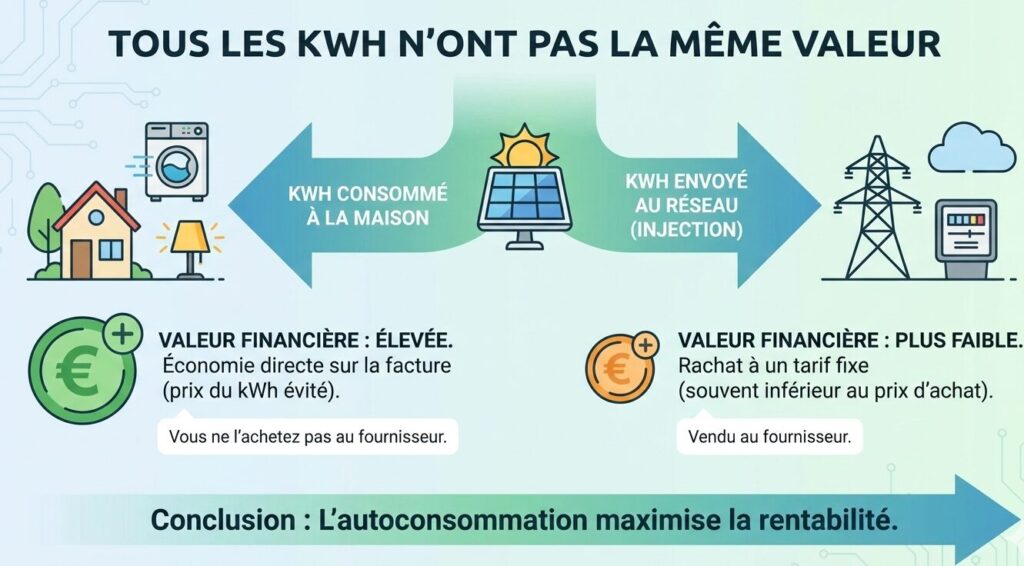
A produced kWh does not automatically have the same financial value. It all depends on what you do with it, at the moment it is produced.
The key difference is this: a kWh consumed by your home and a kWh sent to the grid are not valued in the same way.
Point 2 : Self-consumption, the engine of profitability
A self-consumed kWh replaces a kWh you would have purchased from the grid. So you avoid the full cost (energy, network, and taxes depending on your contract).
In Luxembourg, that means a self-consumed kWh is typically worth around €0.20 to €0.25 per kWh at the moment (all-in, depending on your contract).
Simple conclusion: every self-consumed kWh has a high value. This is one of the main drivers of the profitability of a solar installation in Luxembourg.
Point 3 : Surplus, useful but less well valued
This surplus is bought back at a rate that is generally lower than the price at which you buy electricity.
In practice, exported kWh can be worth anywhere from about €0.00 to €0.10 per kWh, depending on the period (month/day), because it follows variable pricing linked to wholesale market prices. surplus is not “useless”, but it is worth less.
Point 4 : Why “more kWp” works at first… then less
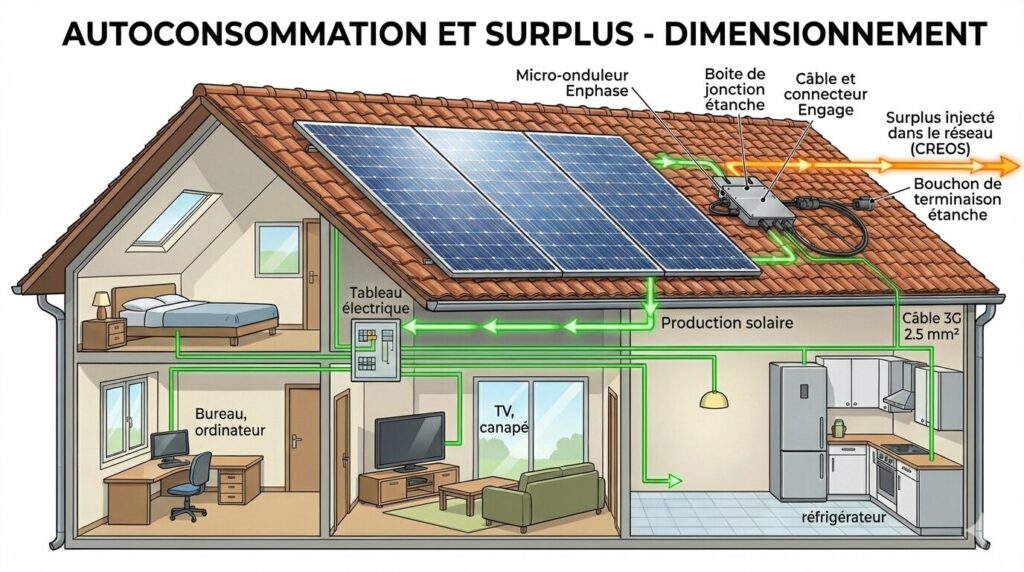
At first, increasing installed capacity often makes sense, because the home has a constant baseline consumption (fridge, standby loads, IT, ventilation, cooking, etc.). Part of the production naturally falls “at the right time”.
So when you add panels, a significant share of the additional production is still self-consumed.
At this stage: the investment is mathematically favorable, because you are mostly adding high-value kWh.
Point 5 : Recognizing the tipping point
From a certain system size, a phenomenon appears: your production regularly exceeds your instantaneous consumption, and the self-consumption rate plateaus.
In other words: even if you add panels, you cannot “magically” consume more electricity at midday.
This is the threshold where marginal value starts to fall: the production added by extra panels is increasingly exported as surplus, so it is valued less.
This is exactly the logic of diminishing returns: each additional kWp brings in less than the previous one, because a growing share of the energy is exported. When your marginal kWh shifts from being worth ~€0.20–€0.25 (self-consumed) to ~€0.00–€0.10 (exported), the math changes fast.
Comparative table: self-consumption vs surplus, the impact on profitability
This table simplifies the field logic. Real cases depend on your home, your roof, and your usage patterns, but the idea remains the same.
| System size | Self-consumed share | Exported share | Average value of produced kWh |
|---|---|---|---|
| Small system | High | Low | Very good |
| Well-sized system | Moderate | Moderate | Good |
| Oversized system | Low | High | Lower |
Point 6 : The 3 factors that determine your threshold in Luxembourg
In most homes in Luxembourg, the point where diminishing returns start to be felt depends mainly on three elements: your consumption, your roof, and your objective.
| Factor | What it changes | Concrete examples |
|---|---|---|
| Consumption profile | The more you consume during the day, the more you self-consume, and the higher the “useful” threshold goes. | Working from home, heat pump, EV, hot water tank, cooking at midday. |
| Roof and real constraints | A large surface does not mean “high profitability” if orientation, shading, or layout makes useful production more complex. | Multiple roof faces, shaded areas, different orientations, inverter and MPPT limits. |
| Project objective | Pure profitability, autonomy, EV/heat pump readiness: the “right” sizing is not the same. | Maximizing ROI, reducing the bill, increasing autonomy, anticipating future electrification. |
Point 7 : A simple method and concrete scenarios
The right reflex is to estimate two things: when you consume and from what point your production regularly exceeds your instantaneous needs.
Rather than thinking only in “kWp”, think in kWh value: will the additional kWh still be consumed at home, or will they mostly be exported as surplus?
A simple approach is to look at your annual consumption, then ask the “daytime” question: what share of my consumption actually happens during production hours? Then, what loads can I shift or control (within reason) to increase self-consumption?
Field rule: when each added kWp is mostly exported as surplus, marginal profitability drops. This is not an opinion, it is a direct consequence of the difference in value between self-consumption and export.
Three typical residential scenarios we see in the field
Scenario 1: standard home, no battery
Often the best balance: moderate capacity, decent self-consumption, a coherent payback, especially if some loads can run during the day.
Scenario 2: electrified home (heat pump, EV, electric water heater)
The threshold shifts: more kWh can be self-consumed, and a higher capacity can remain relevant, as long as you look closely at consumption hours (heating and evening charging, for example, do not always match production).
Scenario 3: large system with no load control
High surplus: a lot of export, lower marginal benefit. You produce a lot, but a growing share of the energy is valued at the surplus rate, so marginal economic performance decreases.
What we recommend at Ecoclima
At Ecoclima, we’re not trying to “sell a dream”. We focus on understanding first, then sizing properly.
In practice, our approach can be summed up in one sentence: don’t default to sizing for the maximum. We think in kWh value, and we aim for a system that fits your profile and your goals.
A battery and load control can be very strong levers, but only if they truly increase self-consumption and improve the overall balance of the project. A battery does not “remove” the logic of diminishing returns, it shifts it, and it also has a cost.
A good solar project is the one that maximizes the value of kWh, not just the annual production on paper.
Conclusion: why the right sizing changes everything
Diminishing returns follow a simple logic: the more you exceed your ability to self-consume, the more the value of your production decreases. This is not a “detail”, it is a central economic reality in residential solar in Luxembourg.
The right sizing is a balance between production, consumption, surplus value, and objectives.
If you’re unsure about the ideal size, we can analyze your roof and your consumption profile to give you a realistic estimate, tailored to Luxembourg, with a clear logic: aim for the best kWh value, not just the biggest production number.
FAQ: Solar diminishing returns in Luxembourg
No. Beyond a certain point, you mostly produce surplus that is valued less. You increase production, but the average value of your kWh decreases.
No. It is part of the normal operation of a system. It is simply worth less than a self-consumed kWh, so it must remain proportionate if the goal is profitability.
It shifts them, but does not remove them. A battery increases self-consumption, but it has a cost and a limited capacity. The right logic is always: value created vs total cost.
No. It depends on your consumption, your roof, and your objective (profitability, autonomy, EV/heat pump readiness).