
Solar panel prices in Luxembourg in 2026: budget examples before and after subsidies
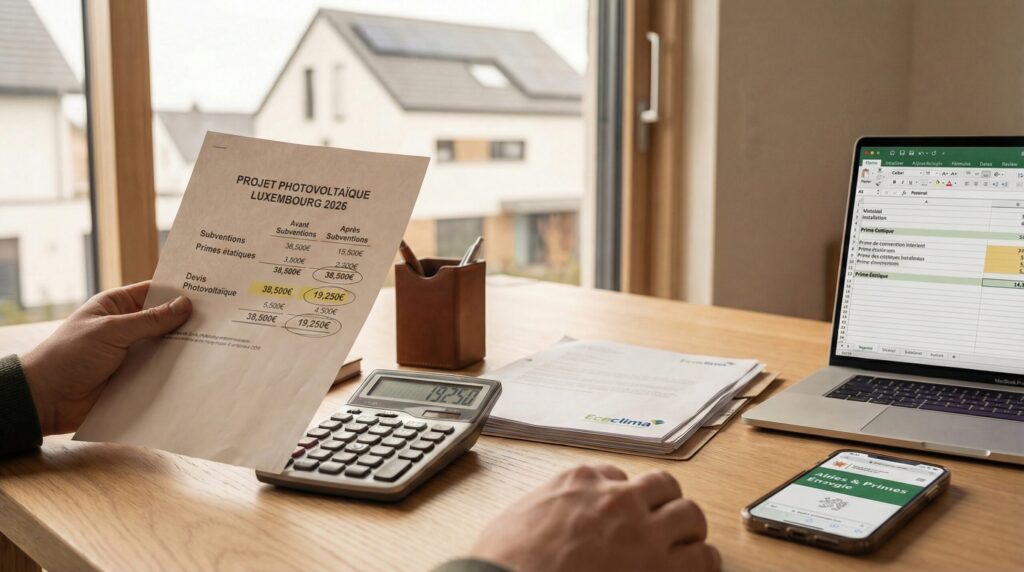
If you’re searching for “solar panel price Luxembourg 2026”, it’s rarely out of curiosity. Most of the time, you want a simple answer: how much does it cost, and how much is left to pay after subsidies.
The problem is that the prices you see online are all over the place. That’s normal: a photovoltaic installation isn’t an off-the-shelf product. Between a simple roof with a clean electrical panel, and a home where the electrical system needs upgrading, access is tricky, or a battery is added, the budget gap is real.
In this Ecoclima guide (2026 edition), we give you realistic ranges, examples of budgets “before subsidies / after subsidies”, and above all a clear reading of what makes the price vary. The goal: help you request a relevant quote and compare offers without getting lost.
Key takeaway: at the same power level, two quotes can be very different, and yet both “fair”. The difference often comes down to the electrical work, site access, inverter type, and options (battery, energy management, EV chargers).
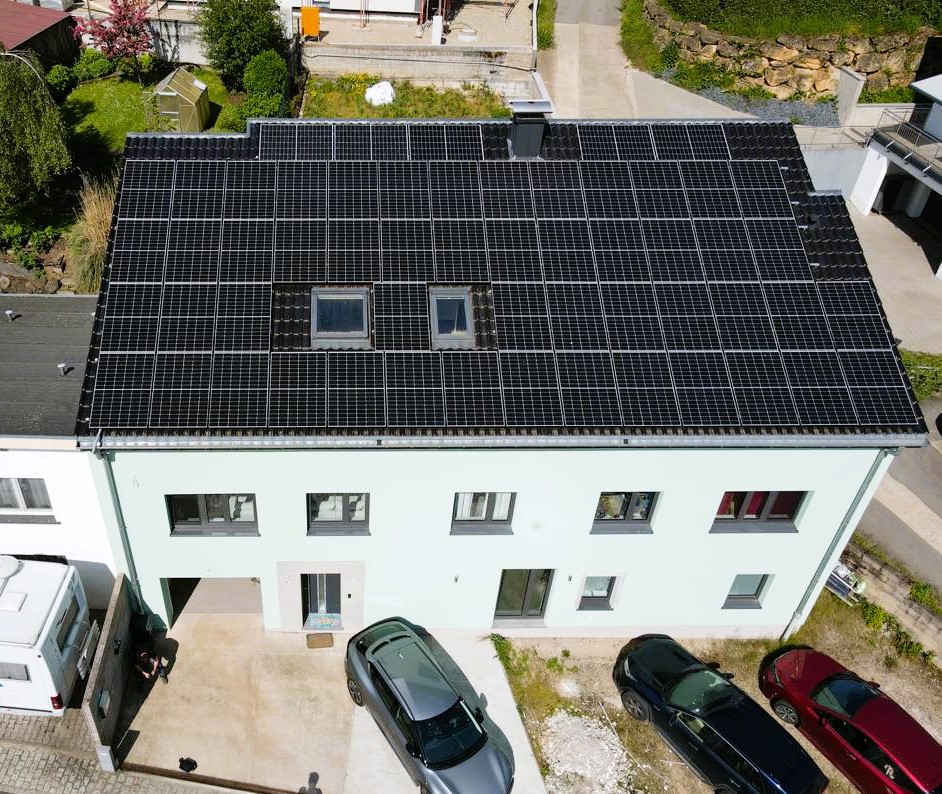
In short: 2026 prices in 30 seconds
- 4-6 kWc: often the “natural format” for a household, typical budget before subsidies in a mid-range bracket, then after subsidies a significantly reduced amount left to pay.
- 7-9 kWc: a common format if you have more electric uses (heat pump, electric vehicle, large family).
- 10-15 kWc: more for larger homes, high consumption, or small commercial buildings. The price per kWc often drops, but technical constraints can increase.
- In 2026, Klimabonus subsidies exist under two logics: self-consumption (higher subsidy) or feed-in (lower subsidy + guaranteed feed-in tariff).
- The super-reduced 3% VAT rate applies directly to the supply and installation of solar panels on private homes (invoiced by the supplier, with no prior application).
Solar panel price table Luxembourg 2026: ranges by system size (before and after subsidies)
The table below provides ballpark figures for “classic” residential installations in Luxembourg, installation included. These are indicative ranges, useful for getting your bearings before requesting a quote. A site, a roof, and an electrical panel can shift the price one way or the other.
| Standard size | Typical profile | Indicative budget before subsidies (incl. VAT) | Most common subsidy logic | Indicative budget after subsidies |
|---|---|---|---|---|
| 4-6 kWc + 5kwh battery | House, “normal” consumption, goal: maximize self-consumption | Often around €11,000 to €15,000 | Self-consumption (investment subsidy) | Often around €5,000 to €7,000 |
| 7-9 kWc + 7kwh battery | Electrified home (EV, heat pump, heavy daytime use) | Often around €15,000 to €19,000 | Self-consumption or energy community | Often around €6,000 to €10,000 |
| 10-15 kWc + 10 kwh battery | Large home, heavy user, or small commercial building | Often around €19,000 to €25,000 | Depending on your strategy: self-consumption or feed-in | Often around €8,000 to €13,000 |
Why “often close to half” after subsidies in self-consumption? Because the investment subsidy in self-consumption is expressed as a percentage of eligible costs, with a cap per kWc. As long as your price per kWc stays in a “standard” zone, the cap doesn’t necessarily kick in, and the subsidy follows the 50% logic.
2026 subsidies in Luxembourg: understanding “before subsidies / after subsidies” without getting it wrong
In Luxembourg, 2026 photovoltaic subsidies fall under the “Klimabonus Wunnen 2026” scheme. But there is a transitional period: depending on the date you sign your offer, you may fall under the new 2026 scheme, or still under the previous scheme (RGD 2022). That’s why we present both: a prospect who signs in 2026 will generally be in the “new” scheme, whereas a project signed earlier and invoiced in 2026 may remain in the “old” one.
Please note: according to Guichet.lu, you can submit a “Klimabonus Wunnen 2026” application from January 1, 2026 (planned entry into force, with retroactive effect if the law has not been published before that date). Processing remains subject to the publication of the law in the Mémorial.
Which scheme applies to you?
- Offer signed up to 30/09/2024: specific rules may apply if the final invoice is issued no later than 31/12/2026. Reference: Klima-Agence.
- Offer signed from 01/10/2024 to 04/03/2026: transitional phase, with two possible routes depending on the case (old scheme or new). Reference: Klima-Agence.
- From 05/01/2026: entry into force of the new scheme, with its own conditions and deadlines. Reference: Klima-Agence.
Important point for the “after subsidies” price in 2026: a pre-financing mechanism exists. It allows households and co-ownerships to benefit immediately from the “Klimabonus Wunnen” subsidy, deducted directly from the final invoice by the installer, without waiting for the State to pay out the subsidy, subject to conditions. Reference: Government and environnement.public.lu.
As conditions can evolve, the best practice is to validate the applicable scheme at the time of the quote, based on your signing date and timelines, via official sources. Ecoclima supports you end-to-end on this entire part.
Important point: depending on your operating choice, the mechanism changes. In simplified terms, you have two approaches.
Option 1: self-consumption (or energy community)
You consume part of your production directly in the home, and you sell the surplus. Under the old scheme (the “historical” rules), the investment subsidy could reach 50% of eligible costs, capped at €1,250 per kWc, for a system operated in self-consumption or within an energy community. Since the new scheme came into force from January 5, 2026, the amount is no longer based on this “50%” and is calculated according to a new formula.
This option is often preferred when your goal is to reduce your bill through self-consumption, and to optimize your daytime uses (water heater, heat pump, EV charging, appliances, etc.).
To be checked for your case: storage (battery) can be among the eligible elements when applying for a new photovoltaic installation, but under technical conditions (notably sizing the capacity relative to kWc, and kWh caps).
Option 2: feed-in (resale with guaranteed tariff)
You feed electricity into the grid and benefit from a guaranteed feed-in tariff via a contract. In this case, the investment subsidy is typically lower: 20% of eligible costs, capped at €500 per kWc (in the case of feed-in to the grid).
This option can still make sense for certain profiles, but it is managed differently. In practice, many residential 2026 projects favor self-consumption because the value of a self-consumed kWh is often “higher” than that of a kWh sold.
The detail that changes everything: dates and conditions
Subsidy schemes are tied to legal texts and dates. For example, some installations ordered between 01/01/2023 and 30/09/2024 could benefit from a temporary increase (if the invoice is issued no later than 31/12/2026). In 2026, this mostly concerns “end-of-cycle” files, not newly signed projects.
To avoid mistakes, it’s best to check your situation via official sources and, if needed, get support to interpret the conditions.
Useful links (official sources): Guichet.lu – Klimabonus RGD 2022 (technical installations), and Klima-Agence – photovoltaic steps.
3% VAT on solar panels in Luxembourg: direct impact on the price
A detail that matters in a budget: the super-reduced 3% VAT. For solar panels on private homes, the supply and installation are invoiced directly at 3% by the supplier, with no prior application under the VAT Housing tax benefit.
Official source: Guichet.lu – super-reduced VAT and solar panels.
2026 budget examples: 4 concrete scenarios (before and after subsidies)
The examples below help you understand “where the money goes” in a quote. They don’t replace an on-site estimate, but they help you spot what is normal and what deserves a question.
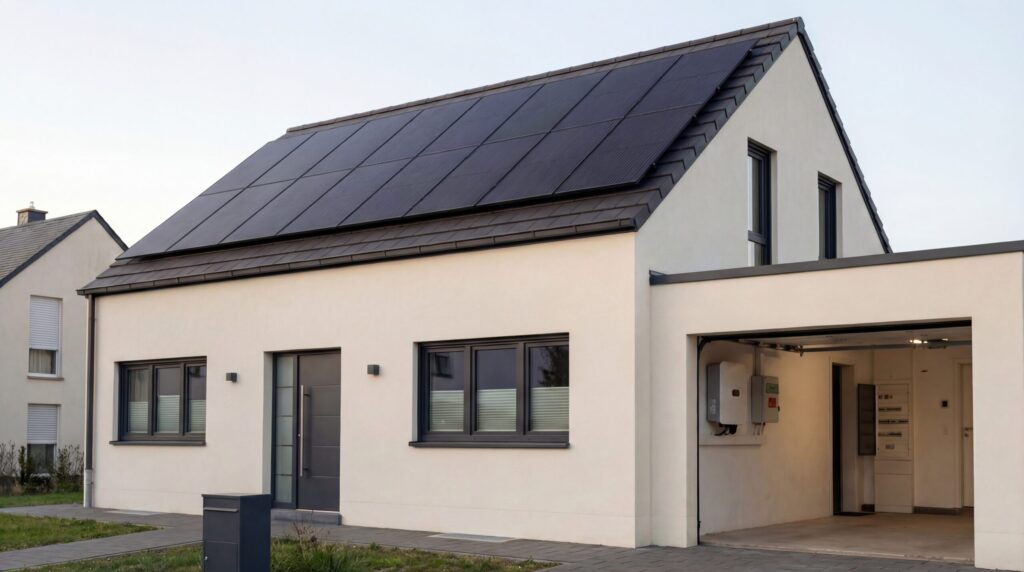
Scenario A: 5 kWc (4-6 kWc), simple roof
Profile: house with standard consumption, self-consumption goal, standard pitched roof, easy site access, decent electrical panel.
- Capacity: ~5 kWc
- Equipment: panels + string inverter, monitoring, electrical protections, mounting structure
- Work: installation, connections, commissioning
Indicative budget before subsidies: for example €11,000 to €15,000 incl. VAT.
After subsidies (self-consumption): in a “standard” case, the amount left to pay can come close to around €5,000 to €7,000, depending on eligibility, file documents, and what is considered eligible costs.
Scenario B: 8 kWc (7-9 kWc), battery-ready (hybrid inverter), optimizations
Profile: a more energy-hungry home, sometimes with an electric vehicle, or a heat pump. You want to maximize self-consumption and keep the system “future proof”.
- Capacity: ~8 kWc
- Equipment: panels + hybrid inverter, protections, advanced monitoring
- Option: partial optimization if there are shaded areas (to be discussed)
Indicative budget before subsidies: for example €15,000 to €19,000 incl. VAT.
After subsidies (self-consumption): often an amount left to pay that can fall around €6,000 to €10,000, with strong sensitivity to electrical work (panel, cable lengths, protections) and site access.
Scenario C: 12 kWc (10-15 kWc), with a 10-12 kWh battery
Profile: large home, high consumption, frequent EV charging, or a desire to significantly increase evening self-consumption. You move into a “production + storage + control” logic.
- Capacity: ~12 kWc
- Equipment: panels + hybrid inverter, battery (10 to 12 kWh), monitoring, protections, potential control (EV charging, water heater)
- Technical point: storage must remain coherent with kWc, otherwise it is oversized and not very cost-effective.
Indicative budget before subsidies: for example €19,000 to €25,000 incl. VAT (the battery is the element that drives the range the most).
After subsidies: depending on eligibility and what is counted as eligible costs, the net cost can drop significantly. The best approach is to ask the quote to clearly distinguish: photovoltaic base, storage option, and control options.
Scenario D: 15 kWc (10-15 kWc), no battery, but a more complex site
Profile: large roof, sometimes outbuildings, long distance between roof and technical room, or access constraints (scaffolding, lift, areas to secure). Here, the price is often driven by logistics, not by the panels.
- Capacity: ~15 kWc
- Equipment: panels + inverter, protections, monitoring
- Work: more labor, more safety, sometimes electrical reinforcement
Indicative budget before subsidies: for example €18,000 to €29,000 incl. VAT, depending on the roof and access.
After subsidies: potentially around €9,000 to €18,000 in self-consumption, but this scenario clearly illustrates why a “larger kWc” isn’t automatically “cheaper”.
Want a quote that protects you? Also read: Installing solar panels in Luxembourg: what a quote must include.
What makes the price of a photovoltaic installation vary (and why it’s normal)
When comparing two quotes, the temptation is to look only at the total. In reality, a good quote is understood in blocks: roof, electrical, inverter, options, and logistics. Here are the variables that explain 80% of the differences.
1) Roof type and installation method
Tile, slate, metal deck, flat roof, façade: each surface has its own mounting system, waterproofing constraints, and installation time. A typical “standard” setup is a rooftop overlay on a pitched roof. A flat roof requires specific structures (ballast, orientation), and an in-roof integration requires more work and more technical risk if done poorly.
2) Site access and safety
Access is an underestimated factor. A house that’s easy to reach with a clear place to drop pallets and set up scaffolding is not the same as a site in a dense area, on a slope, with long distances, or traffic constraints. Sometimes, it’s safety (scaffolding, lifeline, lift) that changes the budget far more than the equipment.
3) Electrical panel, protections, and compliance
Solar isn’t just about panels. A big part of an installer’s seriousness shows in the electrical work: AC/DC protections, surge protection, cable sizing, grounding, available space in the panel, and overall compliance. If the panel is old, overloaded, or non-compliant, it may need upgrading. That’s a cost, but it’s also what protects your home.
4) Inverter: standard, hybrid, microinverters
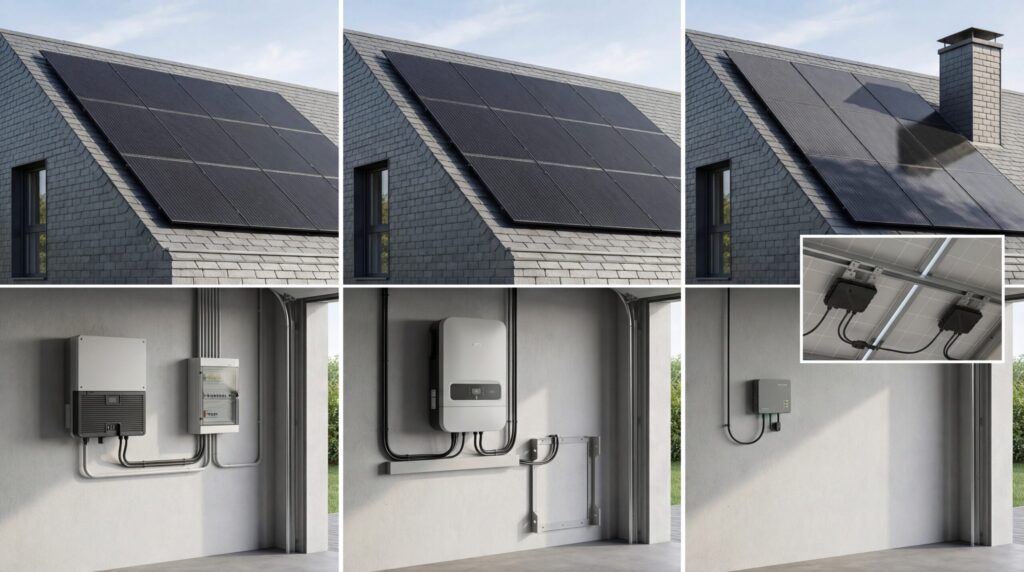
The inverter impacts both price and strategy. A “standard” inverter is often the simplest and most cost-effective option on a roof without shading. A hybrid inverter makes sense if you’re considering a battery now or later. Microinverters or optimizers can be justified on complex roofs (shading, multiple orientations), but they are not “mandatory” by default. The right choice depends on your roof, not on a trend.
5) Battery: how much it adds to the budget, and when it makes sense
A battery can significantly increase the budget, but it can also improve self-consumption and the overall economics, especially if you consume in the evening (cooking, evening EV charging, heat pump, etc.). In 2026, we often see batteries around 10 kWh, but the right sizing depends on your nighttime consumption and discharge power, not just the number of kWh.
As a ballpark figure, an installed 10 kWh home battery can fall within a wide range, typically several thousand euros, depending on the brand, inverter compatibility, and installation complexity. The key point: don’t buy storage “just because”. It needs a use-case logic.
To go further: Solar battery in Luxembourg: kWh vs kW, subsidies, and pitfalls to avoid.
6) Options that increase project value (without necessarily increasing the price much)
Some add-ons don’t cost “a lot”, but they change the long-term value: clear monitoring, a clean electrical diagram, battery readiness, smart water-heater control, or EV charging station compatibility. The idea isn’t to stack options. The idea is to make the system coherent with your real usage.
7) Municipal permits and grid procedures
Depending on your municipality, a building permit may be required. Official sources recommend checking with the municipal administration. In practice, responsibility and procedure can vary, so you should clarify this point from the start, before signing.
Official source about the need to check with the municipality: Guichet.lu – Klimabonus (mentions building permit).
Checklist: how to compare 2 “solar panel price” quotes without getting trapped
Two quotes at the same price can hide major differences. And two very different quotes can both be coherent. Here’s a simple checklist to compare properly.
| Point to check | What you want to see on the quote | Why it matters |
|---|---|---|
| System size and layout plan | Total kWc, number of panels, placement | To compare like-for-like |
| Inverter | Model, type (standard/hybrid), warranties | Reliability, scalability, monitoring |
| Electrical | AC/DC protections, surge protection, cables, grounding | Safety, compliance, longevity |
| Site access | Scaffolding/lift included or not | Avoids “surprises” after signing |
| Grid connection | Grid procedures, meter, commissioning | Turnkey delivery |
| Subsidies | Clearly written assumptions (scheme, conditions) | Avoids vague promises |
| Timelines | Estimated installation and commissioning timelines | Realistic planning |
Steps of a photovoltaic project in Luxembourg (quote to commissioning)
To frame things, here’s a typical workflow. Details vary depending on the roof, grid, and municipality, but the logic stays stable.
- Pre-analysis: consumption, goals (self-consumption, feed-in, battery, EV).
- Roof check: usable surfaces, shading, condition, structure, access.
- Electrical check: panel, protections, cable routing, connection points.
- Detailed quote: base, options, assumptions, timelines, procedures.
- Administrative procedures: depending on the municipality, and grid procedures depending on the configuration. ( At Ecoclima, we support you from start to finish in preparing the subsidy application file )
- Installation: mounting, wiring, protections, tests.
- Commissioning: configuration, monitoring, final check.
- Subsidy file: compiling documents and submitting according to the rules in force.
If you want a transactional starting point: Solar panel installation in Luxembourg (Ecoclima)
Conclusion: a good “2026 price” is mainly a clear quote
In 2026, talking about solar panel prices in Luxembourg without talking about context isn’t very useful. The right approach is simple: define your size (4-6, 7-9, 10-15 kWc), choose a strategy (self-consumption or feed-in), then request a detailed quote that clearly states the items that make the budget vary.
If you have an ongoing project, you can send us the basic information (roof, annual consumption, goals). We’ll come back with a coherent estimate and clear options, without stacking unnecessary choices.
Update note: subsidies and conditions may evolve. Before deciding, always check the rules in force on official sources.
FAQ: Solar panel price Luxembourg 2026
In residential projects, the price mainly varies depending on the system size (4-6, 7-9, 10-15 kWc), the condition of the electrical panel, site access, and options (hybrid inverter, battery). An online range doesn’t replace a quote, but it helps you see whether a price is consistent with your setup.
At 6 kWc, the budget mainly depends on electrical and site constraints (panel, protections, cable lengths, roof access). On a simple roof, it’s often within a “standard” range. Then, the after-subsidy price depends on the applicable scheme and your operating mode.
In self-consumption, the subsidy is calculated as a percentage of eligible costs with a cap per kWc. On many residential projects, the effect can be very significant, sometimes close to half. But it’s never automatic: it depends on the applicable scheme, conditions, and the eligible elements retained in the file.
There is no universal answer. Self-consumption reduces your bill by replacing kWh bought from the grid, so it is often preferred. Feed-in has a different logic, with a guaranteed feed-in tariff and an investment subsidy that is generally lower. The right choice mainly depends on your consumption profile and your ability to consume during the day.
A battery can be relevant if you consume a lot in the evening and want to increase self-consumption. But it must be sized to your usage, otherwise it’s expensive for limited gains. In some cases, it’s better to first optimize daytime usage, then decide based on real data.
Yes, for the supply and installation of solar panels on private homes, the super-reduced 3% VAT rate can apply under the official conditions. In practice, it is billed directly by the supplier when the project fits within the defined framework.
It depends on your municipality and your configuration (roof type, visibility, local rules). The best practice is to check with the municipal administration and clarify this point from the start, before launching the project.
Request a detailed quote (equipment, installation, electrical, protections, procedures), a layout plan, warranties (panels and inverter), and a written clarification of the subsidy assumptions (scheme, operating mode, eligible elements). This is what prevents surprises and allows you to compare two offers properly.