
Photovoltaic Cell Technologies Compared: What Actually Changes in 2026
In this article, we compare the main photovoltaic cell technologies used on rooftops in Luxembourg. When people talk about solar panels, you still often hear “mono or poly”. In practice, for a house or a condominium in Luxembourg, that debate is no longer the right one. Polycrystalline dominated a few years ago, then it gradually disappeared from today’s product ranges. Now, the vast majority of panels installed on residential and commercial rooftops are made from monocrystalline silicon.
The real question is elsewhere: which monocrystalline cell architecture should you choose based on your priorities (efficiency, heat behavior, durability, aesthetics, availability, budget)? This guide sorts it out, without unnecessary jargon, with a practical, field oriented read tailored to the Luxembourg context.
We will also see why some technologies are still mostly reserved for specific use cases (thin film, multi junction for space) and why silicon perovskite tandems get a lot of attention, but are not yet a standard choice for a roof in Luxembourg.
Table of contents
- In short: the simple answer
- Cell, module, marketing: don’t mix everything up
- Why polycrystalline has almost disappeared
- Today’s landscape: almost everything is Mono Si
- PERC, TOPCon, HJT, ABC: a simple explanation
- Comparison table: what to remember
- And in Luxembourg, what does this change in practice
- 6 concrete scenarios (house and condominium)
- Thin film and multi junction: why it’s not the standard
- The future: silicon perovskite tandem
- What Ecoclima recommends
- Checklist: 10 questions before choosing
- Useful sources
- FAQ
- Conclusion
In short: the simple answer before we go into detail
- Almost everything is monocrystalline (Mono Si) on the rooftop market: it’s the standard in 2026.
- Polycrystalline is mostly a historical topic, rarely relevant for a new project today.
- The main modern families of Mono Si cells are: PERC, TOPCon (often N type), HJT (HTJ), ABC (rear contact).
- TOPCon has become the most common option for a good balance of performance, price, and availability.
- HJT often stands out for excellent heat performance and a very stable premium approach.
- ABC is highly sought after for aesthetics (more uniform front side) and very strong performance depending on the product line.
- Thin film and multi junction exist, but are mostly for specific applications.
- Silicon perovskite tandem: promising, but not yet a “ready and simple” rooftop standard.
For a house or a condominium, the choice is no longer “mono vs poly”. The choice is the monocrystalline cell architecture, based on your priorities: budget, performance, aesthetics, or availability.
First: cell, module, marketing. Don’t mix everything up
A common confusion is mixing up cell technology (PERC, TOPCon, HJT, ABC) and module design (half cut, shingled, glass glass, bifacial, full black, black frame, etc.).
Simply put:
- Cell technology: how the cell converts light into electricity and how it reduces internal losses.
- Module design: how cells are assembled and how shading, robustness, aesthetics, heat dissipation, and sometimes bifacial gain are managed.
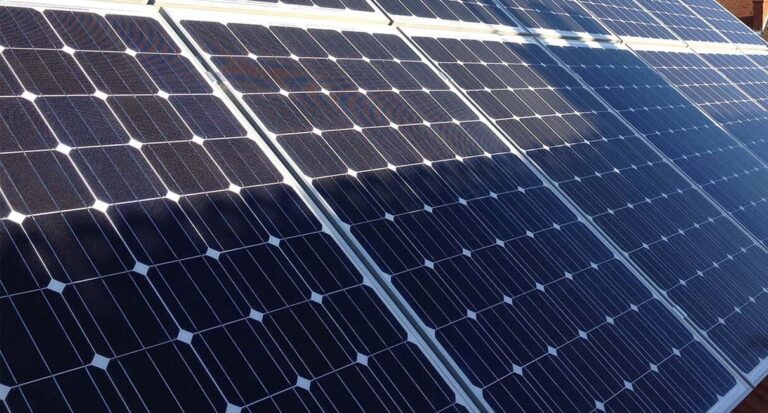
A module can be full black and half cut, in TOPCon or in HJT. These choices stack. So the right final choice depends on the whole package: cell, module, roof context, aesthetic expectations, budget, and installation quality.
Why polycrystalline has almost disappeared (and why it’s not a problem)
Polycrystalline used to be a “good deal” on price. It was simpler to produce and flooded the market. Its main drawback: for the same surface area, it generally delivered lower efficiency than monocrystalline, with a fairly recognizable bluish look.
What changed is not a trend, it’s industrial reality. Monocrystalline became dominant, better optimized, better industrialized, and often competitive on price. As a result, poly product lines became rare, then disappeared from most rooftop catalogs.
So if someone offers you poly for a new project, the question is straightforward: why this choice, and with what warranties, what availability, and what long term support?
Today’s landscape: “almost everything is Mono Si”, except a few specific cases
In the standard market (residential roofs, apartment buildings, SMEs), the vast majority of modules are monocrystalline silicon. Differences happen within this family, with several architectures designed to reduce losses and increase real world yield.
There are exceptions, rarely relevant for a typical roof:
- Thin film (CdTe, CIGS): present in some segments and large projects, but less common on standard rooftops.
- Multi junction: very high efficiencies, mainly in space applications or ultra specialized uses, with costs unrelated to residential projects.
For an installation in Luxembourg, the most useful question remains: which Mono Si sub technology to choose between PERC, TOPCon, HJT, and ABC.
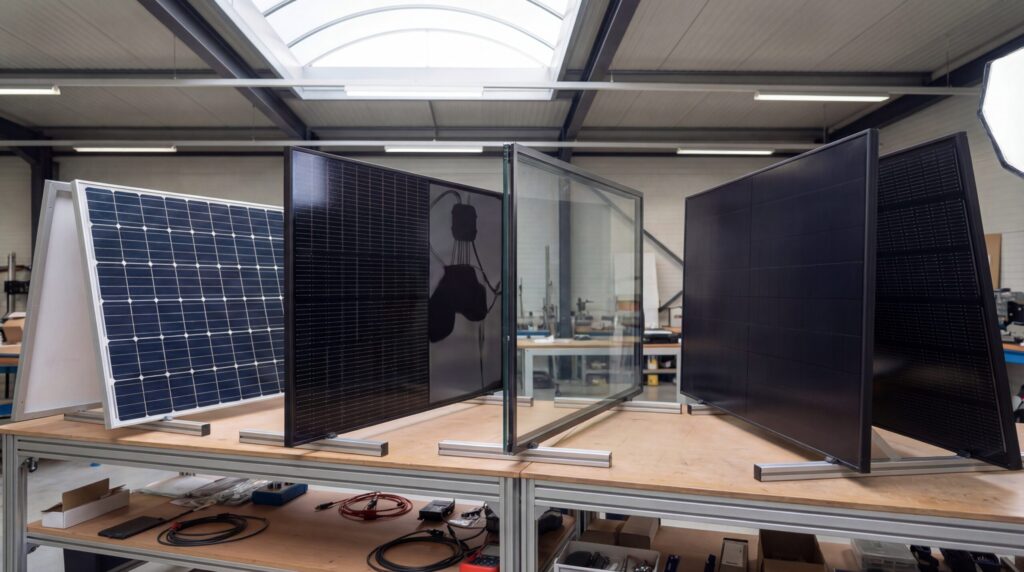
The four main Mono Si cell architectures, explained simply
You can think of these technologies as optimization steps of monocrystalline silicon. The goal stays the same: capture more useful energy, reduce internal losses, and keep strong performance in real life (heat, low light, ageing).
PERC: the “modern legacy” technology
PERC stands for “Passivated Emitter and Rear Cell”. Without diving into lab details: the back side of the cell is improved to reduce certain losses. PERC was the dominant monocrystalline panel technology for years.
Why PERC worked so well:
- Good price performance ratio.
- Mass production, so broad availability.
- Known reliability, lots of real world feedback.
Why PERC is declining in new product lines:
- TOPCon, HJT, and ABC improve efficiency and real world performance.
- The market is moving strongly toward N type cells (depending on product line), which mainly favors TOPCon, HJT, and often ABC.
In short: PERC can still make sense if the price is very competitive and the module quality is solid. But in 2026, it’s no longer the default option for many projects.
TOPCon (often N type): the performance, price, availability sweet spot
TOPCon stands for “Tunnel Oxide Passivated Contact”. The idea is to improve contacts and passivation to reduce losses and increase efficiency. In practice, many TOPCon modules on the market use N type cells, and this has become a very common standard.
Why TOPCon took off so fast:
- Frequent performance gain compared to PERC.
- Broad industrialization, so available stock and references.
- A strong balance for houses and condominiums: solid performance, often controlled pricing, wide aesthetic choice.
Watch out: quality depends heavily on the manufacturer and product line (glass glass, encapsulant, frame, QC). The technology does not make up for a poorly built module. That’s why choosing proven references and a serious installer matters.
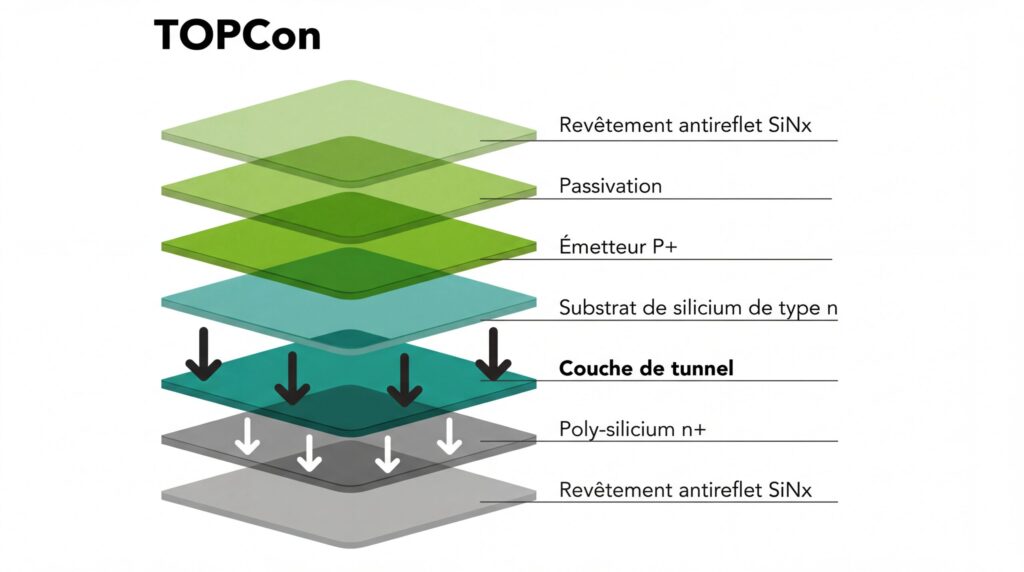
HJT (HTJ): a premium technology with excellent heat performance
HJT (often written HTJ) stands for “Heterojunction”. It combines crystalline silicon with thin amorphous silicon layers to reduce losses. HJT is often recognized for excellent high temperature behavior and very strong performance in real conditions.
Why it can be a great rooftop choice:
- In real life, a panel heats up. A technology that loses less in heat can produce more over the year, all else equal.
- HJT is often associated with high end modules (glass glass and refined finishes depending on the reference).
Watch out: HJT can be a bit more premium on price depending on the product lines and stock. But for demanding projects (stable performance, quality, exposed roofs), it’s a very coherent option.
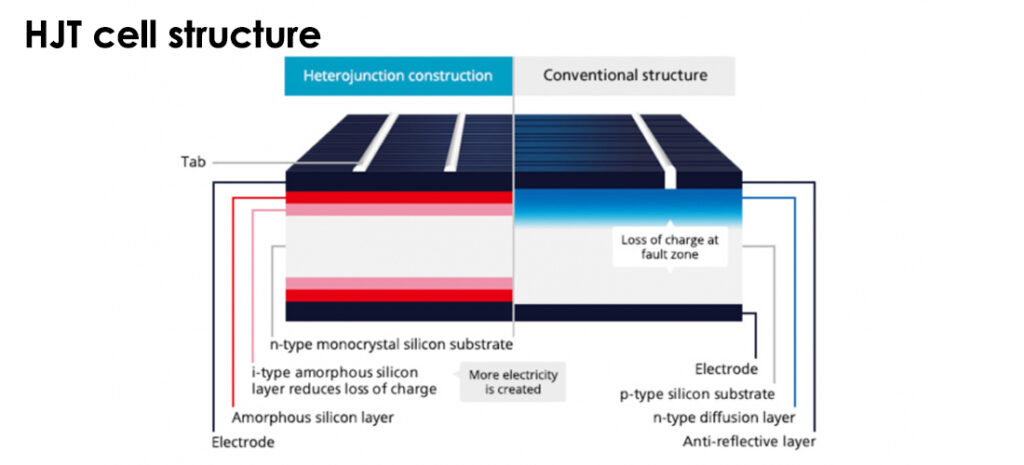
ABC: performance and aesthetics, with rear contacts
ABC stands for “All Back Contact”. The principle is simple: move the metal contacts to the rear. The result is a more uniform, cleaner looking front side. That’s one of the reasons ABC is very popular for premium residential projects and for condominiums where aesthetics matter.
Technically, ABC can also reduce some losses linked to front side metallization. In practice, many ABC modules sit in high performance product lines, with a particularly refined finish.
At Ecoclima, we often install modules based on ABC cells when the project puts strong emphasis on aesthetics (uniform full black look, premium finish). And if you’re targeting a specific technology (TOPCon, HJT, or a specific reference), we can supply and install it, as long as the overall system quality stays coherent.
Comparison table: PERC vs TOPCon vs HJT vs ABC (what to remember)
The table below summarizes the useful differences for a practical decision. Exact values vary by manufacturer and series. The goal is to compare trends and common trade offs, not to sell a spec sheet.
| Technology | Typical positioning | Strengths | Watch outs | Best fit profile |
|---|---|---|---|---|
| PERC | Legacy standard, declining | Price performance ratio, mature tech, real world feedback | Less “state of the art” depending on the product line, heavily dependent on manufacturer and module build quality | Controlled budget, if the product line is serious and the offer is attractive |
| TOPCon (often N type) | Very common option in 2026 | Performance, price, availability balance, wide choice | Quality varies by brand, product line selection matters | Most house and condominium projects |
| HJT (HTJ) | Premium, stable, often very high quality | Excellent heat behavior, strong real world output, often refined finishes | Sometimes higher price, availability depends on references | Demanding projects, looking for annual stability |
| ABC | High end, strong aesthetics | Uniform front side, premium look, very strong performance depending on product lines | Often more premium, system coherence to validate (layout, inverter, constraints) | Aesthetics first, visible roof, condominiums sensitive to visual impact |
And in Luxembourg, what does this change in practice?
Luxembourg alternates cool seasons, sunny periods, and a non negligible share of diffuse light. Concretely, you should look beyond “marketing efficiency”. The best choices are those that stay coherent on:
- annual production in real conditions (temperature, orientation, partial shading),
- durability (performance stability, lamination quality, mechanical strength),
- availability and follow up (tracked brands, solid warranties, after sales),
- aesthetics when the roof is visible (home, street, condominium),
- system integration: sizing, inverter, surplus management, potential battery.
For sizing, the best decisions start from usage: self consumption, surplus, load profile, and upgrade potential (EV charger, battery). If you want a concrete baseline, you can also read our guide on PV sizing in Luxembourg (self consumption, surplus, kWh value).
How to choose: 6 concrete scenarios (house and condominium)
Here is a simple grid that’s very useful in a consultation. The goal is to align cell technology with the project’s main priority.
1) Controlled budget, rational choice
If the main priority is total price, we first look at TOPCon offers, and sometimes PERC if a serious product line is offered at a very competitive rate. In this scenario, module quality and installation quality matter as much as the cell.
2) Best performance price balance, without overthinking it
TOPCon is very often the “simple and effective” choice today: solid efficiency, wide choice, good availability, reasonable pricing. For many houses and condominiums, it’s the best balance.
3) Looking for stable real world performance
If the roof can run hot (dark roof, low ventilation, strong exposure) or if you’re looking for a stable premium solution, HJT is often an excellent option. It’s justified more by real annual performance and product line quality than by a single number on a datasheet.
4) Aesthetics first (highly visible roof, condominium, architectural constraints)
In that case, ABC is often appreciated: more uniform front side, cleaner full black look, premium finishes. This is typically the scenario where the visual impact is immediate.
5) Partial shading: the cell isn’t everything
If you have chimneys, dormers, trees, or other shading, the priority may become module design and electrical architecture (optimizers, micro inverters depending on the case, smart stringing). Cell tech matters, but the overall solution matters more. We cover this in detail in our guide on solar panel mounting based on your roof in Luxembourg.
6) An upgradeable project: battery, EV charger, energy management
If the project aims for future upgrades (battery later, EV charger, self consumption optimization), cell choice should be made together with sizing and the inverter. TOPCon, HJT, or ABC can all fit. The difference is more about the overall strategy than a technology label.
Thin film and multi junction: why it’s not the rooftop standard
We hear more about it lately, so let’s be clear.
Thin film: technologies that differ from classic crystalline silicon. They can have advantages in certain contexts, but on residential roofs and condominiums, the offer, formats, availability, and ecosystem remain overwhelmingly oriented toward Mono Si.
Multi junction: stacking junctions to capture more of the light spectrum. Efficiencies can be very high, but costs and complexity are on a completely different level. They are mainly found in space.
The future: silicon perovskite tandem, promising but not “right now”
Silicon perovskite tandems are among the most closely watched paths, because they aim to push beyond the limits of silicon alone. On paper, the idea is simple: one layer captures part of the spectrum, silicon captures another, and total efficiency rises.
For rooftops, caution comes from very concrete points:
- large scale industrialization: volumes, costs, quality control,
- long term stability: proven durability over 20 to 30 years,
- warranties and follow up: what matters is the written warranty and the manufacturer’s strength.
In short: yes, it’s a strong future track. But for a roof in Luxembourg, a rational decision in 2026 is still based on mature Mono Si technologies (TOPCon, HJT, ABC, and sometimes PERC depending on the offers).
What Ecoclima recommends in practice
Our rule is simple: we don’t choose a technology “because of a slogan”. We choose a coherent long term solution, technically and visually. Today, we often install ABC when aesthetics are a strong priority, and we also install a lot of TOPCon and HJT depending on the goals, stock availability, and the project setup.
Because we work with major distributors, we can adapt to a specific request, as long as we stay coherent on:
- module quality (build, warranties, reliability),
- compatibility with the inverter and electrical architecture,
- sizing (surface, orientation, consumption),
- integration and installation (mounting, waterproofing, cable routing, finishes).
Checklist: 10 questions to ask before choosing a cell technology
- What is my priority: budget, aesthetics, annual performance, future upgrades?
- Is my roof highly visible (condominium, neighbors, aesthetic constraints)?
- Do I have shading? If yes, at what times of day?
- How much roof area is available? Do I need to maximize power per m²?
- What is my consumption profile (day, night, EV, heat pump)?
- Am I targeting self consumption, surplus export, or a mix?
- Do I plan to add a battery later?
- What product and performance warranty is offered, and by which manufacturer?
- Is the module glass glass, bifacial, full black, and is that consistent with my goal?
- Who handles follow up: local installer, after sales support, parts availability?
Useful official sources to go further
If you want to go deeper with recognized sources (roadmaps, state of the art, industry trends), here are two serious references. Numbers change fast, so these links are mainly useful to follow trends and validate market direction.
Conclusion: the right choice is a coherent solution, not an acronym
In 2026, the reality is simple: on rooftops, you are almost always using monocrystalline modules. Then you choose the architecture (TOPCon, HJT, ABC, sometimes PERC) based on your priorities. TOPCon is often the best compromise, HJT targets stability and premium quality, and ABC delivers a very high end aesthetic with excellent performance depending on the product line.
If you want a clear recommendation tailored to your roof (house or condominium), the most efficient approach is to start from clear sizing and a proposal comparing 2 or 3 relevant options, without fluff.
Note: manufacturers’ product lines evolve fast (efficiencies, formats, warranties). For exact figures, we always rely on up to date datasheets and on the conditions in force at the time of the quote.
FAQ: Common questions about photovoltaic cell technologies
In most new projects, no. The rooftop market is largely monocrystalline, with more efficient architectures and better long term support. Poly can exist as an opportunity, but you need to be very cautious about quality, warranty, and availability.
Often, TOPCon brings an efficiency gain and is becoming more common on the market. But “better” depends on the manufacturer, the product line, and the price. A strong PERC module can be preferable to a poorly finished entry level TOPCon.
Some thin film technologies can perform well in diffuse light, but the choice is not made on that criterion alone. For residential rooftops in Luxembourg, the offer and ecosystem are still overwhelmingly Mono Si, with optimized solutions and an excellent overall balance.
No. Aesthetics are a major advantage (more uniform front side), but ABC can also deliver excellent performance depending on the product line. It’s often a premium choice that combines looks and performance, when the budget allows.
They’re promising, but broad adoption depends on proven durability, mass production, and warranties. In the near term, modern Mono Si technologies remain the most rational choice for a roof.
The most reliable way is to start from your objective (self consumption, aesthetics, budget), then size properly and choose a well supported module range. At Ecoclima, we offer clear options (TOPCon, HJT, ABC depending on the project), based on your roof and your usage.