
Solar Battery in Luxembourg: Why profitability has improved significantly in 2026
For a long time, the narrative around home batteries in Luxembourg was simple: interesting, but mainly with subsidies. That reasoning is becoming less and less relevant. In 2026, the context has changed. The price per kWh purchased from the grid remains high for households, while the value of exported surplus can be significantly lower under a self-consumption model with a variable buyback contract. At the same time, residential storage is becoming more accessible and better integrated into photovoltaic projects. Official source on the price context, source on export models.
The central point is this: a battery does not produce more electricity, it increases the economic value of part of your solar production. In other words, it allows you to shift a solar kWh from midday to the evening, early night, or certain deferred uses. The wider the gap between the grid purchase price and the value of exported surplus, the more attractive this shift becomes.
In one sentence: a battery becomes relevant when a stored kWh helps you avoid a grid purchase that is significantly more expensive than what that same kWh would have earned through export.
In short: what you need to remember
- The profitability of solar batteries has improved in Luxembourg.
- The main driver is the gap between the price of purchased electricity and the value of exported electricity.
- A 10 kWh battery is still often a solid baseline, but it is no longer an automatic limit.
- In some homes with a heat pump, EV charger, and strong evening usage, 12, 15, or 20 kWh can make sense.
- The right size depends on the actual consumption profile, not only on the subsidy amount.
- An oversized battery quickly loses value if it is not regularly charged and discharged.
- The right calculation is to measure the annual value of the kWh that are actually shifted.

Why many articles still underestimate the value of batteries
Part of the content published on this topic still relies on an outdated framework:
- a lower retail electricity price than today;
- photovoltaic surplus that was sometimes better valued;
- batteries that were more expensive than they are now.
In that older context, a battery could seem borderline reasonable, except when substantial subsidies were available. In 2026, that reasoning needs to be updated. Luxembourg clearly distinguishes between models with a guaranteed export tariff and models with a variable market-linked tariff. For a residential project focused on self-consumption, this difference completely changes the economic analysis. Official framework on export tariffs, summary presentation of the two models.
Another major development: battery costs have declined in recent years. The International Energy Agency notes that lithium-ion pack prices have dropped significantly, with another marked decline recorded in 2024. This trend alone does not make every project excellent, but it clearly improves the economic case for residential storage. IEA source.
The real financial lever: the value of the shifted kWh
The battery does not create magic. It simply shifts solar energy produced at noon to a time when the home needs it later. The economic gain comes from that arbitrage.
- Your panels produce surplus electricity during the day.
- Without a battery, that surplus is exported.
- In the evening, you consume electricity from the grid again.
- With a battery, part of the surplus is stored and then used later.
The value of a stored kWh is therefore not the full grid price per kWh. It is the difference between:
- what you would have paid to buy that kWh from the grid;
- and what you would have earned if you had let it go to export;
- all while taking charge and discharge losses into account.
| Situation | Without battery | With battery | Economic reading |
|---|---|---|---|
| Solar surplus at noon | It is exported | It is stored | The same kWh can be sold or kept |
| Electricity need in the evening | The grid supplies the energy | The battery supplies the energy | You avoid a grid purchase |
| Value created | You receive the value of the surplus | You avoid buying a more expensive kWh | The battery captures the gap between the two |
Under a prudent approach, it is often this gap that explains the change in profitability. So the question is not only how much a battery costs, but how many kWh it will actually allow you to shift every year, and at what value.
Guaranteed tariff or variable surplus: the distinction that changes the calculation
This is one of the most misunderstood points. In Luxembourg, a photovoltaic project can follow different logics. The guaranteed 15-year export tariff still exists within the regulatory framework. But in a residential project designed for self-consumption, many comparisons are also made using variable buyback contracts offered by suppliers. These contracts are linked to the market and can value surplus electricity at levels very different from the guaranteed tariff. Official source, supplier-side operating example.
In practical terms, this means you have to compare the right things. If a household chooses a self-consumption logic with variable surplus pricing, then the battery should mainly be assessed against the potentially low value of exported surplus. In that case, the gap with the grid-purchased kWh can become very attractive. By contrast, if you reason using a guaranteed tariff, the calculation is not the same. Mixing these two frameworks leads to poor conclusions.
A battery must be judged using the right economic model. Comparing a self-consumption project to a guaranteed tariff without distinguishing the two distorts the return on investment.
Why 10 kWh is no longer an automatic ceiling
A 10 kWh battery remains a relevant capacity in many homes. That is not the issue. The issue appears when this figure becomes a reflex, simply because it matches a market habit or a subsidy logic. A battery should not stop there if the actual household profile justifies more.
A well-electrified home can have substantial demand between the end of the afternoon and the next morning, especially with:
- a heat pump;
- an electric water heater;
- an EV charger;
- strong evening household consumption;
- a photovoltaic installation able to recharge the battery regularly.
In this type of configuration, the real question is no longer only “which battery is subsidized,” but “which capacity allows enough kWh to be shifted to remain economically rational.” If the answer is 12, 15, or 20 kWh, those scenarios should at least be compared seriously.
| Household profile | Indicative PV installation | Battery range often consistent | Quick reading |
|---|---|---|---|
| Standard home, few controlled uses | 4 to 6 kWp | 5 to 8 kWh | Storage can help, but overcapacity should be avoided |
| Family with strong evening consumption | 6 to 9 kWp | 8 to 12 kWh | Often a balanced range |
| Home with heat pump | 8 to 12 kWp | 10 to 15 kWh | Off-sun demand becomes more significant |
| Heat pump + electric vehicle | 10 to 15 kWp | 12 to 20 kWh | Higher capacity can become coherent |
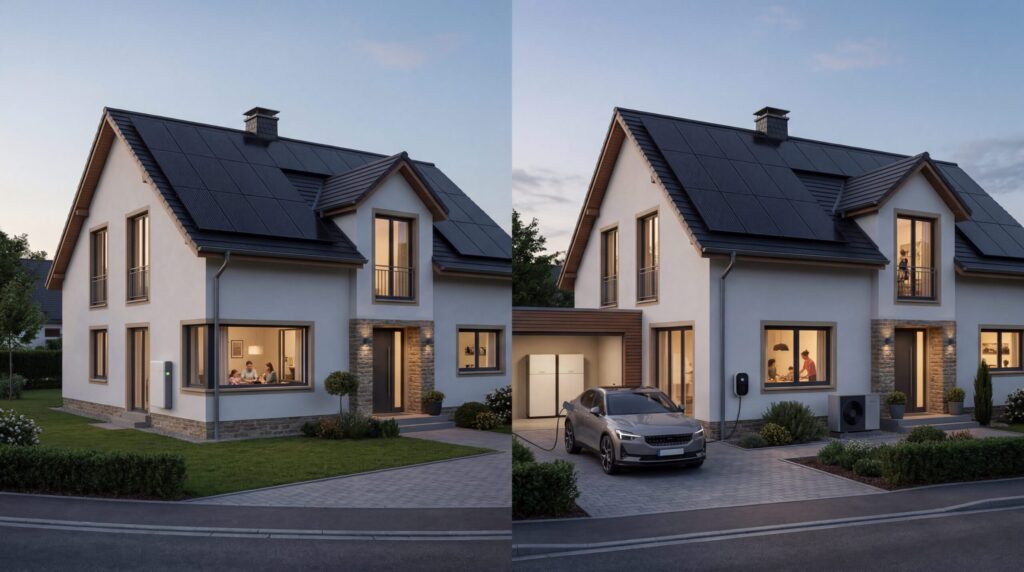
Simple comparison: no battery, 10 kWh, or 15 to 20 kWh
| Option | Who it is for | Advantages | Limitations | Verdict |
|---|---|---|---|---|
| Without battery | Small profile, low evening consumption, tight upfront budget | Lower initial investment | Surplus is less well valued, grid purchases are higher in the evening | Valid for some smaller profiles |
| 10 kWh battery | Many single-family homes | Good compromise, real increase in self-consumption | Can become too limited with heat pump and EV | Often the easiest capacity to justify |
| 15 to 20 kWh battery | Electrified home, significant off-sun needs | More shifted kWh, fewer grid purchases, long-term logic | Requires enough production and enough uses to remain well utilized | Relevant if the profile genuinely justifies it |
The right trade-off is to look at the value of each additional slice of capacity. If moving from 10 to 15 kWh allows many more useful kWh to be shifted over the year, the added capacity makes sense. If that extension remains little used, it becomes harder to justify.
Concrete examples to understand return on investment
The examples below are meant to illustrate the method. They do not replace a real profile study.
- Case 1: a household shifts 1,800 kWh per year thanks to its battery. If the average value of the shifted kWh is significant, the battery starts to generate a tangible annual gain.
- Case 2: a home with a heat pump and strong evening consumption shifts 2,500 to 3,000 kWh per year. In that case, the value of storage becomes much more visible.
- Case 3: increasing capacity from 10 to 15 kWh is only relevant if the added portion is actually used. What matters is its marginal value, not just the total displayed capacity.
This marginal reading is essential. A battery is not profitable because it is large. It is profitable because it works. Additional capacity must be sufficiently charged and then discharged for useful uses, otherwise it ties up budget without creating enough value.
Checklist: when a larger battery deserves a real study
- Your home consumes a lot between the end of the afternoon and the morning.
- You heat with a heat pump.
- You charge an electric vehicle at home.
- Your roof allows for sufficient solar production.
- You want to increase self-consumption, not just export.
- You want to think in the medium and long term, not only about the immediate cost.
- You are ready to control certain uses, such as the water heater, EV charging, or equipment operating schedules.
If several of these points apply to your home, a capacity above 10 kWh may deserve a serious analysis. To go further, you can consult our guide on sizing, subsidies, and mistakes to avoid as well as our page dedicated to correctly understanding battery kWh and kW.
The mistakes that still distort many projects
- Thinking only in terms of subsidies. A subsidy improves a project, but it never replaces proper sizing.
- Confusing capacity and power. kWh stores energy, kW delivers power. Both concepts must be read together.
- Comparing with the wrong tariff. A self-consumption project with variable surplus pricing should not be judged like a project under a guaranteed tariff.
- Oversizing by principle. A battery that is too little used quickly loses value.
- Forgetting load management. Water heater, EV charging, scheduling certain appliances, all of this affects real profitability.
- Expecting the battery to solve winter. A battery shifts energy over the course of the day, it does not compensate for the structural lack of sunlight in winter.
There are also other ways to better value photovoltaic surplus. If this topic interests you, we have also explained how energy communities in Luxembourg work, which can, in some cases, improve the local value of the electricity produced.
2026 subsidies: useful, but no longer sufficient on their own to decide
The pre-financing system introduced in 2026 makes projects easier for households to understand. The principle is simple: in the residential sector, the maximum support amount can be reached for a photovoltaic installation up to 15 kWp and for a battery up to 9 kWh under the pre-financing framework. Batteries added later to an existing installation fall under the standard scheme. Official Klima-Agence source, detailed rules on Guichet.lu.
This framework remains favorable, but it should no longer become a psychological ceiling. A 9 or 10 kWh battery is not automatically the best decision for every home. The right sequence of reasoning is as follows:
- determine the capacity your home actually justifies;
- then check how subsidies improve the project;
- and finally compare the real value of each scenario.
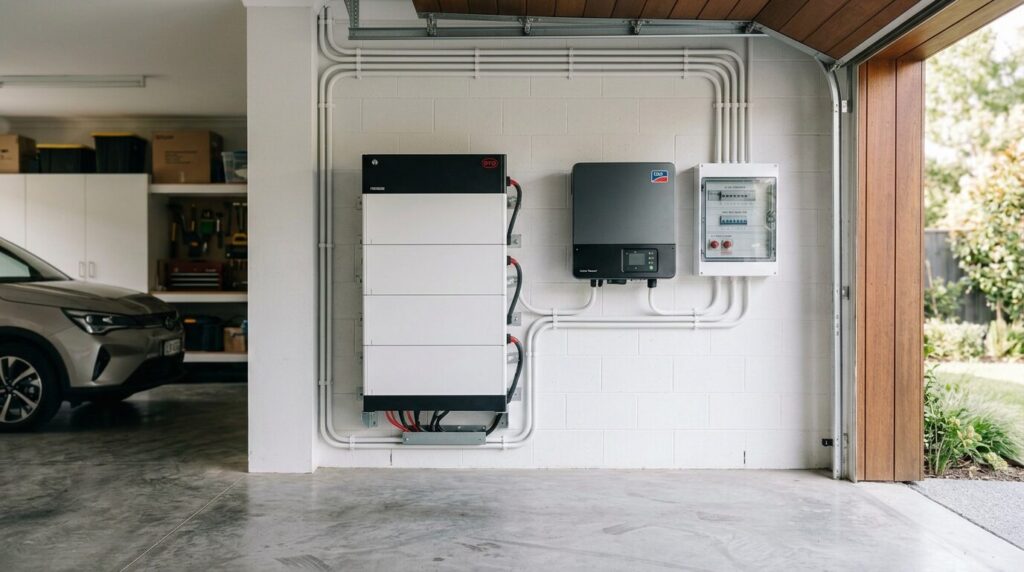
Our approach to recommending 10, 15, or 20 kWh
At Ecoclima, we avoid standard packages applied to everyone. We first look at real consumption between the end of solar production and the next morning, the presence of a heat pump, an EV charger, the photovoltaic power that can actually be installed, and the objective being pursued: self-consumption, comfort, economic optimization, or integration into a broader energy strategy.
We then compare several clear scenarios: without battery, with a standard battery, then with increased capacity if the profile justifies it. This method helps avoid two opposite mistakes: undersizing out of habit or oversizing out of enthusiasm.
You can also find answers to the most frequently asked questions in our renewable energy FAQ in Luxembourg.
Conclusion: the right battery is no longer only the one covered by the subsidy
In 2026, residential storage deserves a more mature reading. A battery is no longer just an add-on included if the budget allows it. In many projects in Luxembourg, it is becoming a coherent economic optimization tool, provided it is sized according to real uses.
The underlying change is simple: we need to stop thinking only in terms of subsidy amount, and start thinking again in terms of the value of the shifted kWh. That is the logic that makes it possible to know whether a 10, 15, or 20 kWh battery makes sense for your home.
Assess your battery + photovoltaic project
If you are hesitating between several capacities, the most useful approach is to compare concrete scenarios based on your roof, your consumption, your evening uses, a possible heat pump, and the role of an EV charger in the project. A serious study makes it possible to quickly see whether a standard battery is sufficient, or whether a larger capacity genuinely creates more value in your case.
As subsidy rules, tariffs, and value mechanisms may evolve, the conditions in force at the time of quotation should be checked on official sources.
FAQ: solar battery and profitability in Luxembourg
Yes, in more cases than before. It all depends on the consumption profile, the size of the photovoltaic system, the type of surplus valuation, and the volume of kWh actually shifted over the year.
You need to think in marginal value. A stored kWh is mainly worth the difference between the avoided grid kWh price and the value of the kWh that would otherwise have been exported, adjusted for system losses.
No. 10 kWh is still often a good baseline, but it is not a universal rule. A home with a heat pump, an electric vehicle, and significant evening usage may justify more.
Not automatically. It becomes excessive only if solar production does not allow it to be charged enough, or if the home does not have enough useful loads to discharge it regularly.
No. A home battery mainly handles day-to-day energy shifting. It does not eliminate the seasonal mismatch between high summer production and winter demand.
Yes, in many cases. However, technical compatibility, the installation architecture, the existing inverter, and the subsidy scheme applicable at the time of the project must be checked.
The best starting point is the real consumption between the end of the afternoon and the next morning, then the annual value of the kWh that the battery will actually allow you to shift.