
Controllable home in Luxembourg: how to consume electricity at the right time in 2026
Installing solar panels, a heat pump, a battery or an EV charging station is no longer always enough to optimise a home. In 2026, the real question becomes more precise: producing, storing, heating and charging at the right time.
Ecoclima Luxembourg Guide | Updated: April 2026 |
Key points in 30 seconds
- A home equipped with solar is not necessarily optimised if its main uses consume electricity at the wrong time.
- A heat pump can fit very well into a solar powered home, but its main demand is often in winter, when photovoltaic production is lower.
- The battery, EV charging station, domestic hot water, air conditioning and certain programmable appliances can increase self consumption.
- In Luxembourg, the Klimabonus 2026 scheme provides a 500 euro subsidy for certain energy management systems capable of connecting several home appliances.
- The right project is not just a collection of equipment. It is a coherent system between production, consumption, storage, heating and charging.
Table of contents
- Why this topic is becoming central in 2026
- Producing is not enough: you need to consume at the right time
- Heat pump and solar: a good combination, but not automatic
- What the ViFlex project proves
- Which uses to manage in a home in Luxembourg
- Dynamic tariffs: opportunity or risk
- The subsidy for energy management systems
- Concrete scenarios for an equipped home
- The Ecoclima method
- FAQ
Why this topic is becoming central in 2026
In Luxembourg, the energy transition is entering a new phase. For a long time, the main question was simple: should you install solar panels or replace your heating system with a heat pump?
In 2026, the question becomes more systemic: how can solar panels, a heat pump, a battery, an EV charging station, air conditioning and the home’s electrical installation work together?
This development makes sense. Klima Agence indicated in April 2026 that Luxembourg already had 32,000 photovoltaic installations connected to the grid at the end of 2025, around 26,000 self consumption installations and around 1,200 electricity sharing groups. Photovoltaics are therefore no longer a marginal subject. They are becoming a normal part of housing.
But the more electrical equipment a home has, the more coordination matters. A home with solar panels, a heat pump and an electric car can be very efficient. It can also be poorly optimised if all major uses start at the same time or if solar production is injected into the grid instead of being consumed locally.
Source: Klima Agence, 2026 press conference

Producing is not enough: you need to consume at the right time
A solar panel mainly produces during the day. Yet in many homes, the largest consumption often happens in the morning, evening or winter. This is where the gap appears between an installation that produces well over the year and an installation that is truly optimised for the household.
Self consumption means directly using the electricity produced by your solar panels. The more a home consumes its own kWh at the right time, the more it reduces its dependence on the grid. Conversely, if a large part of the production is injected into the grid while the household buys electricity back later, the economic potential of the installation may be less well used.
Old logic
An appliance is installed, then its production or consumption is viewed separately.
New logic
A complete home is designed where each appliance is considered according to its hourly and seasonal profile.
Simple example: starting an EV charging station, a heat pump and several powerful appliances at the same time can create unnecessary peaks. Conversely, spreading out usage and prioritising solar production hours can improve the home’s overall balance.
Heat pump and solar panels: a good combination, but not automatic
It is often said that heat pumps and solar panels work perfectly together. The idea is partly true, but it is too simplified.
A heat pump uses electricity to produce heat. If part of this electricity comes from solar panels, the system can become very interesting. But heating is mainly needed during the cold months, when photovoltaic production is lower than in spring or summer.
The right reasoning is therefore not: “I have solar, so my heat pump will automatically be powered by my panels.” The right reasoning is: “what share of my heating consumption can be shifted, stored or optimised without losing comfort?”
| Equipment | Alignment with solar | Correct interpretation |
|---|---|---|
| Heat pump | Medium | Very useful in an electrified home, but its main demand often comes in winter. Sizing and control are essential. |
| Air conditioning | Strong in summer | Good seasonal coherence, because cooling needs often coincide with high solar production. |
| EV charging station | Variable | Very good potential if the vehicle is often at home during the day or if charging is intelligently scheduled. |
| Home battery | Strong | Shifts part of the kWh produced during the day to the evening or night. |
| Domestic hot water | Good | A controllable hot water tank or immersion heater can use solar surplus at certain times. |
Point of attention: a poorly sized, poorly positioned, poorly balanced or poorly configured heat pump can lose part of its value. In Luxembourg, technical requirements include conditions relating to meters, hydraulic balancing, acoustic levels and, in some cases, the buffer tank.
Source: Guichet.lu, Klimabonus 2026 for technical installations
What the ViFlex project proves
A recent project in Germany shows why heat pumps become more interesting when they are connected and controllable.
In the ViFlex project, Viessmann Climate Solutions, TenneT Germany and TransnetBW tested the integration of more than 100 residential heat pumps into grid management mechanisms. The objective was to shift their consumption over time in order to help prevent certain congestions and better integrate renewable energy surpluses.
This test is important because it shows that a heat pump is not just a heating appliance. It can also become a flexible load, capable of adapting to grid needs and energy signals, without necessarily reducing comfort if the system is properly designed.
What this means for a home in Luxembourg
The ViFlex project does not mean that a private homeowner in Luxembourg can already automatically sell the flexibility of their heat pump on a grid market. That would be too quick an extrapolation.
However, it confirms a strong trend: homes equipped with a heat pump, photovoltaics, a battery and an EV charging station will increasingly benefit from intelligent control.
Sources: Viessmann Climate Solutions, ViFlex project and Cooling Post, April 2026
Which uses to manage in a home in Luxembourg
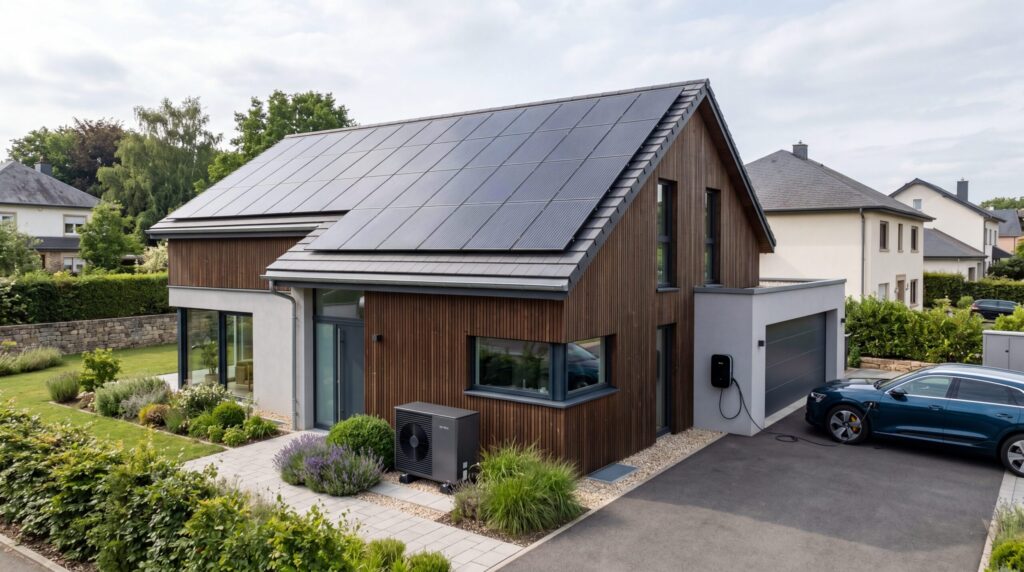
Energy management does not mean turning everything off or sacrificing comfort. It means deciding which uses can be shifted, prioritised or automatically limited according to solar production, battery level, consumption schedules and sometimes electricity prices.
| Use | What can be managed | Potential impact |
|---|---|---|
| Heat pump | Operating periods, set temperature, thermal storage, peak limitation | Reduction of poorly timed consumption and better comfort stability |
| Solar battery | Charging, discharging, minimum reserve, strategy according to production and consumption | Higher self consumption and lower grid purchases in the evening |
| EV charging station | Solar charging, delayed charging, maximum power, priority according to vehicle availability | Better use of photovoltaic surplus |
| Domestic hot water | Heating during solar hours or according to available surplus | Indirect energy storage in the form of heat |
| Air conditioning | Daytime operation, comfort maintenance, peak limitation | Very good alignment with summer solar production |
| Programmable appliances | Washing machine, dishwasher, tumble dryer according to solar hours | Simple gain, especially for households that are present or flexible |
The difficulty is not only technical. It is also practical: every home has its own habits, schedules, equipment and constraints. A household with remote work, a car at home during the day and air conditioning will follow a very different logic from a household absent all day with heating as the main winter use.
Dynamic tariffs: opportunity or risk?
Dynamic tariffs make energy management even more important. The principle is simple: the electricity price can vary depending on the time and market conditions. This can create opportunities, but also risks if major uses start at the wrong time.
Enovos indicates, for example, that its dynamic bundle offer follows market developments, with a logic of consuming and injecting at the best time. The offer also specifies that injection can become unfavourable when prices are low or negative, and that this type of product is better suited to people equipped with smart tools or battery systems.
When this can be interesting
If the home has a battery, a programmable charging station, controllable equipment and precise consumption monitoring.
When this can become risky
If the home injects or consumes without a strategy, especially during hours when prices are not favourable.
Careful conclusion: a dynamic tariff is not a magic solution. It is a tool that becomes relevant if the home is able to react. Without energy management, it can add complexity instead of bringing a real gain.
Source: Enovos, dynamic bundle
In Luxembourg, the energy management system is becoming a strategic piece of equipment
The Klimabonus 2026 scheme confirms the importance of energy management. Guichet.lu mentions a financial subsidy of 500 euros for an energy management system, under certain conditions.
To be eligible, the system must notably allow the connection and integration of at least two pieces of equipment among the following: heat pump, charging station, electricity storage, photovoltaic installation or controllable immersion heater for domestic hot water.
This point is important because it shows that Luxembourg is no longer looking only at equipment separately. The objective is also to encourage their coordination.
What this changes for an Ecoclima project
When a client is considering several pieces of equipment, it becomes relevant to think from the start about the electrical architecture, communication between appliances and operating priorities.
For example: should priority be given to charging the battery, the electric vehicle, hot water or thermal comfort? The answer depends on the home, lifestyle and consumption profile.
Source: Guichet.lu, energy management systems, Klimabonus 2026
Concrete scenarios for an equipped home
To understand the value of energy management, the simplest approach is to reason through scenarios.
| Configuration | Risk if not managed | Possible optimisation |
|---|---|---|
| Solar panels only | Significant daytime injection, electricity bought back in the evening | Schedule certain uses during solar hours |
| Solar panels with battery | Poorly sized battery or overly basic charging strategy | Store useful surplus and avoid unnecessary discharging |
| Solar panels with heat pump | Mismatch between winter heating needs and lower solar production | Optimise heating periods, building inertia and thermal storage |
| Solar panels with EV charging station | Fast charging from the grid instead of using surplus | Activate solar or delayed charging depending on vehicle presence |
| Complete home with PV, heat pump, battery and charging station | Conflict between appliances, power peaks, limited self consumption | Set up a priority logic with an energy management system |
The right indicator is not only annual production. An installation can produce a lot and still be poorly valued if the kWh are not consumed at the right time. Conversely, a well sized and well managed installation can be more coherent than a larger but poorly coordinated system.
The Ecoclima method: think system before product

At Ecoclima, an energy project should not be considered as a simple addition of products. A home in Luxembourg may need solar panels, a heat pump, a battery, an EV charging station, air conditioning or an electrical adaptation. But the order, sizing and coordination make all the difference.
1. Understand the home
Surface area, insulation, roof, orientation, existing heating, electrical panel, consumption habits and mobility project.
2. Identify major uses
Heating, hot water, vehicle charging, air conditioning, appliances, technical equipment and power peaks.
3. Size coherently
An installation that is too small can limit gains. An installation that is too large can create poorly valued injection if it is not considered with storage or usage.
4. Plan energy management
True performance comes from coordination: producing, consuming, storing, heating and charging according to a clear strategy.
Concrete logic for choosing your installations:
| Time frame | Action | Objective | Impact |
|---|---|---|---|
| Short term | Analyse consumption and the schedules of major uses | Know where the electricity goes | Strong |
| Short term | Schedule simple uses during solar hours | Increase self consumption without major work | Medium to strong |
| Medium term | Add or optimise a battery, charging station or hot water management | Shift part of the useful kWh | Strong |
| Medium term | Connect compatible equipment to an energy management logic | Reduce conflicts between appliances | Strong |
| Long term | Design the home as a complete energy system | Prepare for changes in tariffs, the grid and electrical uses | Very strong |
Want to know if your home is truly optimised?
Ecoclima supports you in Luxembourg to design a coherent installation between solar panels, heat pump, battery, EV charging station, air conditioning and general electricity.
The most important thing is not to add one more piece of equipment, but to build a system adapted to your home, your uses and your consumption profile.
FAQ: controllable home, solar and heat pump in Luxembourg
Does a heat pump work well with solar panels?
Yes, but not automatically. A heat pump mainly consumes during the cold season, when solar production is lower. The combination becomes more relevant with good sizing, intelligent management, a battery or a thermal storage strategy.
Is a battery essential with a heat pump?
No. A battery is not essential in every case. It becomes interesting if the household has regular solar surplus, evening or night consumption, an EV charging station or a high self consumption objective.
What is an energy management system?
It is a system that coordinates several pieces of home equipment, for example solar panels, the battery, the heat pump, the EV charging station or hot water. Its role is to improve consumption at the right time and limit conflicts between appliances.
Is there a subsidy in Luxembourg for this type of system?
Yes, the Klimabonus 2026 scheme provides a 500 euro subsidy for certain energy management systems, under conditions. The system must notably connect and integrate at least two pieces of equipment among the categories defined by Guichet.lu.
Are dynamic tariffs always advantageous?
No. They can be interesting with programmable appliances, a battery or a controllable charging station. But without management, they can expose the household to high prices at certain hours or less favourable injection when prices are low or negative.
What is the priority for optimising a home already equipped with solar?
The first priority is to analyse when the home produces and when it consumes. Then, the shiftable uses must be identified: vehicle charging, hot water, battery, air conditioning, appliances or certain heating cycles.