
How much does air conditioning cost in Luxembourg in 2026?
Air conditioning prices in Luxembourg in 2026: how much does installation cost?
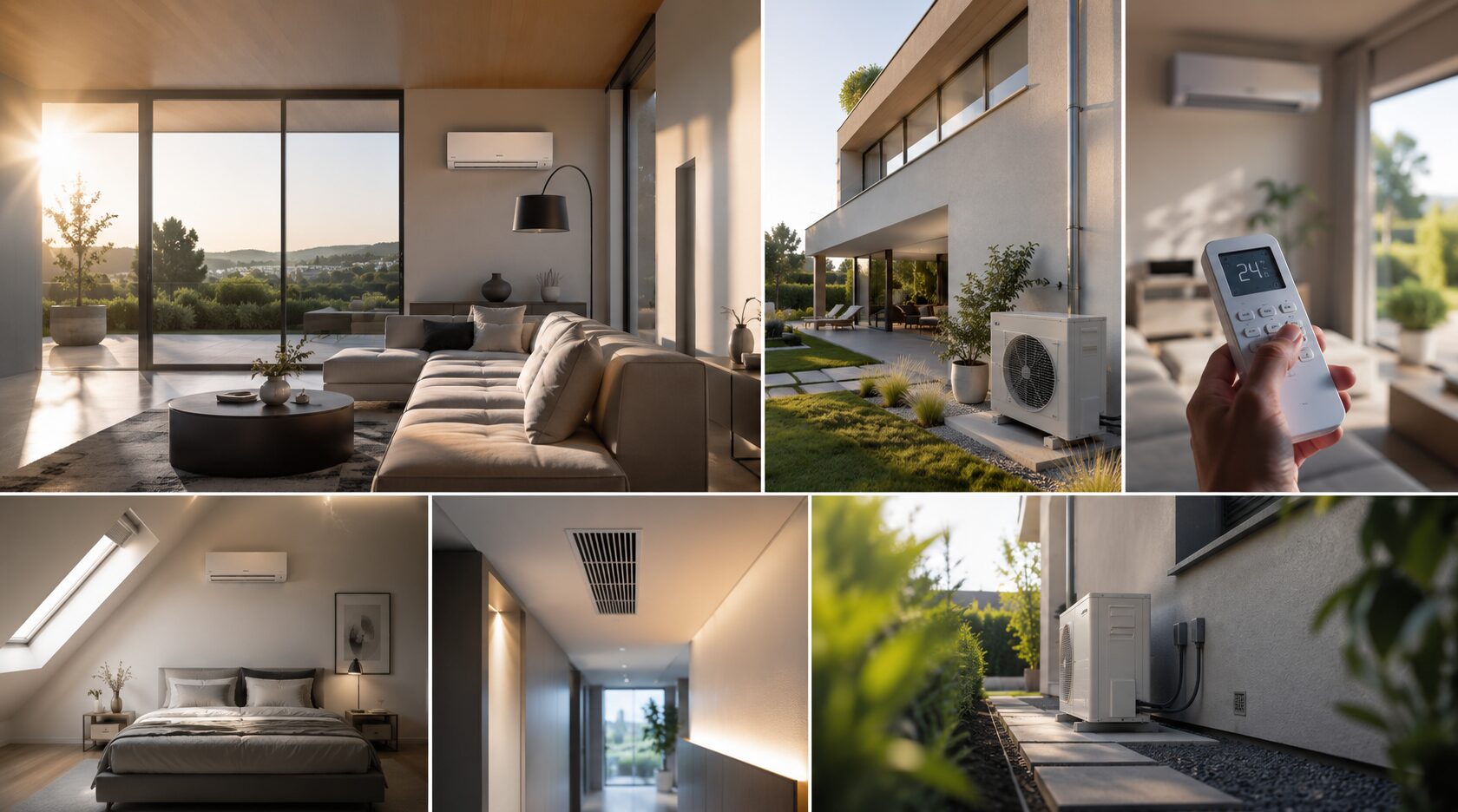
In Luxembourg, the cost of an installed reversible air conditioning system generally ranges from €2,500 to €4,200 for one room, from €4,500 to €7,000 for two rooms, and from €6,800 to €12,000 for three to four rooms.
These budgets include quality equipment, standard installation and Luxembourg’s standard VAT rate. The final cost mainly depends on the number of rooms, the route of the pipework, condensate drainage, site access and the position of the outdoor unit.
1 room€2,500 to €4,200
2 rooms€4,500 to €7,000
3 to 4 rooms€6,800 to €12,000
Periods of intense heat are becoming harder to manage in some Luxembourg homes. With an average temperature of 19.9°C, June 2026 was the hottest June recorded at Findel since measurements began in 1947. Attic bedrooms, large glazed areas and newer, well-insulated apartments can retain heat for several days.
Comfort does not depend on the unit’s capacity alone. The position of the indoor units, pipe routes, water drainage, electrical supply, outdoor noise and the way each room is used all have a direct impact on the result.
What budget should you allow for air conditioning?
- For one room: an installed single-split system generally costs between €2,500 and €4,200.
- For two rooms: a dual-split system often costs between €4,500 and €7,000.
- For three to four rooms: the budget generally ranges from €6,800 to €12,000, depending on the technical routes and finishing work.
- VAT and grants: air conditioning is generally subject to the standard VAT rate. A standard air-to-air heat pump is not automatically eligible for Klimabonus 2026.
How much does air conditioning cost in Luxembourg in 2026?
The budget first depends on the number of zones to be treated. A zone is usually a room with its own indoor unit and independent temperature control. The following ranges are typical for residential installations in Luxembourg.
| Configuration | Typical use | Indicative installed price |
|---|---|---|
| Single-split | One bedroom, a living room or a small apartment | €2,500 to €4,200 |
| Dual-split | Two rooms with independent controls | €4,500 to €7,000 |
| Triple-split or quad-split | Three to four bedrooms or zones | €6,800 to €12,000 |
| Ducted system | Several rooms with concealed indoor units | €10,000 to €22,000 or more |
| VRF | Large house, offices or commercial building | Following a technical assessment |
These 2026 ranges include quality equipment, standard installation and Luxembourg’s standard VAT rate. Straightforward access and short pipe runs keep the cost down. More complex integration, electrical work or concealed routes can increase it.
Always compare what is included in the quotation: the price of the equipment alone cannot be compared with an offer that includes the survey, brackets, pipework, condensate drainage, electrical supply, installation, vacuum testing and commissioning.
What should the price of a complete installation include?
A price is only meaningful when the work is clearly detailed. The quotation should specify the equipment, its location, the work involved and the expected level of finish.
- site visit and technical survey;
- capacity calculation for each room;
- outdoor unit and indoor units;
- wall-mounted or floor-mounted supports;
- insulated refrigerant pipework;
- condensate drainage;
- trunking and agreed finishing work;
- specified electrical connection;
- vacuum testing and leak checks;
- commissioning and an explanation of the controls.
Also check whether drilling, a possible condensate pump, work on the electrical panel, scaffolding, a lifting platform or paint repairs are included. Two quotations that look similar can cover very different scopes of work.
Which factors have the greatest impact on the quotation?
1. The number of rooms to be treated
Each indoor unit requires equipment, pipework, water drainage and installation time. It is not always necessary to equip the entire house. In many homes, treating the attic bedrooms and the main living area is enough to restore comfortable temperatures.
2. The distance between the units
Longer pipe runs require more copper, cable, insulation and trunking. The route must also remain within the manufacturer’s technical limits while keeping the installation visually tidy.
3. Condensate drainage
In cooling mode, the indoor unit produces water. Gravity drainage is preferable whenever possible. Where there is insufficient fall, a condensate pump may be required. This adds cost, a small amount of noise and an additional component to maintain.
4. The location of the outdoor unit
An outdoor unit placed at ground level with easy access costs less to install than one mounted at height, on a roof or in a location requiring a lifting platform. Its position should also limit vibration transfer, maintain proper airflow and avoid disturbing neighbours.
5. The electrical supply
Depending on the capacity and configuration, a dedicated circuit and suitable protection may be required. On an older electrical installation, the distribution board and cable sizes should be checked before work begins. At Ecoclima, this coordination is made easier by our general electrical services in Luxembourg.
6. The required level of finish
Short, visible trunking remains the most economical solution. Concealed routes, false-ceiling integration or additional finishing work require more preparation. The expected finish should be agreed before the work starts to avoid last-minute compromises.
Why every home requires a different assessment
A single property may require several different solutions. In one of our projects in Luxembourg, the project combined a wall-mounted unit, a false-ceiling solution and a VRF system to meet the requirements of different zones.
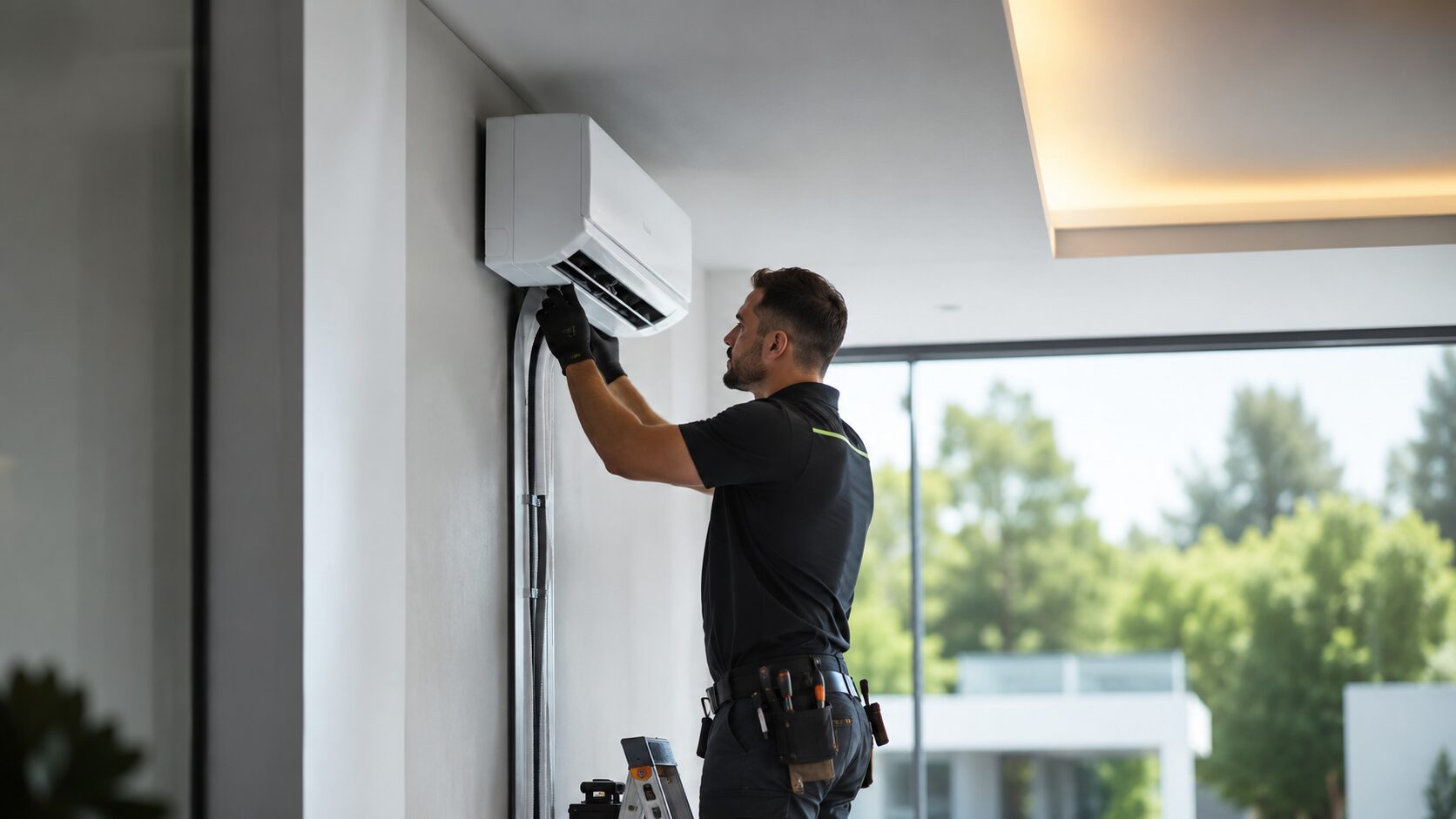
Floor area alone is therefore not enough to choose the right system. The architecture, available ceiling voids, number of independent zones, visual integration and use of each room all influence the solution.
What we check before preparing the quotation
- which rooms genuinely overheat and when the problem occurs;
- solar gains, glazing, external shading and insulation characteristics;
- possible pipe routes and condensate drainage;
- the acoustic and visual position of the outdoor unit;
- the capacity of the electrical panel and coordination with the home’s other equipment.
Single-split, multi-split or ducted: which system should you choose?
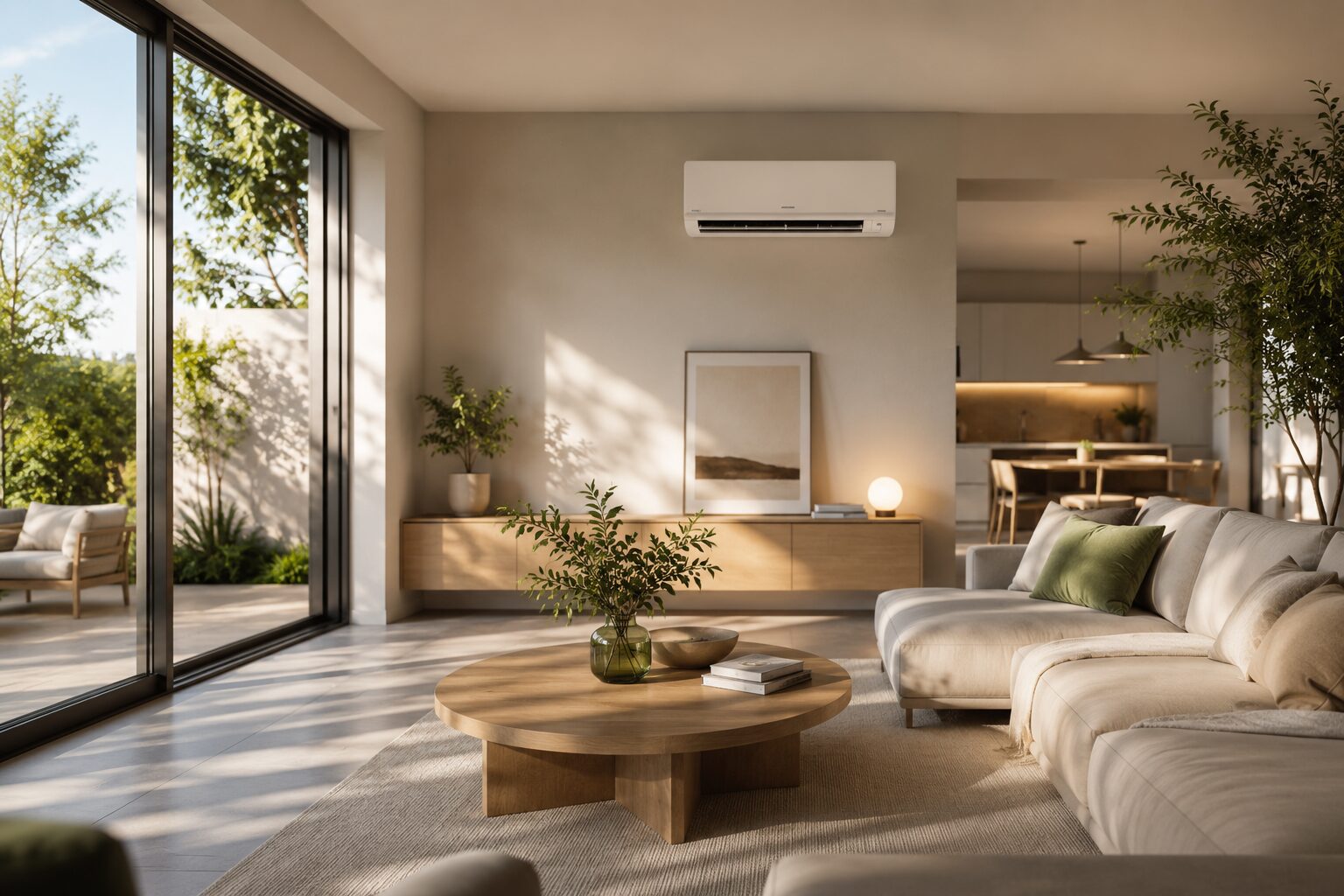
Single-split
Suitable for an attic bedroom, a living room or a small apartment. It is the simplest solution to install and maintain when only one zone needs cooling.
Multi-split
Suitable for several bedrooms or independently controlled zones. One outdoor unit supplies several indoor units, reducing the number of units visible on the exterior.
Ducted
Suitable for a new build, a major renovation or a property with a false ceiling. The indoor equipment remains discreet, but the air ducts and associated work must be planned from the outset.
A multi-split system is not automatically better than several single-split systems. Separate systems can provide greater flexibility, while a multi-split reduces the number of outdoor units. The right choice depends on the building, noise constraints, appearance and ease of maintenance.
How do you choose the right air conditioning capacity?
Floor area alone is not enough. Two 25 m² rooms can have very different requirements depending on the floor, orientation, glazed area, insulation, ceiling height and number of occupants.
| Situation | Initial estimate | What to check |
|---|---|---|
| Newer, well-insulated property with limited glazing | Approximately 60 to 80 W/m² | Avoid oversizing |
| Average insulation | Approximately 80 to 100 W/m² | Check the orientation and floor level |
| Attic room, large windows or strong south-west exposure | Approximately 100 to 130 W/m² | Calculate each room separately |
These ratios provide an initial estimate. Final sizing must take the actual characteristics of each room into account.
An oversized unit does not necessarily provide more comfort. It may run in short cycles, create draughts, dehumidify less effectively and become noisier. Conversely, an undersized unit may run for long periods without reaching the desired temperature.
How much electricity does reversible air conditioning use?
The stated cooling capacity is not the same as the electrical power consumed. A unit capable of delivering 3.5 kW of cooling may, depending on conditions, draw well under one kilowatt of electricity once it has settled into operation. Inverter models adjust their output instead of constantly running at full load.
How can you estimate annual electricity use?
Estimated annual electricity use = average electrical input × equivalent operating hours.
| Usage pattern | Calculation | Electricity use |
|---|---|---|
| Occasional use in a bedroom | 0.6 kW × 300 h | 180 kWh |
| Regular use in a living room | 0.9 kW × 500 h | 450 kWh |
| Several heavily used zones | 1.5 kW × 700 h | 1,050 kWh |
The running cost then depends on your electricity tariff. For annual consumption of 450 kWh:
- 450 kWh at €0.25/kWh = €112.50;
- 450 kWh at €0.30/kWh = €135;
- 450 kWh at €0.35/kWh = €157.50.
Actual consumption depends on the set temperature, insulation, solar shading and everyday habits. A setting around 25°C, blinds closed before the hottest part of the day and windows kept shut while the system is running can significantly reduce demand.
Can air conditioning be powered by solar panels?
Yes. Cooling demand often occurs when photovoltaic panels are producing the most electricity. When the air conditioning runs during the day, part of its consumption can be covered directly by electricity generated on site.
This does not make air conditioning free. Solar output varies with the weather and the home’s other electricity use. It is often more efficient to cool the property gently during production hours and then maintain a stable temperature.
This coordination also depends on the electrical capacity available. Our article on reference power in Luxembourg explains how solar panels, an EV charger, a heat pump and other electrical equipment can operate together.
Grants, VAT and regulations in Luxembourg in 2026
Is a standard air conditioning system eligible for Klimabonus?
Reversible air conditioning is an air-to-air heat pump, but it does not work in the same way as an air-to-water heat pump connected to a central heating system. Our comparison of air-to-air and air-to-water heat pumps in Luxembourg explains this difference in detail. Klimabonus 2026 specifically covers systems such as geothermal and air-to-water heat pumps. A split air-to-air system is therefore not automatically eligible.
Conditions can change. Check Guichet.lu and contact your municipality before including any grant in your budget.
Does the 3% VAT rate apply?
No, not under the general reduced-VAT scheme for housing. Guichet.lu lists air conditioning among the works that do not qualify for the 3% rate. The budget should therefore generally include Luxembourg’s standard VAT rate.
Is permission required?
The answer depends on the location and the building:
- in a co-owned building, installing an outdoor unit on a façade, roof or common area must be approved in accordance with the building’s rules;
- municipal permission may be required depending on the municipality, visibility from public areas or whether the property is in a protected zone;
- the location must take neighbouring properties into account and limit noise disturbance;
- work on the refrigerant circuit must be carried out by appropriately certified individuals and companies.
Installation, maintenance, repair and recovery of fluorinated gases must comply with the certification rules set out by the Environment Administration.
6 mistakes to avoid before installing air conditioning
1
Choosing only the cheapest quotation without checking the equipment, work and finishing included.
2
Sizing the system from floor area alone without considering glazing, orientation, insulation and floor level.
3
Positioning the indoor unit directly opposite the bed or sofa and being exposed to the airflow.
4
Choosing the outdoor location too late, resulting in longer pipe runs, poorer integration or more noise.
5
Overlooking condensate drainage, even though it affects reliability, noise and maintenance.
6
Forgetting the electrical supply and having to add a circuit or protection device during the installation.
How Ecoclima prepares your installation
Step 1Identify the rooms that need treatment
We identify where heat builds up, when it occurs and the level of comfort you are looking for.
Step 2Assess the property
We check the orientation, glazing, insulation, floor level, pipe routes and water drainage.
Step 3Select the right configuration
Single-split, multi-split, false-ceiling and ducted options are compared against the property’s constraints.
Step 4Prepare a detailed quotation
The equipment, installation, electrical work, access requirements, finishing and options are clearly identified.
A solution designed for your home
We assess the rooms that overheat, technical routes, noise, electrical supply and the home’s other equipment. You receive a clear proposal sized for your needs and designed to remain accessible for maintenance.
Request an assessment for my homeFrequently asked questions about air conditioning in Luxembourg
How much does air conditioning cost for a house in Luxembourg?
For a house with three to four zones, the budget often ranges from €6,800 to €12,000. A ducted installation or a whole-house system with many rooms can exceed €15,000 to €20,000. The price depends more on the technical configuration than on the total floor area.
How much does it cost to air-condition one bedroom?
A quality single-split installation generally costs between €2,500 and €4,200, including installation. A bedroom with easy access, close to an external wall and with gravity drainage will usually be towards the lower end of the range.
What is the difference between single-split and multi-split?
A single-split connects one outdoor unit to one indoor unit. A multi-split connects one outdoor unit to several independently controlled indoor units. A multi-split reduces the number of outdoor units but makes the design and pipework more complex.
Can reversible air conditioning heat a home in winter?
Yes. Reversible air conditioning is an air-to-air heat pump: it reverses its cycle to produce heat. It can be useful in the shoulder seasons or as supplementary heating. Its suitability as the main heating system should still be assessed according to insulation, climate, room layout and available capacity.
Does air conditioning use a lot of electricity?
Consumption mainly depends on the temperature setting, insulation and operating time. To estimate it, multiply the average electrical input by the number of operating hours. A correctly sized system used between 24°C and 26°C in a well-shaded home consumes considerably less than an undersized unit running continuously.
Are grants available for air conditioning in Luxembourg?
Not automatically. Klimabonus 2026 specifically covers systems such as geothermal and air-to-water heat pumps. For air-to-air conditioning, check the conditions on Guichet.lu and with your municipality before including a grant in your budget.
Does the 3% VAT rate apply to air conditioning?
No, not under the general reduced-VAT scheme for housing. Guichet.lu lists air conditioning among the works that do not qualify for the 3% rate. You should therefore generally allow for Luxembourg’s standard VAT rate.
How long does installation take?
A straightforward single-split can generally be installed in one day. A multi-split often takes two days or more depending on the number of rooms, distances, finishing work, access and electrical requirements. The duration should be confirmed after the technical visit.
Is reversible air conditioning a heat pump?
Yes. Reversible air conditioning is an air-to-air heat pump: it transfers heat between indoors and outdoors to cool or warm the air. It does not, however, heat the water in a radiator circuit like an air-to-water heat pump.
Where should the outdoor air conditioning unit be installed?
The outdoor unit should be well ventilated, accessible for maintenance and sufficiently far from noise-sensitive areas. Its position should take neighbouring properties, appearance, vibration and pipe routes into account.
What maintenance does an air conditioning system require?
Filters should be cleaned regularly according to use and the surrounding environment. A professional inspection can also check condensate drainage, heat exchanger cleanliness, performance, leak tightness and the overall condition of the installation. The exact frequency depends on the system and how it is used.
Official sources consulted
- MeteoLux: June 2026, the hottest June recorded at Findel
- Guichet.lu: technical systems and Klimabonus 2026
- Guichet.lu: housing VAT and ineligible work
- Environment Administration: certification relating to fluorinated gases
- Ecoclima: projects and customer feedback in Luxembourg
- Ecoclima: team, expertise and local presence