
Reference power in Luxembourg: what impact do an EV charger, a heat pump and solar panels have?
Ecoclima Luxembourg Guide · Updated in July 2026
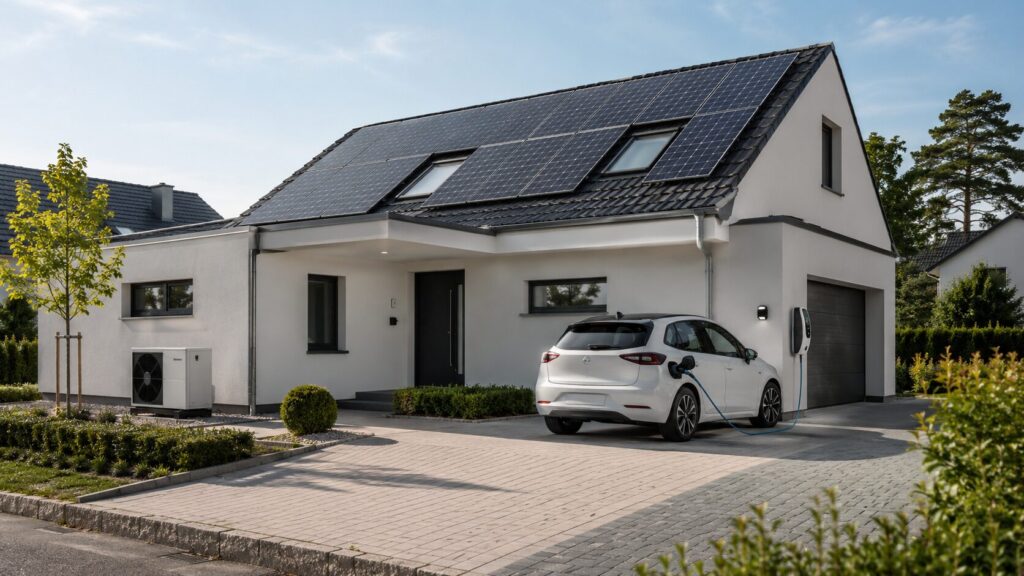
An 11 kW EV charger, a heat pump and solar panels can work perfectly well in the same home. The real issue is how much power the property actually draws from the grid at the same time.
Since 1 January 2025, Luxembourg’s low-voltage electricity network tariff has taken greater account of this power. This guide explains how reference power works, what can genuinely cause it to change, and how to coordinate an EV charger, heat pump, photovoltaic system, battery and electrical installation.
The answer in 30 seconds
- Reference power is a tariff category, not the technical limit of your electricity meter.
- It is recalculated each month using your quarter-hourly grid withdrawals over the previous 12 months.
- An 11 kW EV charger therefore does not automatically place you in the 12 or 17 kW category.
- Photovoltaics reduce peaks only when the system is generating electricity at the same time as the appliances are consuming it.
- The most effective solution is often smart control: modulating the EV charger, scheduling loads, energy management and, for some projects, a battery.
Contents
- What is reference power?
- What are the network tariffs in 2026?
- How is reference power calculated?
- What impact can an 11 kW EV charger have?
- What impact can a heat pump have?
- Solar panels and batteries: what can they really reduce?
- Practical example: a home with an EV charger and heat pump
- How can you limit peaks without reducing comfort?
- Checklist before adding new equipment
- Frequently asked questions
What is reference power in Luxembourg?
Reference power is the grid withdrawal level assigned to your supply point for the purpose of calculating part of the electricity network usage charges. It affects three separate components:
1. Fixed charge
A monthly amount based on your reference power category.
2. Volumetric charge
It applies to every kilowatt-hour drawn from the grid.
3. Exceedance charge
It applies only to the volume drawn above the reference power level.
Do not confuse the two: a reference power of 3 kW does not mean that your electricity will be cut off as soon as your home exceeds 3 kW. The circuit breaker and connection capacity determine the technical limit. Reference power is used to calculate the network tariff.
What are the reference power tariffs in 2026?
The Luxembourg Institute of Regulation’s 2026 report lists several reference power categories. For a home, the most common levels are generally between 3 and 27 kW.
| Reference power | 2026 fixed charge | Volumetric charge | Exceedance charge |
|---|---|---|---|
| 3 kW | €7.42/month | €0.0510/kWh | €0.0765 per exceeded kWh |
| 7 kW | €12.84/month | €0.0510/kWh | €0.0765 per exceeded kWh |
| 12 kW | €19.61/month | €0.0510/kWh | €0.0765 per exceeded kWh |
| 17 kW | €26.39/month | €0.0510/kWh | €0.0765 per exceeded kWh |
| 27 kW | €39.94/month | €0.0510/kWh | €0.0765 per exceeded kWh |
These are the values published for 2026. They should be checked when the article is updated for 2027.
How is reference power calculated?
The network operator does not simply add together the rated power of all your appliances. It analyses your quarter-hourly load curve and compares the different tariff categories to identify the one that minimises the cost based on your consumption history.
- Grid withdrawals are measured in 15-minute intervals.
- The calculation uses up to 12 months of historical data to account for seasonal variations.
- Each reference power category is tested using its fixed charge and exceedances.
- The most financially advantageous category is selected.
- The calculation is repeated every month, and any new value applies from the following month.
Important point: exceeding the threshold is not a fine. It may cost less to remain in a lower category and pay for occasional exceedances than to pay the higher fixed charge of the next category throughout the year. This is precisely the trade-off assessed by the monthly calculation.
What about a new connection?
Where there is not enough historical data, a standard value is initially assigned according to the connection current. The ILR’s 2026 report gives the following examples: 40 A = 3 kW, 50 A = 7 kW, 80 A = 12 kW and 120 A = 27 kW. The monthly calculation then gradually takes over.
Should you request a different category yourself?
A voluntary change is possible, in principle once per calendar year, except after a lasting change to the installation such as adding an EV charger, a heat pump, photovoltaic generation or storage. However, an explicit change may suspend automatic reassessment until the next tariff period. Unless there is a clear technical reason, it is therefore generally safer to allow the automatic calculation to identify the optimum category.
Does an 11 kW EV charger automatically increase reference power?
No. An EV charger capable of charging at 11 kW does not necessarily operate at full power every night, and its maximum output does not automatically become your reference power. What matters is the home’s actual grid withdrawal, measured in 15-minute intervals, and the resulting cost under each category.
An 11 kW EV charger can nevertheless create a significant peak if it charges at full power while the heat pump, oven, water heater or other appliances are already running.
Do you really need 11 kW at home?
Not always. Charging at 5.5 kW for eight hours theoretically transfers 44 kWh before accounting for losses and vehicle limits. For many daily journeys, that is already more than enough energy. Klima-Agence also recommends reducing charging power when the vehicle remains parked for a long time, to avoid unnecessary peaks.
| Charging power | Theoretical energy in 8 hours | Suitable use |
|---|---|---|
| 3.7 kW | 29.6 kWh | Low daily mileage or long parking duration |
| 5.5 kW | 44 kWh | A common compromise for limiting peaks at home |
| 11 kW | 88 kWh | Faster charging when it is genuinely required |
On the Creos network:
- an application is required for an EV charger rated at 7 kW or more on a three-phase connection, or above 4.6 kW on a single-phase connection;
- the installation must be completed and documented by an electrician in accordance with the applicable procedure;
- the rules may differ if your supply point is connected to another network operator.
What impact can a heat pump have?
A heat pump’s electrical consumption is not constant. It varies according to the outdoor temperature, required water temperature, system sizing, building insulation and controls. Some systems also include an electric backup heater that can temporarily increase the power drawn.
The risk of a peak mainly arises when the heat pump is working hard while an EV charger is charging at full power and several household appliances are in use. The correct response is not necessarily to oversize the grid connection: actual simultaneous demand and control options should be assessed first.
Points to check during the assessment: the heat pump’s actual electrical input, the presence of an electric backup heater, domestic hot-water operation, the heating curve and the vehicle charging windows. The thermal output stated in a brochure is not enough to assess the home’s electrical peak.
Can solar panels reduce reference power?
Photovoltaics can reduce the amount of electricity drawn from the grid and therefore limit a peak, but only when solar generation is available at the same time as consumption.
- During a sunny day: solar production can supply part of the EV charger, heat pump or household appliances.
- In the evening and at night: the panels do not reduce the amount drawn from the grid.
- In variable weather: solar output can change quickly, so a controlled EV charger must be able to adjust its charging power.
- When there is surplus generation: charging the vehicle or heating water at the right time may be more useful than exporting all the electricity.
Can a battery shave consumption peaks?
Yes, provided that the system is designed and configured for this purpose. The battery must offer sufficient discharge power, have enough energy available at the right time, and use an inverter or management system capable of responding to high power demand.
A large capacity in kWh therefore does not, on its own, guarantee a substantial reduction in peaks. To explore this point in more detail, read our guide to the difference between the power and capacity of a solar battery.
Practical example: EV charging, heat pump and cooking at the same time
Consider a home equipped with an 11 kW EV charger and a heat pump. The values below are deliberately simplified to illustrate the effect of simultaneous use; they are not a substitute for actual measurements.
| Equipment | Uncontrolled scenario | Controlled scenario |
|---|---|---|
| EV charger | 11.0 kW | 5.5 kW |
| Heat pump | 3.0 kW | 3.0 kW |
| Oven and hob | 2.5 kW | Postponed or charger slowed down |
| Background consumption | 0.8 kW | 0.8 kW |
| Simultaneous total | 17.3 kW | 9.3 kW |
With a reference power of 12 kW, an average withdrawal of 17.3 kW over a 15-minute period represents an exceeded volume of:
(17.3 kW − 12 kW) ÷ 4 = 1.325 kWh exceeded
At the 2026 rate of €0.0765 per exceeded kWh, this represents approximately €0.10 in additional network charges for that 15-minute period.
Taken in isolation, this amount is small. If repeated several times a day for months, however, a higher category may become more advantageous. Conversely, a few rare peaks do not necessarily justify paying a higher fixed charge throughout the year. This is why the full load curve must be assessed, rather than a single moment.
What the ILR examples also show: in its 2026 standard profiles, a four-person household with a heat pump and electric vehicle is associated with an optimal 12 kW category, while another profile with an optimised electric vehicle is associated with 7 kW. These profiles do not have the same annual consumption and therefore cannot be compared directly, but they clearly illustrate the importance of how the equipment is used.
How can you limit peaks without losing comfort?
1. Modulate the EV charger automatically
An EV charger with dynamic load management can reduce its power when the home is consuming more, then increase it again when other loads fall. This is generally more reliable than a fixed schedule.
2. Charge according to the actual need
You do not need to recharge a completely empty battery every night. The distance travelled, departure time and remaining range should determine the useful charging power.
3. Use solar generation at the right time
When the vehicle is at home during the day, charging from photovoltaic surplus can reduce both exports and grid withdrawals. The control system must, however, follow actual production rather than a theoretical forecast.
4. Coordinate the heat pump and hot water
Properly configured controls can prevent the electric backup heater, hot-water cylinder and vehicle charging from all operating at full power at the same time. Thermal comfort remains the priority: the aim is not to switch off the heating arbitrarily.
5. Add a home energy management system
A HEMS can coordinate solar panels, a battery, EV charger, heat pump and other appliances. Its value nevertheless depends on genuine compatibility between the equipment and the quality of the configuration.
6. Check the electrical panel and grid connection
Smart control is not a substitute for a suitable electrical installation. Cable sizes, protective devices, phase balancing, the electrical panel, the connection and future equipment must be checked before installing an EV charger or heat pump. You can also discover our electrical services in Luxembourg.
Checklist before adding an EV charger or heat pump
- Check the reference power currently assigned to the property.
- Analyse the quarter-hourly consumption curves in Leneda or the network operator’s portal.
- Check the capacity and type of electrical connection.
- Identify the main appliances that may operate simultaneously.
- Check the maximum electrical input of the heat pump and its backup heater.
- Define the charging power actually required on a daily basis.
- Check whether the EV charger supports dynamic load management and photovoltaic integration.
- Check the charging and discharging power of any planned battery.
- Plan for future uses: a second vehicle, air conditioning, an extension, sauna or swimming pool.
- Have the electrical panel, protective devices and required procedures validated by a qualified professional.
Where can you find your reference power?
Your reference power appears in your network billing information. The official Leneda platform also allows you to access your energy data. Since late 2025, its notification centre has informed users whenever their reference power changes.
To interpret the data correctly, review grid withdrawals over several weeks and under different conditions: winter weather, periods of frequent charging, heating operation and days with high solar generation.
Frequently asked questions about reference power
Does a reference power of 3 kW limit my home to 3 kW?
No. It is a tariff level. The technical limit depends on the connection and electrical protective devices. Exceeding the reference level results in an additional charge, not an automatic cut-off caused by that threshold alone.
Does an 11 kW EV charger require a reference power of 12 kW or more?
No. The network operator compares the cost of each category using your actual load curve. A charger that is frequently modulated or used when other appliances have low demand may have a limited impact.
Does electricity cost more in the evening because of reference power?
Not under the network tariff structure described here: simultaneous power demand matters, not the time of day. A dynamic energy contract may, however, change the energy price from one hour to another. The two mechanisms should not be confused.
Do solar panels always reduce consumption peaks?
No. They reduce grid withdrawals only while generating electricity during consumption. Night-time charging is not offset by daytime solar production unless energy is stored or the load is shifted.
Is a battery enough to prevent every exceedance?
Not necessarily. It must have enough available energy, sufficient discharge power and a control system capable of shaving grid demand. An empty battery or one with limited output cannot compensate for a major load.
Can a heat pump and EV charger operate at the same time?
Yes, provided the connection, electrical panel and protective devices allow it. Dynamic load management can automatically reduce the charger’s power when the heat pump or other appliances place greater demand on the installation.
Should I manually request a lower reference power?
Not without running a simulation. A lower category reduces the fixed charge but increases the volume billed as exceedance. In addition, a voluntary change may temporarily interrupt automatic recalculation. Both effects should be compared before taking action.
Before adding new equipment, consider the home as one complete system
At Ecoclima, the assessment is not limited to selecting an EV charger, a heat pump or a number of solar panels. We review the electrical panel, grid connection, simultaneous loads, solar production, potential storage and future needs in order to design a coherent, controllable and scalable installation.
Related guides
- Installing a smart EV charger in Luxembourg
- Air-to-water heat pump: assessment and installation in Luxembourg
- Solar panel installation in Luxembourg
- Controllable home in Luxembourg: use electricity at the right time
Official sources
- Luxembourg Institute of Regulation: 2026 report on electricity transmission and distribution network tariffs
- ILR: composition of network usage tariffs
- MyILR: the new network usage tariff
- Creos: low-voltage electricity network tariff structure
- Creos: procedure for installing an EV charger
- Klima-Agence: electricity prices and advice on reducing peaks
- Klima-Agence: EV charger and energy management system comparison tool
- Leneda: Luxembourg’s official energy data platform
Informational article updated in July 2026. Tariffs, procedures and technical rules may change. Always check the applicable conditions with your network operator and the official authorities before modifying your installation.