
Dual-junction photovoltaic cells: the future of solar in Luxembourg?
Dual-junction photovoltaic cells (often called tandem cells) are among the most credible innovations for reaching a new level of solar efficiency. The idea is simple: instead of a single active “layer” like in a standard silicon panel, two are stacked, each optimized for a different part of the light spectrum. The expected result is more electricity produced from the same roof area, which is particularly relevant in Luxembourg, where available roof space can quickly become the limiting factor.
This point matters: dual-junction photovoltaic cells are not yet widely available for homes at scale, with pricing, warranties, and long term field experience comparable to today’s monocrystalline modules. But on a realistic 5 to 10-year horizon, this technology could become a new benchmark, just like TOPCon and heterojunction have already reshaped the market in recent years.
Why silicon is approaching its efficiency limits
The vast majority of panels installed on homes in Luxembourg are based on monocrystalline silicon. It’s a solid, reliable, industrialized technology, with long warranties and generally very convincing economics in self-consumption. But from a physics standpoint, silicon in a “single-junction” cell has a limit: even by improving manufacturing, contacts, passivation, or cell architecture, you can’t push efficiency indefinitely beyond a certain ceiling.
In practice, the market has already optimized a huge number of parameters: lower internal losses, better charge collection, better surface texturing, higher performing modules. Gains become slower. Progress is still possible, but big “jumps” in efficiency often require a change in concept, not just incremental refinement.
The Shockley–Queisser limit, explained simply
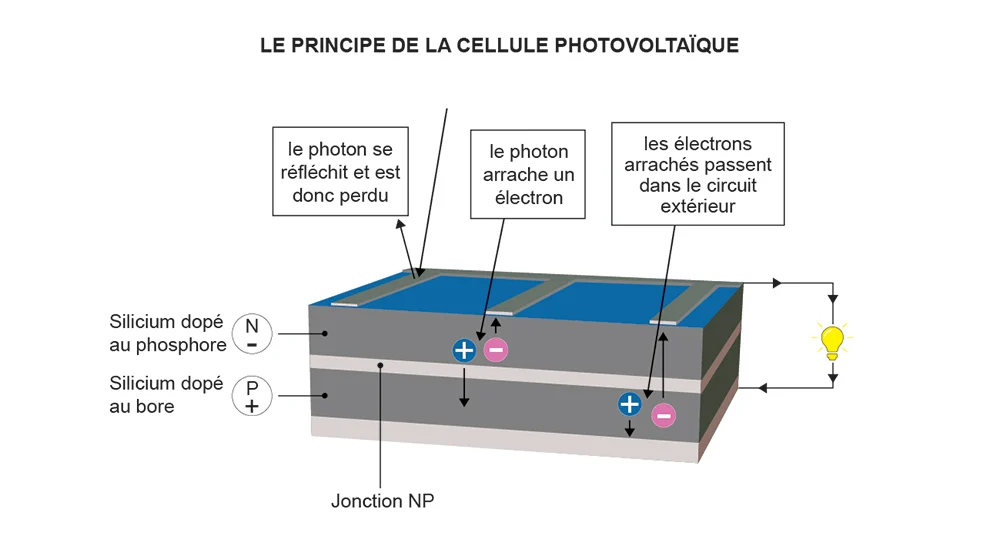
The well-known Shockley–Queisser limit is a physics result describing the maximum theoretical efficiency of a single-junction solar cell (one band gap, one semiconductor). This limit mainly comes from two families of losses that are easy to understand:
- Photons that are too weak: part of sunlight doesn’t have enough energy to be absorbed by the material. Those photons pass through the cell without generating electricity.
- Photons that are too energetic: when a photon has “too much” energy, the excess isn’t converted into electricity. It’s lost as heat (thermalization).
Silicon is excellent, but it can’t “choose” photon energies perfectly: it has a single band gap, so it inevitably suffers these losses. Put simply: a single-junction cell cannot efficiently convert the entire solar spectrum. That’s exactly where dual-junction photovoltaic cells become interesting: they split the job in two.
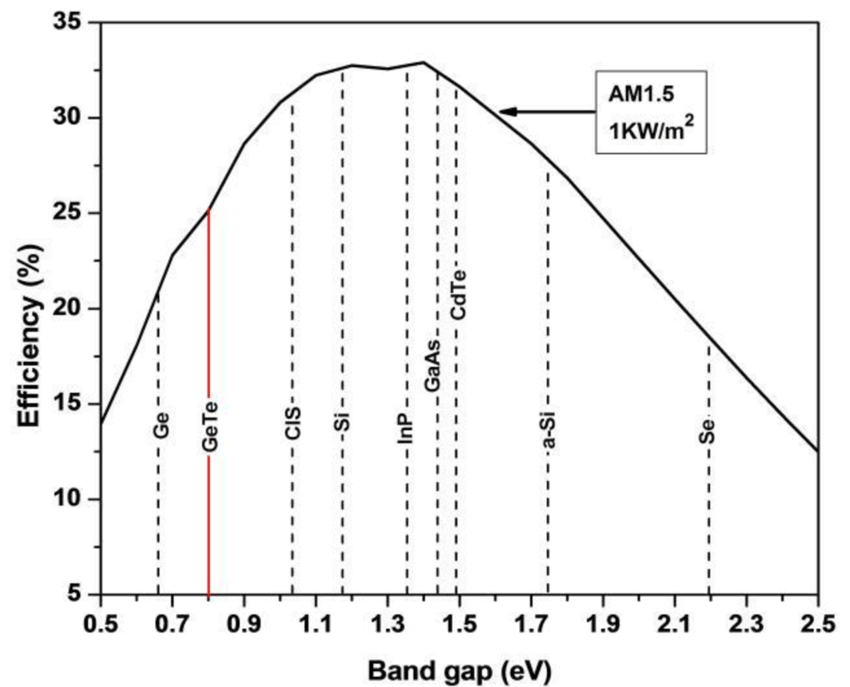
This diagram shows the Shockley–Queisser limit, which defines the maximum theoretical efficiency of a single-junction solar cell as a function of its band gap.
The optimal efficiency is reached around 1.3 to 1.4 eV (close to silicon), with a maximum of about 33%, beyond which physical losses become unavoidable.
What is a dual-junction (tandem) photovoltaic cell?
A dual-junction photovoltaic cell stacks two active layers, each designed to capture a different part of the light spectrum. The most commonly cited combination today is:
- A top layer with a higher band gap (often perovskite), which absorbs more of the blue and part of the visible spectrum.
- A bottom layer made of silicon, highly effective in the red and near-infrared.
Instead of letting “too weak” photons pass through or losing a large share of “too strong” photons as heat, energy is distributed across two complementary materials. It’s an elegant way to move beyond the limits of a single junction, without relying on ultra-expensive technologies reserved for aerospace applications.
Dual junction vs multi-junction: what’s the difference?
People sometimes refer to “multi-junction” cells with 3, 4, or even more junctions. They reach record laboratory efficiencies, often under concentrated light. The issue is that these architectures frequently use very expensive materials (III-V), which are difficult to industrialize at low cost for residential rooftops.
Dual-junction is a very sensible compromise: enough complexity to deliver a real step change in efficiency, while remaining an industrially realistic goal if stability and manufacturing are mastered.
Why this technology could be a “new frontier” for photovoltaics
If the promises hold, dual-junction photovoltaic cells could bring several concrete benefits, especially for a home:
- More power on a limited roof: for the same surface area, a more efficient module allows more kWp to be installed, and therefore more energy produced each year.
- Better performance in real conditions: the goal is to improve conversion across a wider range of light, which helps in climates where irradiance is variable (clouds, haze, winter).
- A direct lever for self-consumption: more kWh produced on-site means more opportunities to cover a heat pump, an EV charger, or simply reduce the electricity bill.
In Luxembourg, the “surface” argument is often the most compelling: a roof isn’t expandable. When a household wants to add an electric car, a heat pump, or a battery, the question comes up quickly: “Do I have enough panels?” High-efficiency technologies address that problem directly.
Why it’s not commercially viable for residential yet
There’s a reason why dual-junction photovoltaic cells remain mostly an R&D and pilot-line topic: moving from the lab to a homeowner’s roof is a huge leap. To become truly “commercially viable,” several boxes must be ticked at the same time:
- Long term stability: perovskite must withstand moisture, UV, hot-cold cycles, and material fatigue over time.
- Encapsulation and repeatable manufacturing: across thousands, then millions of modules, with consistent quality.
- Standards, certification, bankability: so insurers, lenders, and the market accept warranties, degradation curves, and real-world performance.
- Materials management: some perovskite formulations contain lead. The question isn’t only “is it dangerous,” but “how do we secure use and recycling at scale.”
The most credible scenario isn’t a sudden replacement, but gradual adoption: first in pilot projects, then in a few premium offers, then broad rollout once warranties and costs become comparable to today’s silicon.
What it would change concretely for a home in Luxembourg
You can summarize the value of dual-junction photovoltaic cells in one sentence: more electricity produced per square meter. But in a home, the impact is very practical:
1) Maximize a constrained roof
Between skylights, chimneys, dormers, shaded areas, and sometimes multiple orientations, a “perfect” roof is rare. When space is limited, a more efficient module lets you either:
- reach a target capacity with fewer panels,
- or increase installed capacity on a given surface.
In both cases, you gain annual production, and therefore autonomy.
2) Better cover rising electric uses
In Luxembourg, electrification is accelerating: heat pumps, electric cars, heat pump water heaters, reversible air conditioning. Producing more from the same roof makes it easier to cover a significant share of these uses through self-consumption.
3) Reduce dependence on electricity prices
A solar installation, even with today’s panels, is already a way to “lock in” part of your energy cost over 20 to 30 years. If tandem cells become accessible, the idea is to amplify that effect: more kWh produced locally means fewer kWh purchased from the grid.
Luxembourg framework: VAT, incentives, the grid, and what will still matter tomorrow
Even if the technology changes, a few Luxembourg fundamentals will remain structural for profitability: taxation, incentives, and grid connection. For a residential project, these are elements to factor in right now, because they often determine net cost and payback speed.
If you want to verify an official point on taxation, Guichet.lu details the application of the super-reduced VAT rate to certain works and equipment, including solar panels (conditions depend on the dwelling).
| Item | What it means for a home in Luxembourg | Impact on the decision |
|---|---|---|
| Super-reduced VAT (3%) | The supply and installation of solar panels on a private home may qualify for the super-reduced rate, under certain conditions. | Reduces the total cost. This lever will remain relevant even as modules evolve (silicon today, tandem tomorrow). |
| Klimabonus (PV incentives) | Incentives vary depending on the scheme, system size, self-consumption choices, and the application file. There are caps and conditions. | Accelerates payback. The higher the self-consumed production, the stronger the economic case. |
| Smart meter | Consumption and production tracking becomes more precise, useful for optimizing self-consumption (water heater control, EV charger, etc.). | Helps maximize the value of each kWh, whatever the panel technology. |
| Grid connection and export | Surplus can be exported under the applicable rules and contracts. Administrative steps and compliance remain essential. | To consider from the design stage, especially if you target higher capacity on a large roof. |
Key point: even if tandem panels become the norm one day, a residential customer will still face the same core questions: self-consumption, installed capacity, surplus management, sizing, control (EV charger, heat pump, battery). The technology changes, but the logic of a well-designed solar project remains the same.
Average cost and pricing drivers: today vs tomorrow
In 2025, a residential PV system in Luxembourg depends mainly on:
- system size (kWp) and roof type,
- inverter choice (string, microinverters),
- complexity (scaffolding, access, multiple orientations, shading),
- options (advanced monitoring, control, battery, backup).
Tomorrow, if dual-junction photovoltaic cells reach the market, two parameters will become decisive:
- The module price per Wp: at first, it could be higher than a premium silicon module, then decline with industrial scale-up.
- Real rooftop performance: the kWh-per-square-meter gain must be stable, measurable, and confirmed over several years.
In other words: tandem will be adopted at scale when it delivers a clear production (or surface) advantage without sacrificing reliability and warranty, and when any extra cost is reasonable compared with the benefit.
Profitability: concrete scenarios for a home (Luxembourg)
To talk about profitability without making things up, you have to be transparent: since tandem cells are not yet a standard residential product, we think in scenarios. The goal here is to understand the order of magnitude: what can an efficiency gain change in real life for a household in Luxembourg?
Simple assumptions (to adjust to your situation):
- Average production: 1,000 kWh per kWp per year (a common order of magnitude depending on orientation and shading).
- Avoided electricity price: €0.25 / kWh (varies by contract and context).
- Self-consumption share: 40% without control, 55% with control (water heater, EV charger, heat pump), and up to 70% with a battery depending on the profile.
| Scenario | Usable roof area | Possible capacity | Estimated annual production | Self-consumption value (40%) | Notes |
|---|---|---|---|---|---|
| Premium silicon panels (2025) | 30 m² | ~6 kWp | ~6,000 kWh/year | ~6000 x 40% x €0.25 = €600 / year | Already strong economics with incentives and VAT, especially if control increases self-consumption. |
| Dual-junction tandem (projection) | 30 m² | ~8 to 9 kWp | ~8,000 to 9,000 kWh/year | ~8500 x 40% x €0.25 = €850 / year | The gain mainly comes from higher installable kWp on the same surface. The value increases as the home electrifies (heat pump, EV). |
| Tandem + control (projection) | 30 m² | ~8 to 9 kWp | ~8,000 to 9,000 kWh/year | ~8500 x 55% x €0.25 = €1,169 / year | Control is often the real ROI accelerator: it maximizes the value of each kWh produced, whatever the module. |
This table highlights a simple reality: higher efficiency isn’t just a “technical detail”. On a limited roof, moving to a technology that enables more installed kWp directly increases annual production, autonomy, and bill savings.
At Ecoclima, we often see the same logic: a well-sized, well-controlled system already makes a real difference on the bill. If you want a clear baseline, you can request an estimate tailored to your roof and consumption via our solar quote page.
Conclusion: yes, tandem may be the future, but solar is already a solid decision in 2025
Dual-junction photovoltaic cells are a very serious path to move beyond silicon’s limits and reach a new step in efficiency. If stability, warranties, and costs follow, this technology has a strong chance of becoming a reference over the next decade, especially for roofs where every square meter matters.
At the same time, in Luxembourg, residential photovoltaics are already a mature and generally profitable solution when the project is well designed: coherent sizing, suitable equipment, and a self-consumption strategy. At Ecoclima, we track technology evolution while staying focused on one thing: installing reliable, clean, and optimized systems for your home, with a transparent and local approach.
Request your solar quote in Luxembourg: go directly to our solar quote page.
Description for this block. Use this space for describing your block. Any text will do. Description for this block. You can use this space for describing your block.
FAQ: dual-junction photovoltaic cells
Yes, in laboratories and on pilot production lines. Very high efficiencies are being achieved in R&D. But it’s not yet a widely commercialized residential solution with the same level of availability, pricing, and warranties as silicon.
Because perovskite has very interesting optoelectronic properties, and it can be deposited as a thin film. Combined with silicon in a tandem cell, it helps make better use of the solar spectrum.
The Shockley-Queisser limit describes the theoretical ceiling of a single-junction cell. Tandem cells, by stacking two complementary junctions, aim to move beyond that ceiling by reducing losses from “photons that are too weak” and “photons that are too energetic”.
Not automatically. They’ll be more profitable if the production gain offsets any potential extra cost and if reliability is up to standard. On a limited roof, the increase in installable capacity can be decisive, especially if the household uses a lot of electricity during the day (EV charger, heat pump, etc.).