
Photovoltaics and Heat Pumps in Luxembourg: How to Properly Size Them for Your Solar System?
Combining a heat pump with solar panels is an excellent strategy in Luxembourg, as long as you understand one simple reality: photovoltaic production and a heat pump’s consumption are not perfectly aligned over the year. That is exactly why system sizing and smart control matter just as much as installed capacity.
In this article, we answer the questions we hear most often on site: should you install a larger solar system if you have (or plan to have) a heat pump, when photovoltaics truly support a heat pump’s demand (shoulder season heating, domestic hot water, even cooling), and why the myth “my heat pump will run on free electricity thanks to solar” is an incomplete way of thinking in Luxembourg.
This guide is designed for the local context: climate, Creos procedures, Klimabonus incentives and surplus compensation. At Ecoclima, we install photovoltaics and heat pump systems in Luxembourg with a co sizing approach, aiming for high self consumption and consistent profitability.
Understanding co sizing: why this duo works well
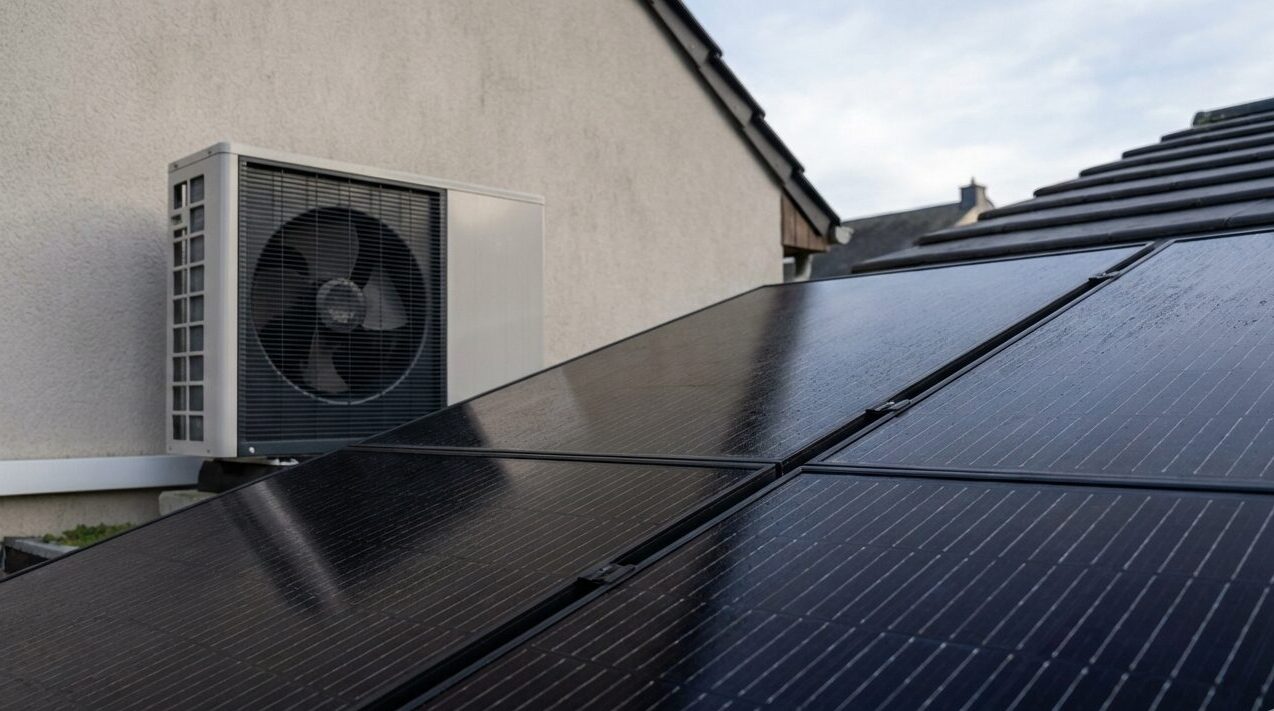
A heat pump turns electricity into heat with much higher efficiency than direct electric heating. That is why it has become a very common solution in energy renovations and new builds. Photovoltaics, on the other hand, produce electricity mainly during the day, with peaks in late spring and summer.
When we talk about photovoltaics and heat pump systems in Luxembourg, the goal is not to “cover everything” all the time, but to maximize the share of solar electricity used directly by the heat pump and the household’s other loads.
The most solid benefits of the combo are usually:
- More self consumption: a heat pump is a significant load, so part of the PV production can be absorbed on site.
- A more stable electricity bill: you buy fewer kWh from the grid, especially during periods when solar production is strong.
- A strategy that stays consistent over time: even if tariffs change, producing and consuming on site remains the most robust lever.
Should you install a larger solar system if you have a heat pump
This is the question we hear most often, and the answer is nuanced: yes, a heat pump can justify a slightly larger PV system, but heavily oversizing is not automatically profitable.
The right way to think about it is:
- A heat pump increases your annual electricity consumption.
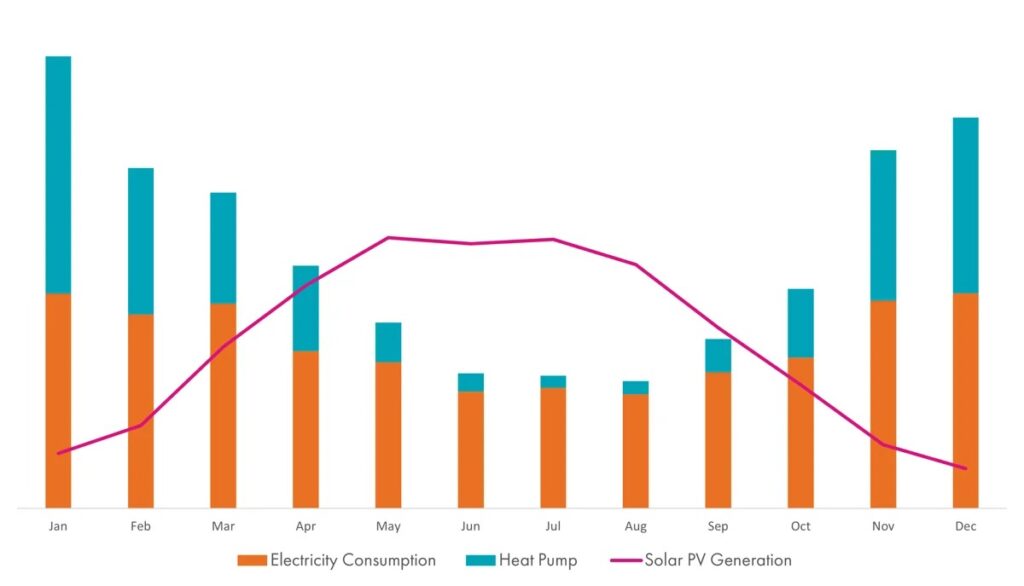
- But it mainly increases consumption in winter, when PV production is lower.
- PV produces mostly during the day and much more strongly in spring and summer.
So installing more kWp can help, but the objective is not to “compensate winter” with extra panels. In Luxembourg, if you install much more kWp than you can consume during the day, you will create more surplus in summer. That surplus is compensated via a feed in tariff, but that tariff is lower than the retail price of a kWh from the grid, which is why self consumption is often more attractive than overproduction.
Operational takeaway: yes, we often size a bit larger when a heat pump is planned, but we do it with a control and usage strategy, not with a “bigger is better” mindset.
The key criterion: controllable daytime consumption
The most important factor is not only the heat pump’s annual consumption, but the share of consumption you can shift to daytime:
- Heat domestic hot water between 10am and 4pm when the panels are producing.
- Raise the buffer tank temperature slightly during the day (if your system allows it).
- Schedule certain shoulder season heating cycles when PV production is strong.
The more you can control these loads, the more the combo photovoltaics and heat pump in Luxembourg performs without needing excessive installed power.
Where photovoltaics truly support a heat pump’s demand
We sometimes hear “with solar panels, the heat pump runs for free”. In reality, solar supports a heat pump at very specific times, mainly:
- In the shoulder seasons (spring and autumn), when it is still cool but the days are already sunny.
- All year round for domestic hot water, because hot water demand is more consistent than space heating.
- In summer if the heat pump also provides cooling, because PV production is high when cooling demand rises.
In a photovoltaics and heat pump project in Luxembourg, it is exactly this complementarity by end use that makes the difference.
Space heating: solar mainly helps in the shoulder seasons
In Luxembourg, space heating is the big winter load. Winter is also the period with the lowest solar production. Result: photovoltaics rarely cover most of space heating in the middle of winter, even with a large system.
However, in spring and autumn, the heat pump can run several hours during the day to maintain comfort. That is exactly where PV is useful: it can supply a significant share of heating cycles, especially if the home’s insulation is good.
Domestic hot water: the best “playground” for self consumption
Hot water demand exists all year. That means a hot water tank can act as a “thermal reservoir”: you heat the water more during the day when the panels are producing, then use that heat later.
In many homes, this is one of the most effective and simplest optimizations to improve the photovoltaics and heat pump in Luxembourg ratio without overspending.
Cooling: when the heat pump consumes right when solar produces
If your heat pump is reversible and also provides cooling, the production consumption match becomes even more favorable. Hot and sunny periods are also when PV produces the most. In this case, solar can cover a significant share of daytime cooling, which increases the value of the installation.
Please note: Cooling with air-to-water heat pumps is only possible with specific heat distribution systems such as underfloor cooling or fan coil units. It is not possible with traditional radiators.
Table: when photovoltaics cover a heat pump
| period | photovoltaic production | heat pump demand | what solar covers best | practical optimization lever |
|---|---|---|---|---|
| winter | low | very high (space heating) | a small share during the day, mainly on bright cold days | limit peaks, improve insulation, buffer tank if relevant |
| spring | medium to high | moderate (shoulder season) | daytime shoulder season heating, domestic hot water | schedule heating on solar hours |
| summer | very high | low (excluding DHW) or moderate if cooling | domestic hot water and daytime cooling | DHW control, run electric loads during the day |
| autumn | medium | moderate to high | early heating needs during the day, domestic hot water | restart the control strategy before winter |
A myth to debunk: “my heat pump uses free electricity thanks to solar”
This myth comes from a real but partial observation: in summer or on sunny shoulder season days, you see your PV production rise and your heat pump (or hot water tank) switch on. In those moments, yes, part of the electricity comes from solar.
The problem is that many people extrapolate that situation to the whole year. In Luxembourg, winter combines two effects:
- Days are shorter and often cloudier, so photovoltaics produce less.
- The heat pump consumes more, because it must compensate for the building’s heat losses.
Result: even with a well designed photovoltaics and heat pump system in Luxembourg, you will still buy electricity from the grid in winter. Solar reduces the annual bill, but it does not make the heat pump “free” all the time.
This is essential to understand to avoid two common mistakes:
- Oversizing PV thinking “I will cover winter”, when most of the extra production will be surplus in summer.
- Being disappointed after the first winter when you see the heat pump still draws from the grid.
Sizing: how to decide PV capacity when a heat pump is planned
Good sizing is a balance between:
- total annual consumption (home + heat pump + habits),
- the share you can control during the day (domestic hot water, buffer tank, possibly cooling),
- roof area and orientation,
- your value strategy (self consumption first, surplus export second).
In practice, in Luxembourg we often see that:
- Without a heat pump, many homes sit in a “natural” range of 4 to 8 kWp depending on usage.
- With a heat pump, we are often closer to 6 to 12 kWp, depending on insulation and consumption.
This is not a universal rule. It is a starting point for discussion. The key is to keep a “self consumption and control” logic so the combo photovoltaics and heat pump in Luxembourg stays profitable.
A simple method to understand the logic
Without going into a full thermal study, here is a simple way to understand:
- Estimate the heat pump’s annual consumption (kWh per year). In renovation, this can be higher if insulation is average.
- Add the home’s electricity use excluding heating (appliances, cooking, lighting, etc.).
- Estimate the annual production of 1 kWp in Luxembourg (order of magnitude) and your available roof area.
- Ask yourself: what share of this consumption can be used during the day? That is what drives self consumption upward.
Then we size PV capacity to cover a coherent share of needs, without generating too much poorly valued surplus.
Sizing scenarios and payback order of magnitude
The figures below are orders of magnitude intended to visualize the logic. A personalized study remains essential.
| scenario (home) | heat pump | total annual electricity use | suggested PV size | recommended strategy | payback (order of magnitude) |
|---|---|---|---|---|---|
| well insulated new build | air to water low temperature heat pump | 6 000 to 9 000 kWh per year | 6 to 9 kWp | self consumption + DHW control | 7 to 10 years (with incentives, depending on energy prices) |
| renovation with decent insulation | air to water heat pump | 9 000 to 13 000 kWh per year | 8 to 12 kWp | self consumption + DHW tank, shoulder season heating control | 8 to 12 years |
| poorly insulated renovation | high temperature heat pump or hybrid | 12 000 to 18 000 kWh per year | 10 to 14 kWp | prioritize insulation first, then right sized PV | highly variable, often weaker without insulation |
| home with cooling (reversible heat pump) | air to air or reversible air to water heat pump | 9 000 to 15 000 kWh per year | 8 to 12 kWp | high self consumption in summer, cooling control | often better thanks to summer consumption |
Do you need a battery when you have a heat pump
A battery is often considered, but it is not mandatory. The logic is simple:
- A battery stores PV electricity produced during the day to use it in the evening and at night.
- It increases the self consumption rate, especially for evening loads.
- But it does not solve the main winter issue: when production is low, there is not much to store.
In a photovoltaics and heat pump project in Luxembourg, a battery is no longer a “nice to have”. In today’s market, it is typically a top priority for ROI, because it lets you use more of your own solar energy instead of exporting it at a much lower value than the price you pay when buying electricity from the grid.
A battery becomes relevant in almost all residential cases, especially if:
- you want to maximize self-consumption and reduce how much you buy from the grid,
- you have heat pump demand in the evening or at night (space heating, hot water),
- you charge an EV or have other large evening consumers (cooking, laundry, etc.),
- you want more autonomy and smoother peak management,
- you want a system that is future-ready (smart control, dynamic tariffs, potential backup options depending on hardware).
Given the current Luxembourg conditions (difference between grid purchase price and export tariff, battery pricing trends, and available subsidies), installing solar without a battery is now the exception. That is why we integrate storage in the vast majority of projects, and then fine-tune control on top of it (hot water scheduling, buffer tank strategy, smart timing).
Optimize the combo: 7 practical actions that make the difference
To make photovoltaics and heat pump in Luxembourg work at its best, the key is to increase daytime solar consumption. Here are simple and effective actions:
- Schedule domestic hot water to heat around midday (depending on your habits).
- Use the tank as thermal storage: you “charge” during the day, you use it later.
- Avoid unnecessary peaks: overly aggressive settings create pointless grid consumption.
- Adjust the heating curve: a well tuned curve reduces consumption without losing comfort.
- Monitor production and consumption: monitoring highlights drifts and opportunities.
- Optimize the shoulder seasons: that is when solar can cover many heating cycles.
- Invest in insulation first if needed: a heat pump and PV on a poorly insulated home leads to a less coherent result.
Incentives and procedures in Luxembourg: what you should know
Luxembourg offers a very favorable framework to accelerate energy renovation projects and local solar production. Two points are particularly important:
- Klimabonus incentives for technical systems (including photovoltaics and heat pumps) are described on Guichet.lu and via the Klima-Agence.
- The Klima-Agence also explains the transition to a new regime and mentions reference amounts for self consumption PV, with a change announced from 5 January 2026 depending on periods and conditions.
Heat pump: incentives and energy consistency
Incentives for technical systems that use renewable energy are also detailed on Guichet.lu. The key point is to treat the heat pump and PV as one coherent project: sizing, control and priorities (insulation, heat distribution, settings) have a direct impact on annual electricity consumption.
In many cases, the best profitability of the combo photovoltaics and heat pump in Luxembourg comes from a simple strategy: produce locally, consume at the right time, and reduce the building’s heat losses as much as possible.
Conclusion: making your photovoltaics and heat pump project a success in Luxembourg
The combo works very well in Luxembourg, but it should not be seen as a promise of “free heating”. Real performance comes from co sizing: coherent PV capacity, smart control (hot water, shoulder season), and a home that limits heat losses.
If you have an ongoing project or an existing heat pump, Ecoclima can help you size and optimize a photovoltaics and heat pump system in Luxembourg adapted to your roof, your consumption, and your goal (self consumption, comfort, autonomy).
Request your solar quote in Luxembourg: https://ecoclima.lu/
To go further on maintenance and long term performance: https://ecoclima.lu/fr/pompe-a-chaleur-panneaux-solaires-luxembourg-rentable-2026/
FAQ: Photovoltaics and heat pump in Luxembourg
Often yes, but not necessarily much more. We mainly size based on your controllable daytime consumption and available roof area. Excessive oversizing creates more surplus in summer, valued at a tariff lower than the retail price per kWh.
Partially, mainly during the day on clear winter days. But overall, winter is the period when the heat pump consumes the most while photovoltaics produce less. That is why self consumption is mainly strong in the shoulder seasons and for domestic hot water.
Not throughout the year. You can have hours that are “very cheap” during the day in spring and summer, but seasonal mismatch in Luxembourg means you will still need the grid in winter. The right goal is to reduce the annual bill and increase the self consumed share.
No. A battery can improve self consumption in the evening and at night, but it does not create production in winter. Many projects start without a battery, with good DHW control and shoulder season heating strategy, then evaluate a battery later.