
Solar panel prices in Luxembourg in 2026: budget examples before and after subsidies

To compare solar panel prices in Luxembourg, first specify the installed capacity, the work included and whether a battery is supplied. The cost after aid is then the VAT-inclusive price minus the aid actually awarded.
Indicative budgets based on the assumptions below, to be adapted to your roof, electrical installation and needs.

Illustrative solar installation prices and costs after aid
Shared assumptions: a single-family home in Luxembourg, a private homeowner, a new self-consumption installation, waiver of the regulated feed-in tariff, and a first battery where included. Order dated 15 September 2026, work completed and invoice issued on 5 October 2026, application assumed submitted on 6 October 2026. No leasing, other grants, discounts or financing charges. Aid remains subject to assessment of the application.
| ID | PV | Useful battery capacity | Total incl. VAT | Estimated aid | Cost after aid |
|---|---|---|---|---|---|
| A0 | 5 kWp | Excluded | €10,300.00 | €4,950.00 | €5,350.00 |
| A1 | 5 kWp | Included · 5 kWh | €16,150.00 | €6,755.56 | €9,394.44 |
| B0 | 8 kWp | Excluded | €14,420.00 | €7,128.00 | €7,292.00 |
| B1 | 8 kWp | Included · 7 kWh | €21,440.00 | €9,266.89 | €12,173.11 |
| C | 12 kWp | Included · 10 kWh | €26,730.00 | €11,358.00 | €15,372.00 |
| D | 15 kWp | Excluded | €24,720.00 | €10,000.00 | €14,720.00 |
Swipe or scroll horizontally to see every column.
Loi du 19 décembre 2025 — A647 · RGD du 19 décembre 2025 — A648 · FAQ officielle du préfinancement — PDF
What these indicative budgets include
All examples include panels, an inverter, mounting, PV wiring and protection, production monitoring, installation, internal electrical connections and commissioning. A0 and A1 use the same 5 kWp PV system with a string inverter; A1 adds AC-coupled storage with its dedicated conversion equipment. B0 and B1 use the same 8 kWp base with a hybrid inverter; only B1 includes a battery. C includes a hybrid inverter and exactly 10 kWh of useful storage. D includes a suitable inverter and the additional access equipment and cabling for a complex site, without a battery.
Excluded: roof renovation, a complete electrical panel overhaul, grid operator charges, an EV charger, a heat pump, a separate HEMS and maintenance. These need separate prices. A1’s storage conversion equipment is included once, within the battery hardware amount.
Amounts excluding VAT and VAT used in the calculation
| ID | PV excl. VAT | Battery equipment excl. VAT | Battery installation excl. VAT | VAT PV · 3 % | VAT battery · 17 % |
|---|---|---|---|---|---|
| A0 | €10,000.00 | €0.00 | €0.00 | €300.00 | €0.00 |
| A1 | €10,000.00 | €4,000.00 | €1,000.00 | €300.00 | €850.00 |
| B0 | €14,000.00 | €0.00 | €0.00 | €420.00 | €0.00 |
| B1 | €14,000.00 | €5,000.00 | €1,000.00 | €420.00 | €1,020.00 |
| C | €18,000.00 | €6,000.00 | €1,000.00 | €540.00 | €1,190.00 |
| D | €24,000.00 | €0.00 | €0.00 | €720.00 | €0.00 |
Swipe or scroll horizontally to see every column.
FAQ officielle du préfinancement — PDF · Administration fiscale — circulaire 816
How to calculate photovoltaic aid in 2026
For these applications handled in 2026, the calculation follows the law and Grand-Ducal Regulation of 19 December 2025. Round PV capacity and useful storage capacity to two decimal places, then round each grant to the nearest cent.
PV: for 2 ≤ P < 15 kWp, aid = P × (1,155 − (1,155 / 35) × P).
From 15 kWp: scheduled amount of €10,000.
Battery: for 2 ≤ Q < 9 useful kWh, aid = Q × (500 − (500 / 18) × Q).
From 9 useful kWh: scheduled amount of €2,250.
Eligible costs and application conditions still limit these amounts. The 9 kWh threshold is not a maximum permitted battery capacity. A battery-ready installation with no storage supplied does not qualify for a battery grant.
Loi du 19 décembre 2025 — A647 · RGD du 19 décembre 2025 — A648
The PV system must, among other requirements, have at least 2 kWp and operate in self-consumption with waiver of regulated remuneration for electricity exported to the grid. Surplus electricity can still be sold on market terms. The battery must be stationary, provide at least 2 useful kWh and serve an identifiable PV installation; an electric vehicle battery is excluded. In a multi-unit building, the PV system serving the storage must exceed 1.5 kW per private unit.
A PV extension or an additional battery needs a separate assessment: the law applicable in 2026 provides, in particular, a two-year interval between first PV injections, with a specified exception for some small co-ownerships, and five years from acquisition of the last storage installation, evidenced by the invoice. These examples cover new installations only.
Loi du 19 décembre 2025 — A647
Loi du 19 décembre 2025 — A647 · FAQ officielle du préfinancement — PDF · Guichet — simulateur photovoltaïque
| ID | PV incl. VAT | Battery incl. VAT | PV · Estimated aid | Battery · Estimated aid |
|---|---|---|---|---|
| A0 | €10,300.00 | €0.00 | €4,950.00 | €0.00 |
| A1 | €10,300.00 | €5,850.00 | €4,950.00 | €1,805.56 |
| B0 | €14,420.00 | €0.00 | €7,128.00 | €0.00 |
| B1 | €14,420.00 | €7,020.00 | €7,128.00 | €2,138.89 |
| C | €18,540.00 | €8,190.00 | €9,108.00 | €2,250.00 |
| D | €24,720.00 | €0.00 | €10,000.00 | €0.00 |
Swipe or scroll horizontally to see every column.
The historical 50%, 62.5% and 20% rates: which applications qualify?
The 50% rate remains relevant to some applications under the previous scheme: it applies to eligible costs excluding VAT, capped at €1,250 per kWp. For orders from 1 October 2024 to 4 March 2026 with an invoice by 31 December 2026, transitional provisions allow the previous or new scheme, subject to conditions. The historical grant with a guaranteed feed-in tariff is 20% of eligible costs excluding VAT, capped at €500 per kWp.
Orders from 1 January 2023 to 30 September 2024, invoiced by 31 December 2026, may qualify for the historical increase: 62.5% of eligible costs excluding VAT, capped at €1,562.50 per kWp for self-consumption. That scheme has different storage conditions. Historical grants cannot be added to the new calculation for the same investment and do not qualify for the PV pre-financing described here.
The December 2025 scheme entered into force on 4 January 2026. The law of 24 July 2026 provides for a new framework from 1 January 2027 for PV, storage and pre-financing. Our examples are deliberately limited to applications submitted in 2026; a project submitted or invoiced later needs its own deadline check.
Loi du 19 décembre 2025 — A647 · Loi du 24 juillet 2026 — A416 · Guichet — Klimabonus RGD 2022 · Guichet — définition des coûts effectifs · Gouvernement — annonce du 9 janvier 2026
VAT: separate panels from storage
These examples assume that PV supply together with installation on a private home in Luxembourg qualifies for 3% VAT. Battery hardware and installation are calculated at 17%. The 3% rate does not apply automatically to every project item: equipment-only purchases, separate services and additional equipment need their own assessment. The quote should show the amounts excluding VAT and the rate for each item.
FAQ officielle du préfinancement — PDF · Guichet — TVA super-réduite · Administration fiscale — circulaire 816
Worked example: 5 kWp with 5 useful kWh of storage
- PV: €10,000.00 excluding VAT + €300.00 VAT = €10,300.00 including VAT.
- Battery: €4,000.00 hardware excluding VAT + €1,000.00 installation excluding VAT + €850.00 VAT = €5,850.00 including VAT.
- Total: €10,300.00 + €5,850.00 = €16,150.00 including VAT.
- PV aid: 5 × (1,155 − (1,155 / 35) × 5) = €4,950.00.
- Battery aid: 5 × (500 − (500 / 18) × 5) = €1,805.56 after rounding.
- Total estimated aid: €4,950.00 + €1,805.56 = €6,755.56.
- Estimated cost after aid: €16,150.00 − €6,755.56 = €9,394.44.
Without the battery, the same PV base costs €5,350.00 after aid in this example. Adding storage therefore increases the final cost by €4,044.44. This extra cost is not a profitability estimate.
Pre-financing: final cost and cash to advance
Under the ordinary procedure, you pay the invoice and then request the grant, which is paid if awarded. With pre-financing, a registered installer deducts the aid from the final VAT-inclusive invoice and receives it from the State. It covers a new PV installation with or without a battery purchased together with it. A battery added on its own to existing PV uses the ordinary procedure.
Pre-financing is for eligible owners or holders of property rights in residential buildings; businesses subject to a business permit are excluded. Leasing is excluded from this procedure, and total deposits must not exceed 30% of the projected final VAT-inclusive price in the signed offer. Check the installer’s registration and contractual commitment. The same expenditure must not be submitted under both pre-financing and post-financing.
For A1, without pre-financing, you pay a total of €16,150.00 before reimbursement. With accepted pre-financing and an illustrative 30% deposit, you pay €4,845.00 followed by a €4,549.44 balance: €9,394.44 overall. The €6,755.56 aid is deducted once. This assumes the final invoice equals the signed offer; 30% is a limit, not a compulsory deposit.
The regulation provides for a decision within 15 working days, with possible interruption for additional documents, followed by payment to the installer within 15 working days after the award. This does not guarantee a household reimbursement within 30 days. No ordinary payment period is promised here.
| ID | Total advanced without pre-financing | Illustrative 30% deposit | Balance with pre-financing | Cost after aid |
|---|---|---|---|---|
| A0 | €10,300.00 | €3,090.00 | €2,260.00 | €5,350.00 |
| A1 | €16,150.00 | €4,845.00 | €4,549.44 | €9,394.44 |
| B0 | €14,420.00 | €4,326.00 | €2,966.00 | €7,292.00 |
| B1 | €21,440.00 | €6,432.00 | €5,741.11 | €12,173.11 |
| C | €26,730.00 | €8,019.00 | €7,353.00 | €15,372.00 |
| D | €24,720.00 | €7,416.00 | €7,304.00 | €14,720.00 |
Swipe or scroll horizontally to see every column.
Loi du 19 décembre 2025 — A647 · RGD du 19 décembre 2025 — A648 · Guichet — préfinancement photovoltaïque · Guichet — registre des installateurs
What changes the price of a quote
Compare roof structure, access, site safety, cable runs, protection and inverter type on the same basis. Ask for separate prices for additional electrical work and options.
Assess a battery against available surplus, evening consumption, useful capacity, charging and discharging power, losses and warranty. A nominal 10 kWh capacity does not establish 10 kWh of useful capacity. The grant amount alone does not demonstrate that storage will pay for itself.
Production monitoring, battery readiness, water-heater control and an EV charger are distinct items. Ask which are included and what each option costs, without assuming the extras are inexpensive.
1) Roof type and installation method
Tile, slate, metal deck, flat roof, façade: each surface has its own mounting system, waterproofing constraints, and installation time. A typical “standard” setup is a rooftop overlay on a pitched roof. A flat roof requires specific structures (ballast, orientation), and an in-roof integration requires more work and more technical risk if done poorly.
2) Site access and safety
Access is an underestimated factor. A house that’s easy to reach with a clear place to drop pallets and set up scaffolding is not the same as a site in a dense area, on a slope, with long distances, or traffic constraints. Sometimes, it’s safety (scaffolding, lifeline, lift) that changes the budget far more than the equipment.
3) Electrical panel, protections, and compliance
Solar isn’t just about panels. A big part of an installer’s seriousness shows in the electrical work: AC/DC protections, surge protection, cable sizing, grounding, available space in the panel, and overall compliance. If the panel is old, overloaded, or non-compliant, it may need upgrading. That’s a cost, but it’s also what protects your home.
4) Inverter: standard, hybrid, microinverters
The inverter impacts both price and strategy. A “standard” inverter is often the simplest and most cost-effective option on a roof without shading. A hybrid inverter makes sense if you’re considering a battery now or later. Microinverters or optimizers can be justified on complex roofs (shading, multiple orientations), but they are not “mandatory” by default. The right choice depends on your roof, not on a trend.
5) Municipal permits and grid procedures
Depending on your municipality, a building permit may be required. Official sources recommend checking with the municipal administration. In practice, responsibility and procedure can vary, so you should clarify this point from the start, before signing.
Official source about the need to check with the municipality: Guichet.lu – Klimabonus (mentions building permit).
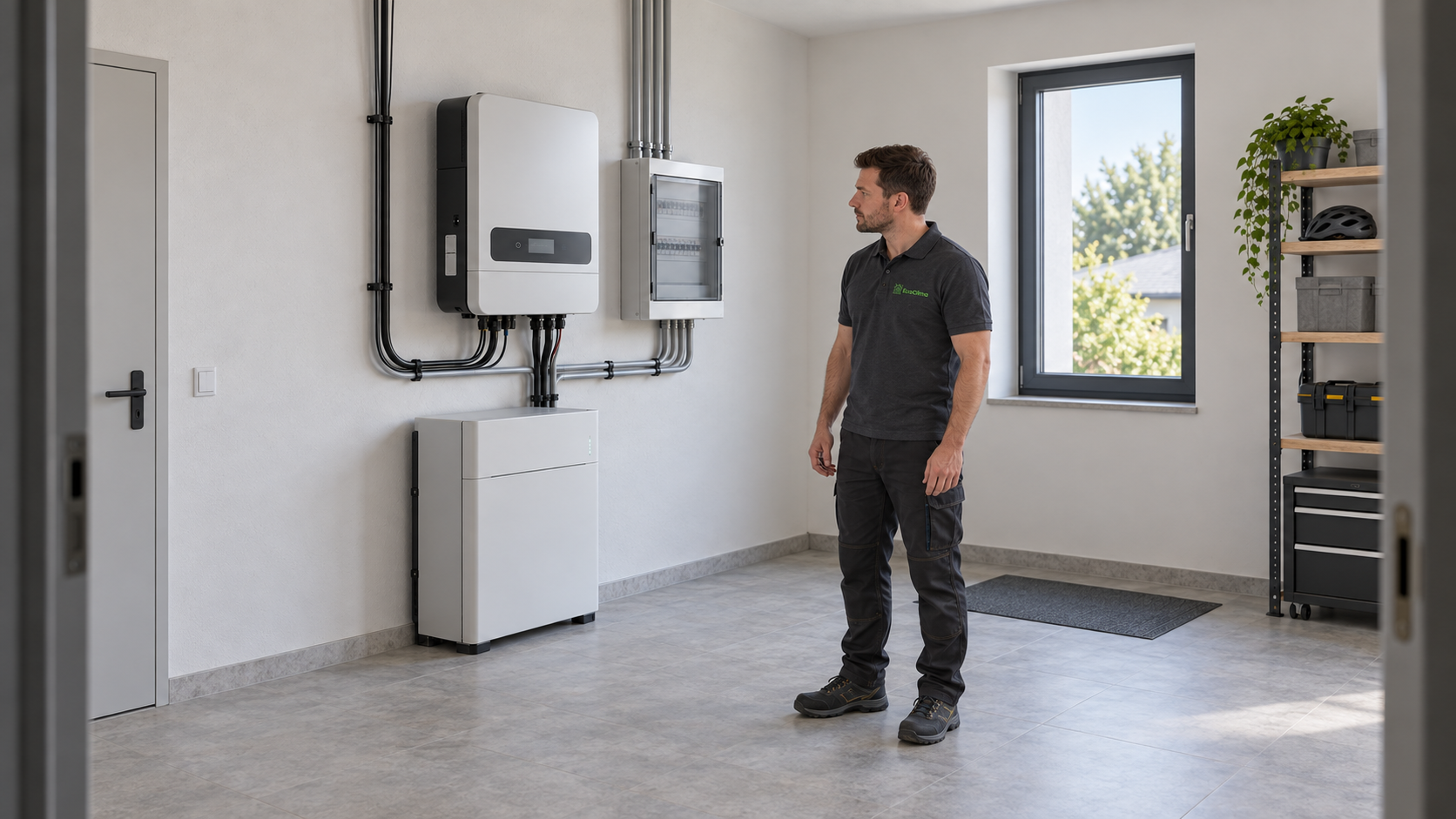
What to request on the quote
- Exact PV capacity, layout plan, equipment, warranties and included work.
- Battery included or excluded, useful capacity, and itemised hardware, conversion and installation.
- Amounts excluding VAT, VAT rates and amounts, and totals including VAT for each item.
- Aid scheme, relevant dates, technical conditions, formula and cost caps.
- Conditional cost after aid, deposits and chosen application procedure.
- Responsibility for municipal permissions, grid connection, metering and the aid application.
| Point to check | What you want to see on the quote | Why it matters |
|---|---|---|
| System size and layout plan | Total kWc, number of panels, placement | To compare like-for-like |
| Inverter | Model, type (standard/hybrid), warranties | Reliability, scalability, monitoring |
| Electrical | AC/DC protections, surge protection, cables, grounding | Safety, compliance, longevity |
| Site access | Scaffolding/lift included or not | Avoids “surprises” after signing |
| Grid connection | Grid procedures, meter, commissioning | Turnkey delivery |
| Subsidies | Clearly written assumptions (scheme, conditions) | Avoids vague promises |
| Timelines | Estimated installation and commissioning timelines | Realistic planning |
From the quote to payment of the grant
Before signing, have the roof, electrical installation, municipal and grid requirements, applicable scheme and aid procedure checked. The contract sets out the work, schedule and deposits. After installation and commissioning, collect the detailed invoices, supporting documents and required certificates. Under the ordinary procedure, the application follows payment; with pre-financing, the intermediary installer submits the application and passes the grant on through the final invoice.
A price you can use to decide
Compare an exact capacity and an identical list of services, then separate the total including VAT, estimated aid and cash to advance. For a quote, provide your annual consumption, roof information and storage needs so the estimate reflects your home.
Frequently asked questions
What is the average price of a photovoltaic installation in Luxembourg in 2026?
The budgets shown are indicative and use the assumptions detailed in the article. Compare the same capacity, work and configuration with or without a battery.
How much does a 6 kWp installation cost in 2026?
The price requires a quote. For an eligible 6 kWp PV system, the schedule used here gives 6 × (1,155 − (1,155 / 35) × 6) = €5,742.00 before eligible-cost limits. This is theoretical aid, not the installation price.
Can subsidies cut the price in half?
There is no general 50% rule for the new applications shown here. Aid depends on PV capacity and useful storage capacity, followed by the applicable conditions and caps. Historical rates remain restricted to their scheme and dates.
Self-consumption or feed-in: which is more profitable?
Compare your usage, electricity purchase price and surplus-sale terms. The schedule described here requires self-consumption and waiver of the regulated feed-in tariff. Benefits under an older guaranteed-tariff contract must not be added to these simulations.
Is a battery useful?
It can shift some generation to the hours when you consume electricity. Its value depends on available surplus, losses, power, service life and extra cost. A compatible inverter does not mean a battery is included in the quote.
Does 3% VAT apply to the whole installation?
In the eligible residential case described here, it applies to PV supply together with installation. Storage is calculated at 17%, including when supplied with the panels. Other items need a separate assessment.
Do you need a building permit?
Check the applicable rules with your municipality before starting work and clarify who handles the procedures and grid connection.
Which documents should you request from the installer?
Request an itemised quote, layout plan, technical specifications and warranties, amounts excluding and including VAT by item, aid dates and assumptions, and payment and any pre-financing terms.
Further reading

About the author
Abel Lovasz · Sales Director at Ecoclima
More than seven years of experience in the energy transition, supporting hundreds of customers, including with their solar energy projects.
Explore his background