
Solar panel mounting on roofs in Luxembourg: The complete guide for your roof (Tile, Slate, Metal, Flat)
In 2026 , when we talk about solar PV, we often talk about panels, inverters, batteries, incentives. But on site, one element makes all the difference in terms of reliability, watertightness, and wind resistance: the mounting system.
A roof is never “standard”. Tiles, slate, standing seam, trapezoidal steel deck, flat roof. Each surface requires its own method, its own accessories, and above all its own key points to watch. In this article, we provide a clear, practical recap, with the solutions we use at Ecoclima and what you should check before signing a quote.
Goal: to give you a simple way to compare offers, ask the right questions, and understand why two systems with the same capacity can be installed very differently.
In short: a good mounting system is one that respects your roof, manages water properly, withstands wind loads, and stays durable for 25 years. Everything else is a compromise.
Quick overview: which PV mounting for which roof type?
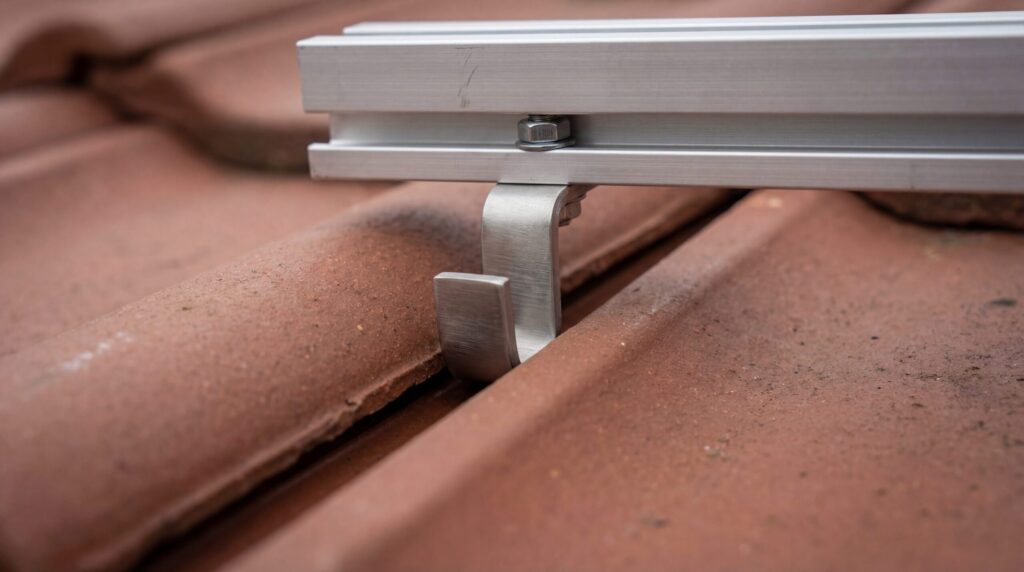
- Tiled roof: hook mounts under the tiles. Sometimes no cutting, sometimes minor grinder adjustments depending on the tile shape and the roof structure.
- Slate roof: also hooks, but more meticulous work. More labor, and waterproofing must be handled with extra care.
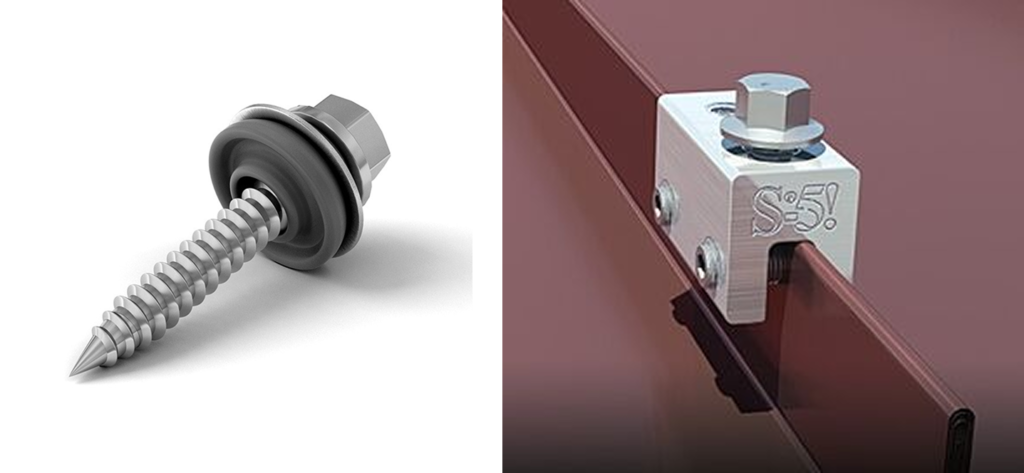
- Standing seam roof: installation with clamps that grip the seams. Very clean, very fast, zero penetration.
- Trapezoidal steel deck: mounting with specific screws and EPDM washers. Integrated waterproofing when done correctly.
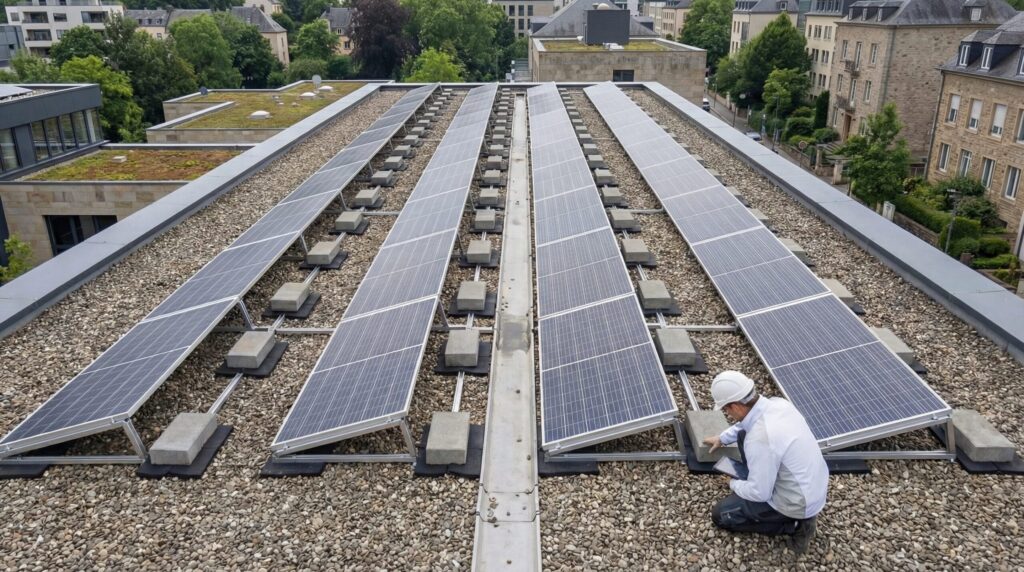
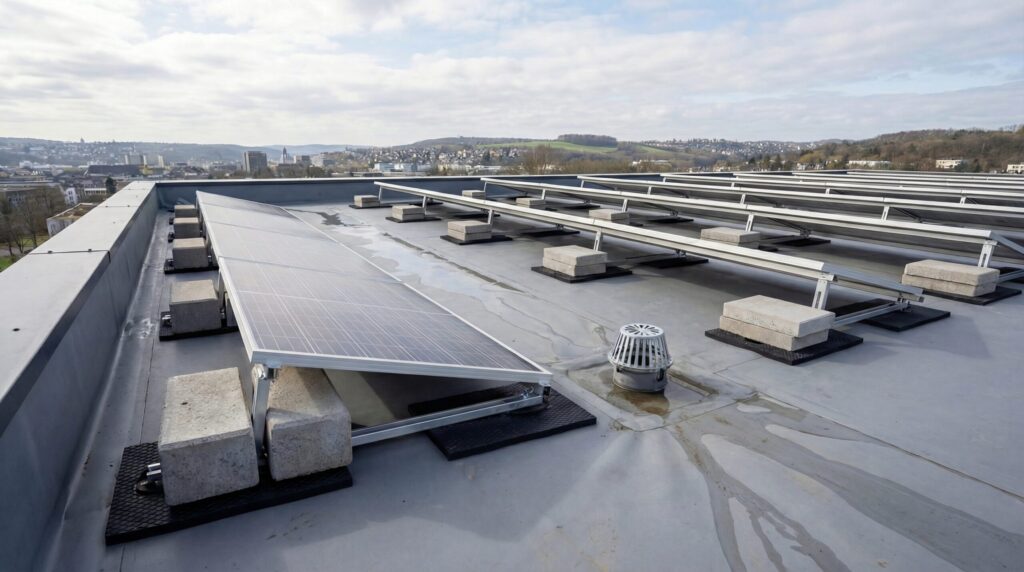
- Flat roof: ballasted mounting. No penetrations, only weight. Very low leak risk if the design is correct.
Why the mounting system matters as much as the panels
A panel is an industrial component. It’s tested, certified, with guaranteed performance. The mounting system, however, has to adapt to a real job site: sometimes older roofs, uneven tiles, fragile slate, steel decks that move, wind, rain, frost, thermal expansion.
What the mounting system must deliver, all at the same time:
- Watertightness: water must keep draining as before, without creating weak points.
- Mechanical strength: wind loads, uplift suction, vibrations, and forces transferred to the roof structure.
- Durability: corrosion, galvanization, material pairings (stainless, aluminum, steel), long-term seal performance.
- Maintenance access: replacing a module, working on cables, visual inspection.
- Aesthetics: height, alignment, finishes, cable routing.
In Luxembourg, roofs are often exposed. But above all, there’s huge variety: classic residential tiled roofs, outbuildings in steel deck, flat roofs on apartment buildings, shops, or garages. That’s why a tailored mounting approach matters, not a one-size-fits-all recipe.
Comparison table: PV mounting solutions by roof type
| Roof type | Mounting principle | Strengths | Points to watch |
|---|---|---|---|
| Tiles | Hooks under tiles + aluminum rails | Proven solution, adaptable, durable | Tile handling, water paths, alignment |
| Slate | Hooks + reinforced waterproofing | Clean integration if well executed | Fragile roof, workmanship, installation time |
| Standing seam | Clamps tightened on the seams | Zero penetration, fast, very clean | Thermal expansion, field segmentation |
| Trapezoidal steel deck | Screws with EPDM washers + rails | Efficient, cost-effective, quick | Expansion, waterproofing at screw points, torque settings |
| Flat roof | Ballasted structures | No penetrations, very low leak risk | Weight, wind zones, drainage, gravel and membrane |
Tiled roofs: the standard… with variations that matter
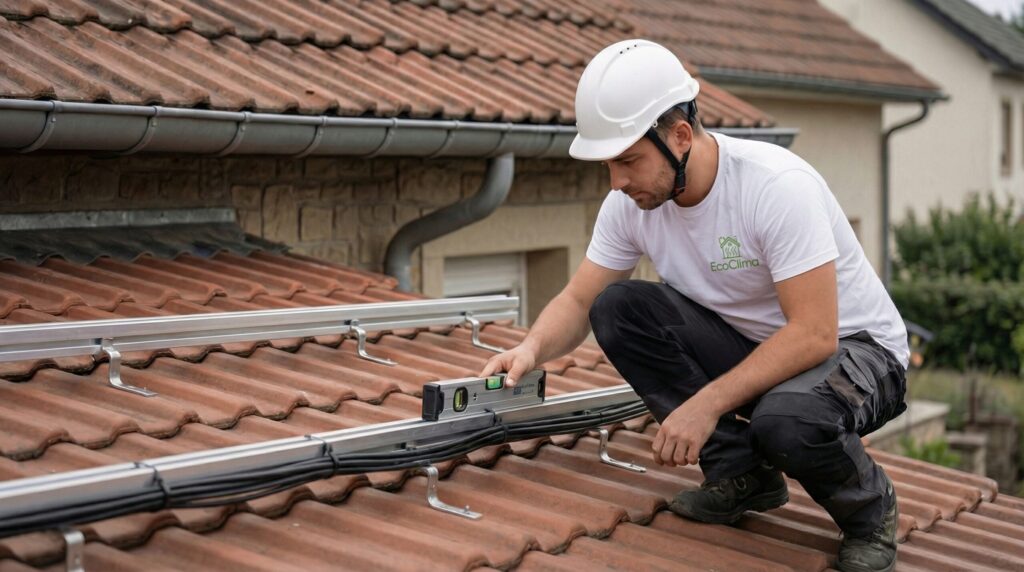
On tiled roofs, the most common solution is the hook fixed into the roof structure, which comes out beneath the tile to support the aluminum rails. The panels are then attached to these rails.
On paper, it’s simple. In reality, everything comes down to details: the tile type, its geometry, its condition, and how the hook “exits” without creating a pressure point.
Angle grinder or not: why we sometimes need to adjust
Some tiles leave enough room. The hook fits, the tile sits properly again, and the water line remains natural. In that case, no cutting is needed.
On other models, the tile presses on the hook. If you force it, you create stress. And stress on a tile often ends in a crack, sometimes immediately, sometimes after a winter.
The solution isn’t to “bend” the tile. It’s to adapt the interface: local adjustment and clean management of the pass-through area. Depending on the situation, that may require a light grinder trim. Sometimes, nothing at all. What matters is that the tile sits without tension and that drainage remains perfect.
The 5 things to check in a tiled-roof quote
- Distribution of anchoring points on the roof structure (not done “by feel”).
- How waterproofing is handled at hook locations.
- Quality of rails and fasteners (anti-corrosion).
- Cable routing, discreet and protected.
Slate roofs: same principle, but real craftsmanship
Slate is an elegant roof covering, but more demanding. It’s still hooks and rails, but installation is more labor-intensive, and waterproofing must be managed with greater precision.
Why? Because slate is more fragile, overlaps are specific, and tolerances are tighter. Where a tile roof might sometimes “forgive” a small deviation, slate rarely does.
What we do on slate roofs at Ecoclima
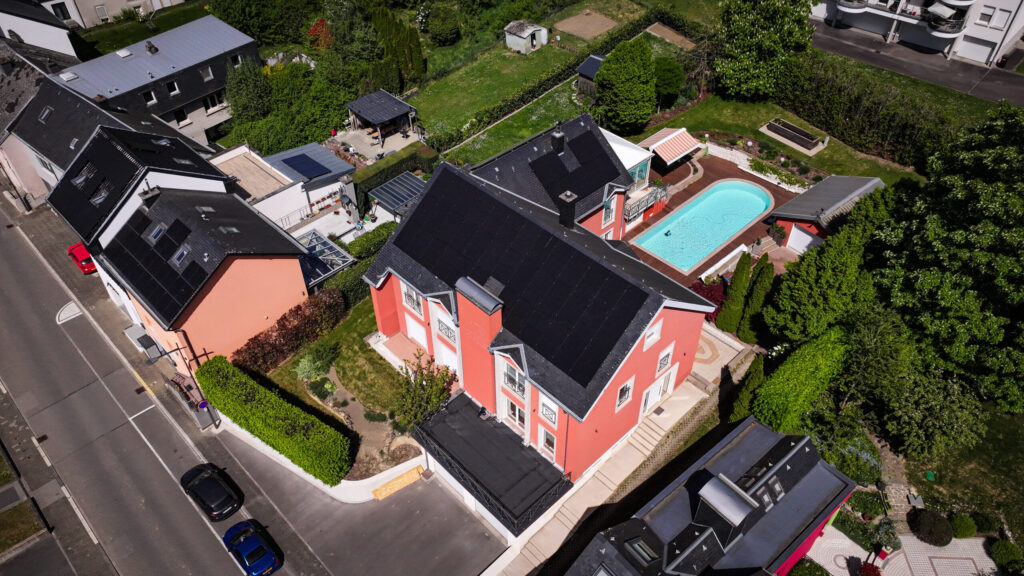
- Stainless steel hooks: corrosion resistance and long-term stability.
- Double aluminum flashing: to secure waterproofing around sensitive points.
- Slower, more controlled installation, with systematic checking of overlaps.
On slate, labor matters more. That often explains a price gap between two quotes. And it’s not a “marketing markup”. It’s the real time needed to deliver an installation that doesn’t put your roof at risk.
Key takeaway: if you have a slate roof, ask one simple question: “How do you manage waterproofing around the hooks?” The answer should be specific, not vague.
Standing seam roofs: the cleanest install, with no penetrations
Standing seam is a very popular case for solar PV. The principle: we use clamps that grip the seams of the metal roof. The clamps are tightened to the correct torque, then the rails and panels are mounted on top.
Immediate advantage: zero holes in the roof. It’s fast, clean, and very safe, if properly engineered.
Zero risk… as long as thermal expansion is respected
The critical point is that a metal roof moves. It expands and contracts with seasons and sunlight. If you create a PV field that’s too long and too “continuous”, you can prevent that movement.
Potential result if poorly managed: abnormal stresses, noise, deformation, and in worst cases, local tearing or mechanical fatigue. It’s not common, precisely because serious installers address it in the design stage.
At Ecoclima, we take this seriously: we avoid overly long continuous blocks, we segment, we follow mounting-system recommendations, and we adapt the design to roof lengths and exposed zones. In practice, it’s invisible to you, but it’s what makes for a “no worries” installation over 20 years.
What you can easily check
- The quote clearly states no penetrations (clamps on seams).
- The quote mentions a segmentation approach or adaptation to the metal roof.
- You’re told how the system handles roof movement.
Trapezoidal steel deck: effective, but screw quality makes all the difference
On trapezoidal steel decking, we typically use metal-specific screws with EPDM sealing washers. You’ll sometimes hear “self-washing EPDM screws” to describe screws designed to maintain good sealing and reduce water retention around the fixing point.
It’s a very common solution for outbuildings, garages, agricultural buildings, sheds, workshops. It can be excellent, but it depends on one key point: the screwing.
Common mistakes on steel deck roofs
- Screw overtightened: the EPDM washer is crushed and wears out faster.
- Screw not tight enough: water finds a path, especially with wind-driven rain.
- Poor placement: screw in the wrong part of the profile, or on a section that flexes.
- Material mismatch: faster corrosion risk if metals aren’t properly selected.
Thermal expansion too: a critical point that’s often forgotten
As with standing seam, steel decking moves with heat. Over long spans, movement can be significant. Here too, PV fields that are “too continuous” can become an issue if the design doesn’t leave enough allowance.
Best practice is to design a mounting system that holds mechanically while respecting the roof’s own logic. At Ecoclima, we adapt the layout, avoid long uninterrupted zones when it’s not appropriate, and use mounting systems consistent with the type of steel deck.
Flat roofs: ballasted mounting, the no-penetration solution
On flat roofs, the most reassuring solution for many owners is the ballasted mounting system. Concretely, we place a structure, then stabilize it with weight. No drilling into the membrane. No penetration points. The leak risk related to solar PV becomes very low, because the membrane is not “opened”.
You sometimes hear: “yes but weight on my roof is risky”. In reality, it’s all about distribution and design. A good ballasted system spreads loads and respects roof drainage.
What must be addressed on a flat roof
- Wind: on a flat roof, uplift suction can be strong. Ballast must be designed for that, zone by zone.
- Drainage: drainage outlets must never be blocked. Water must keep flowing.
- Membrane protection: an interface between structure and membrane to prevent abrasion and punctures.
- Orientation and tilt: a balance between production, wind exposure, and aesthetics.
Focus: water, wind, corrosion. The three enemies of poor mounting
Whatever the roof, a PV mounting system must “survive” three permanent constraints. They explain 90% of the problems when things are done poorly.
1) Water: always assume it will find a path
A roof works because water is guided away. When we add anchoring points, we must preserve that logic. It’s not just “adding silicone”. It’s respecting overlaps, slopes, drainage paths, and interfaces between materials.
2) Wind: it’s not weight that matters, it’s uplift suction
Many people imagine wind as a pushing force. On a panel, it’s often the opposite: it “pulls” upward, especially along roof edges and corners. That’s why proper sizing and anchor distribution are essential, and why a “minimum” mounting design can be a false economy.
3) Corrosion: the invisible detail that becomes expensive after a few years
Stainless steel, aluminum, galvanized steel. Choosing compatible material pairings is essential. A good mounting system anticipates corrosion, especially on metal roofs, in humid zones, and where water can stagnate. That’s also why we prioritize quality components and mounting solutions that match the roof type.
Checklist: the right questions to ask before approving a quote
- What is the exact mounting type planned for my roof (hooks, clamps, EPDM screws, ballast)?
- How do you manage waterproofing at sensitive points?
- How is thermal expansion handled on metal roofs (standing seam, steel deck)?
- Is the mounting engineered for exposed zones (edges, corners, building height)?
- What is the fastener quality (stainless, anti-corrosion treatment) and rail quality?
- Can I replace one panel without dismantling half the array?
- What is your method to protect cables and prevent abrasion?
How Ecoclima chooses the right mounting system
We never start from a “default” mounting approach. We start from your roof and build the solution around it.
Our process follows 5 steps:
- Roof assessment: roof covering type, condition, fragile zones, access, drainage outlets.
- System selection: hooks, clamps, EPDM screws, or ballast, depending on the surface.
- Layout: segmentation if needed, edge management, aesthetics, technical routing.
- Controlled installation: waterproofing, tightening torque, alignment, protections.
- Final check: visual inspection, finishing details, and overall consistency of the PV array.
And if you also work on proper sizing, it’s even better: a well-sized, well-segmented array that matches your roof is often more profitable than a “maximized” array with no logic. On this topic, you can also read our article on sizing in Luxembourg: PV sizing, self-consumption and the value of kWh.
What about incentives and procedures in Luxembourg?
Mounting systems don’t have a “specific” incentive, but they’re part of an installation’s overall costs. For procedures and incentive frameworks that evolve over time, the safest approach is to refer to an official source first, then speak with an installer to translate that into technical choices.
If you want a broader “home” view, combining solar PV with other solutions, you can also check: heat pumps and solar panels in Luxembourg: profitability.
FAQ: solar panel mounting systems (Luxembourg)
No. On standing seam roofs and on flat roofs with ballasted mounting, installation can be done without penetrations. On tiles and slate, we use hooks fixed to the roof structure. On steel decking, we use suitable screws with EPDM washers, so there are fixing points into the roof covering.
It’s not “risky” if it’s done methodically. It’s mainly more demanding. It requires precision, solid waterproofing management, and suitable components. At Ecoclima, we use stainless steel hooks and double aluminum flashing to secure sensitive areas.
Because a metal roof moves. If you block its movement with a PV field that’s too long and too continuous, you can create unnecessary stresses. The right approach is to design the mounting so the roof and the PV structure can “move” properly, without excessive constraint.
Often yes, because it’s penetration-free and very clean. But it requires respecting the metal roof’s rules, especially expansion, and choosing clamps that match the roof profile.
Look at the mounting section: mounting type, component quality, roof complexity, waterproofing management, segmentation on metal roofs, finishing, and site access. On complex roofs, that’s often where the gap comes from, far more than the panels themselves.
Yes, if it’s properly engineered and if the design accounts for exposed zones. Wind doesn’t act uniformly. Edges and corners are more stressed. That’s why we design mounting with a zone-by-zone logic, and why we don’t “copy-paste” a generic solution.
In many cases, yes. But it depends on the roof type, the condition of the surface, and the original design. The best approach is to plan for this scenario at the quote stage if you expect to redo the roof covering in the medium term.
No. On standing seam roofs and on flat roofs with ballasted mounting, installation can be done without penetrations. On tiles and slate, we use hooks fixed to the roof structure. On steel decking, we use suitable screws with EPDM washers, so there are fixing points into the roof covering.
It’s not “risky” if it’s done methodically. It’s mainly more demanding. It requires precision, solid waterproofing management, and suitable components. At Ecoclima, we use stainless steel hooks and double aluminum flashing to secure sensitive areas.
Because a metal roof moves. If you block its movement with a PV field that’s too long and too continuous, you can create unnecessary stresses. The right approach is to design the mounting so the roof and the PV structure can “move” properly, without excessive constraint.
Often yes, because it’s penetration-free and very clean. But it requires respecting the metal roof’s rules, especially expansion, and choosing clamps that match the roof profile.
Look at the mounting section: mounting type, component quality, roof complexity, waterproofing management, segmentation on metal roofs, finishing, and site access. On complex roofs, that’s often where the gap comes from, far more than the panels themselves.
Yes, if it’s properly engineered and if the design accounts for exposed zones. Wind doesn’t act uniformly. Edges and corners are more stressed. That’s why we design mounting with a zone-by-zone logic, and why we don’t “copy-paste” a generic solution.
In many cases, yes. But it depends on the roof type, the condition of the surface, and the original design. The best approach is to plan for this scenario at the quote stage if you expect to redo the roof covering in the medium term.
Conclusion: good mounting means peace of mind for 25 years
The mounting system is the least “visible” part of an installation. And yet, it’s the part that protects your roof, your investment, and your peace of mind.
If you have a quote, or if you’re hesitating between several solutions, we can clearly explain which mounting method is best suited to your roof.
Update note: rules, methods, and requirements can evolve depending on systems, manufacturers, and on-site conditions. When in doubt, we always align with current technical recommendations and the real constraints of your roof.