
Charging your electric car with solar panels in Luxembourg: What you need to know !
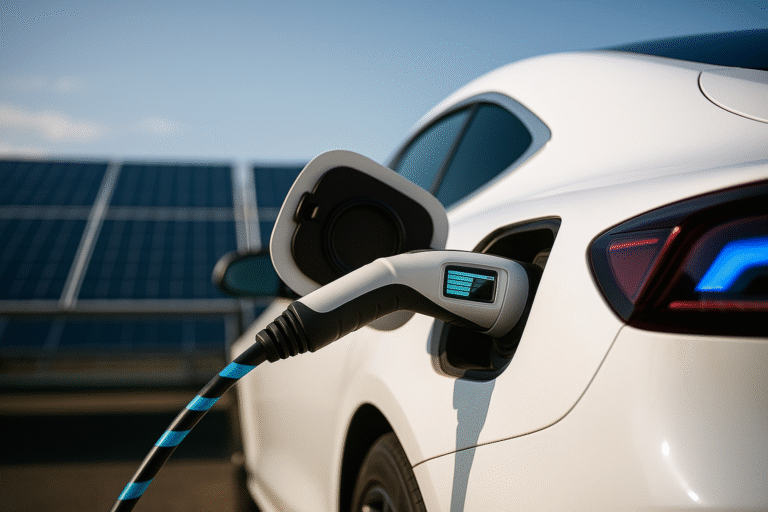
Charging your electric car with solar panels in Luxembourg is an excellent way to reduce your mobility costs while increasing your share of local green energy. This guide explains how to optimize charging, why all batteries cannot deliver 11 kW (which is the standard charging power of residential charging stations in Luxembourg), how optimized solar charging changes everything, and why charging a little more slowly can also extend the lifetime of the vehicle battery. We also discuss the prospect of bidirectional charging (vehicle-to-grid), which is not yet authorised in Luxembourg as of today, and the key points for those who already have panels as well as for those gathering information before buying.
Why consider solar charging for your vehicle in Luxembourg?
Combining an electric vehicle (EV) and photovoltaics (PV) increases your self-consumption and reduces your purchases of grid electricity. In practice, every solar kWh consumed in the car is one less kWh purchased from the supplier. This is particularly relevant in Luxembourg, where the state supports self-consumption (subsidies, 3% VAT on the PV installation) and where sunlight, although lower in the winter season, still covers a significant share of charging needs during spring and summer.
Key point no. 1: the power limit of home batteries
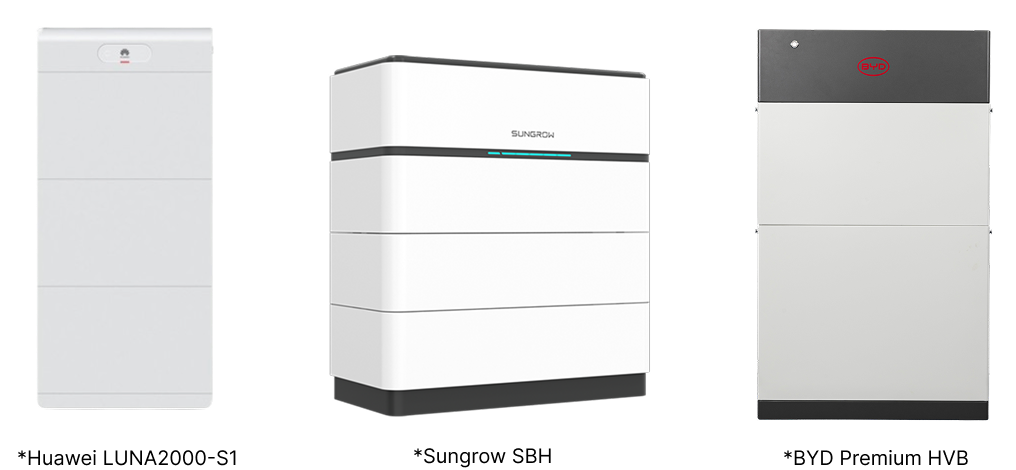
Most home storage batteries cannot deliver 11 kW of output power. A typical example in Luxembourg: a 10 kWh Huawei LUNA2000 battery only discharges around 5 kW in nominal mode. Direct consequence: if you schedule a night-time charge at 11 kW expecting to “draw from the battery”, it will only supply part of it (≈ 5 kW) and the rest will be taken from the public grid. Result: a charge more expensive than expected and reduced effectiveness of your solar strategy.
Best practice
- Limit night-time charging power to the battery’s discharge capacity (often 3–5 kW).
- Reserve higher-power charging (7–11 kW) for periods of full sun, when your panels can cover most of the demand.
- Use time scheduling and dynamic control to adjust charging power according to available solar production and the EV’s state of charge.
Key point no. 2: 11 kW “flat” night charging is rarely optimal
Given the limitation above, charging at 11 kW at night often results in drawing a significant portion from the grid. If your objective is to maximise the actual solar energy used, a slower charge (e.g. 4–5 kW) allows you to stay within the home battery’s capacity and avoid unnecessary grid draw. Yes, charging takes longer, but it happens while you sleep: zero inconvenience and better economic efficiency.
Key point no. 3: “optimized solar charging”
Optimized solar charging (often called “PV surplus mode” or “solar-optimized charging”) consists of adjusting in real time the power delivered to the car to match the actual photovoltaic surplus available after the household’s consumption.
In practice, the system analyses solar production and household consumption at every moment. For example:
- If instantaneous solar production is 4.8 kW
- And household consumption (appliances, lighting, etc.) is 1.0 kW
Then, the charging station in “solar-optimized” mode will automatically limit charging power to 3.8 kW (the available solar surplus). This ensures that no electricity is drawn from the grid and that all the energy used comes directly from your panels. If a cloud reduces production, the station lowers power; when sunlight returns, it increases again. Everything happens automatically, with no manual intervention.
How does Ecoclima activate this at your home?
In our projects, we activate this functionality when the customer chooses a charging station and an inverter of the same brand or compatible brands (direct communication or via current sensors/smart meters). Result: your car charges automatically from the sun, without monitoring or “switch juggling”. You of course retain the option to “force” a fast grid charge if needed (unexpected departure, urgent autonomy, etc.).
Key point no. 4: slower charging preserves the vehicle battery
On a daily basis, favouring moderate charging power (for example 3.7 to 7.4 kW in AC) is beneficial for your car battery’s longevity. Fast charging (high-power DC) remains useful while travelling, but a “slow/intelligent” home routine keeps the battery in a thermal and electrical comfort zone that supports durability. Combining solar + gentle charging helps you optimise costs, CO₂, and equipment lifetime.
Local context: subsidies, grid and VAT
In Luxembourg, your project may benefit from:
- The Klimabonus grant for the installation of a private charging station (amount depending on the station type and eligibility conditions).
- Possibly, additional municipal subsidies (depending on your municipality).
- For residential photovoltaics: investment subsidies and a 3% VAT rate on the supply and installation of the PV system (panels, inverter, related cabling, etc.).
Important reminder: the home battery (storage) is generally excluded from the 3% VAT rate and remains billed at 17% (even if installed at the same time as the panels). Ecoclima advises you on the proper structuring of the quotation and handles the entire application process for grants and subsidies.
Typical financial aid for a private charging station:
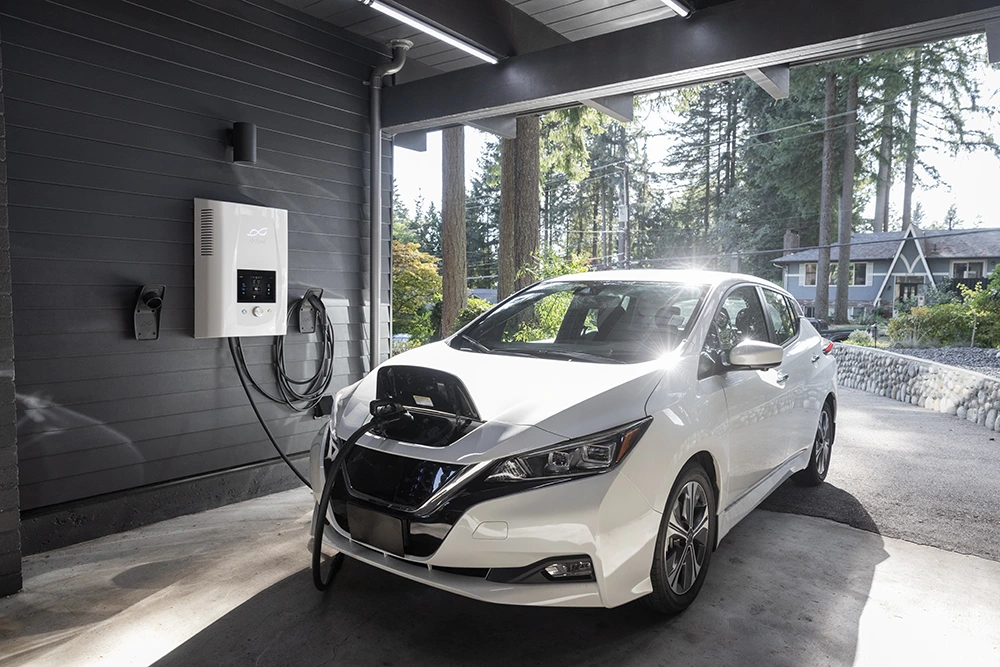
The amounts below are presented for indicative purposes in order to illustrate the funding logic. Always check the rates and conditions in force at the time of your application.
| Type of charging station | National aid (Klimabonus) | Municipal aid (e.g. participating municipality) | General conditions (extracts) |
|---|---|---|---|
| AC charging station ≤ 11 kW | Subsidy (cap depending on category) | Possible supplement (if provided by the municipality) | Purchase and installation by a professional, application within deadlines, compliant charging station |
| “Smart” charging station (OCPP) | Higher subsidy (higher cap) | Possible supplement (if provided by the municipality) | Control/communication functions, compliance with standards and power rating |
To know exactly what you are entitled to, Ecoclima checks the national rules and municipal bonuses applicable to your address, prepares the file and assists you through to payment.
Economic scenarios (order of magnitude)
Simplified comparison for 100 km, based on indicative averages, to illustrate the benefit of directing charging towards solar and/or slow night charging adapted to the home battery.
| Scenario | Price/usage hypothesis | “Fuel” cost for 100 km (approx.) | Comment |
|---|---|---|---|
| Solar charging (self-consumption) | PV surplus directed to the charging station | ≈ €0 (excluding equipment amortisation) | Optimised via smart charging station + real-time control |
| Grid charging at home | Standard residential tariff | Low | Can be optimised with off-peak hours |
| Petrol (comparison) | 6 L/100 km (approx.) | High (≈ twice as expensive as EV on grid power) | Varies according to pump prices |
How to set your charging station to “charge from the sun”
- Measure the PV surplus (meter/CT-clamps at the delivery point) to know the exportable excess in real time.
- Connect the charging station to the inverter (or to the measurement system) so that it automatically adjusts charging power.
- Define modes in the app: “Solar only”, “Solar + grid mix”, “Fast grid charge”.
- Set thresholds (e.g. do not charge above 4–5 kW at night if the home battery cannot keep up).
- Monitor and fine-tune: check the production/charging history and adjust your schedules.
Case A: You already have solar panels
- Check brand compatibility between charging station and inverter (Ecoclima can activate the “PV surplus” mode).
- If you have a home battery, note its discharge power (often 3–5 kW) and limit the EV’s night-time charging power to this level.
- Plan daytime charging (e.g. weekends, working from home) to capture as many solar kWh as possible.
- Refine your self-consumption profile (gradual adjustment of settings to avoid grid draw).
Case B: You are planning to install panels and a charging station
- PV sizing: as a rule of thumb, 1 kWp ≈ 1,000 kWh/year in Luxembourg. An EV consumes 15–20 kWh/100 km. 1 kWp can therefore cover 5,000–6,500 km/year if dedicated to mobility.
- Charging station power: single-phase (3.7–7.4 kW) or three-phase (up to 11 kW). The key point is modulation capability (smart charging station).
- Storage: useful if you want to shift part of the solar production to the evening/night. Pay attention to the discharge power, which remains the bottleneck for 11 kW charging.
- Administration: Ecoclima assists with the application to the grid operator (PV connection + charging station declaration) and with your subsidy application file.
Bidirectional charging (V2H/V2G): near future, framework still missing
Bidirectional charging (from the vehicle to the home or to the grid) will enable very interesting use cases: home backup, peak-time valorisation, grid services. As of today in Luxembourg, the legal and technical framework for residential projects is not yet deployed. Standardisation is progressing in Europe and equipment compatibility is becoming more widespread, but an official framework and local commercial offers are still needed. Ecoclima follows these developments closely in order to offer compliant and efficient V2H/V2G solutions when the time comes.
Sources and useful links
- Guichet.lu – Official administration portal (Klimabonus grants, mobility, energy)
- Klima-Agence – Official advice on energy & PV
- How a solar panel installation works with Ecoclima
Conclusion
In Luxembourg, charging your electric car with solar panels is a winning choice: savings, autonomy, and lower carbon footprint. The key points to remember: limit night-time charging to the discharge power of the home battery, activate optimized solar charging via a compatible smart charging station, and prioritise moderate charging power to preserve the battery lifetime of the vehicle. Ecoclima designs and configures these turnkey solutions, manages subsidies, and supports you from the initial study through to ongoing monitoring.
If you would like to receive a free quote for your installation: Request your free solar quote today.
Frequently Asked Questions (FAQs)
Keep the simple rule of thumb: 1 kWp ≈ 1,000 kWh/year ≈ 5,000–6,500 km/year (depending on vehicle and usage). We size the system according to your journeys, habits and available roof space.
In summer, often yes for a large share. In winter, production drops significantly and the grid will top up. The goal is to maximise the solar share (charging schedule, smart charging station, possible battery).
Not necessarily. Many use cases are covered with 7.4 kW (single-phase). Three-phase (11 kW) brings extra comfort for larger batteries, but is not essential if you charge regularly and intelligently.
On the contrary, regular charging at moderate power is favourable to the vehicle battery’s durability. Keep very fast charging for long trips.
How much does it cost? What is the return on investment?
Prices depend on the configuration (PV power, type of charging station, possible storage). Thanks to subsidies and the 3% VAT rate on PV installation, many projects show a ROI of around 5 to 10 years, depending on the level of self-consumption achieved and annual mileage. Ecoclima calculates your specific case and optimises the settings to accelerate the return on investment.