
Electricity price cut in Luxembourg: what impact on solar in 2026?
Direct answer
Luxembourg’s 4 c€/kWh electricity price cut, applicable from 1 August to 31 December 2026, slightly reduces the value of each self-consumed solar kWh for five months. On its own, it does not undermine a photovoltaic project assessed over several decades: the actual impact depends on the number of kWh purchased from the grid or self-consumed during this period.
−4 c€
incl. VAT per eligible grid kWh
The key is not to confuse the temporary effect on a 2026 electricity bill with the overall profitability of a solar installation. Saying that the price cut “changes nothing” would be inaccurate. Concluding that solar is no longer worthwhile would be equally misleading: the result primarily depends on the self-consumption rate, the roof, the net project cost and future electricity needs.
Luxembourg electricity price cut: key facts
- The €0.04/kWh including VAT reduction applies automatically to residential customers whose annual consumption is below 25,000 kWh.
- It covers electricity drawn from the grid between 1 August and 31 December 2026.
- For 1,000 kWh purchased during this period, the reduction is worth €40.
- A self-consumed solar kWh remains valuable, but for five months it replaces a grid kWh that costs four cents less.
- The measure concerns the electricity price: the government announcement does not change Luxembourg’s photovoltaic grants, prefinancing or the output of your roof.
- A measure limited to five months should not be treated as a permanent assumption when calculating a project designed to operate for several decades.
Understanding the impact on your solar project
What changes on electricity bills from 1 August 2026?
Luxembourg’s Chamber of Deputies has approved a subsidy of 4 c€/kWh including VAT on the price of electricity. According to the official announcement published on 14 July 2026, it will be applied automatically to all residential customers with annual electricity consumption below 25,000 kWh.
No separate application is required under the announced rules. The reduction applies from 1 August to 31 December 2026. The announcement concerns the price of electricity billed to households: it does not present the measure as a new solar grant and does not announce any change to Klimabonus or grid export contracts. At the publication date of this article, the official end date remains 31 December 2026.
Important: electricity generated and used directly in the home is not purchased from a supplier, so it does not receive this reduction. The measure affects its relative value indirectly because the avoided grid kWh temporarily becomes cheaper.
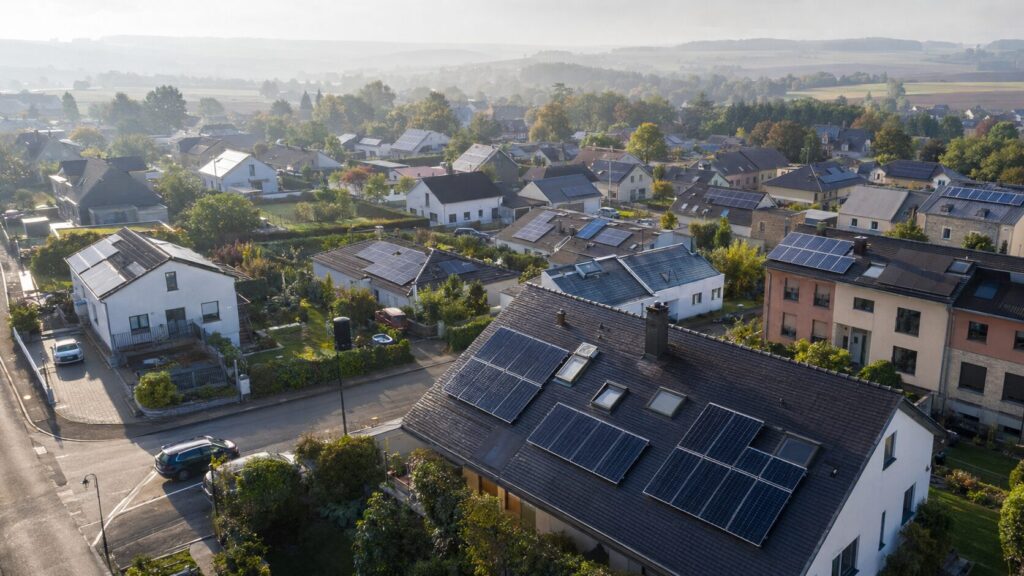
4c€/kWh electricity price cut: what does it mean in euros?
The calculation is straightforward: multiply the number of kWh actually drawn from the grid during the five-month period by €0.04. The four-cent reduction should not be applied to your full annual consumption.
Temporary saving = grid electricity purchased from 1 August to 31 December × €0.04
| Grid electricity during the period | Estimated bill reduction | How to interpret it |
|---|---|---|
| 500 kWh | €20 | Low consumption or high self-consumption |
| 1,000 kWh | €40 | Simple reference example |
| 1,500 kWh | €60 | Household purchasing more grid electricity |
| 2,500 kWh | €100 | Higher consumption over the five months |
A solar-powered home may receive a smaller total subsidy than a comparable home without panels simply because it purchases less electricity. This is not a penalty: self-consumed kWh have already been removed from the variable part of the electricity bill.
Does the 4 c€/kWh reduction lower solar panel profitability?
Yes, slightly and temporarily. The value of a self-consumed kWh mainly reflects the grid electricity cost it avoids. If that price falls by four cents, the saving associated with the solar kWh falls by roughly the same amount during the relevant period.
For example, if an installation enables a household to self-consume 1,000 kWh between August and December, its economic benefit will be approximately €40 lower than it would have been without this measure. This does not mean the household loses €40 because it has solar panels. It still avoids purchasing those 1,000 kWh at the remaining applicable price.
A common error is to project a situation lasting only a few months across 20 or 30 years. Nothing currently indicates that the additional four-cent reduction will become permanent. A credible assessment should separate the 2026 scenario from the electricity price assumptions used for later years and compare several scenarios instead of promising a fixed return.
What changes for solar battery storage and self-consumption?
A battery shifts part of the solar production to the evening or night. During the five-month subsidy period, each kWh supplied by the battery also avoids a grid purchase that is temporarily cheaper. Its short-term value therefore falls slightly, but its annual relevance cannot be judged on this factor alone.
The correct calculation still depends on the amount of surplus that can genuinely be stored, the export price that surplus would otherwise receive, storage losses, annual cycles and evening consumption. An oversized battery does not become worthwhile simply because grid prices rise, nor does it become pointless because a subsidy lowers those prices for five months.
For a more detailed calculation, read our analysis of solar battery profitability in Luxembourg in 2026.
A useful step for homes that already have solar
Continue scheduling flexible electricity use during solar production hours: charge an electric vehicle, heat water, run the dishwasher or use air conditioning during the day. Purchasing a cheaper kWh because of the subsidy is still generally less advantageous than not purchasing it at all.
Should you install solar panels now or wait until 2027?
The 4 c€/kWh price cut is not, on its own, a sound reason to wait. It is temporary, applies to the electricity price and affects only the relevant kWh over five months. Delaying a project may also postpone commissioning and the solar production the system would otherwise have generated.
However, it is worth taking the time to correct a poorly sized project. The decision should be based on the realistic output of the roof, the net cost after grants, the share of electricity that can be used on site, the value of exported surplus, any battery storage and future needs such as an EV charger or heat pump.
| Question to check | Why it matters more than the temporary price cut |
|---|---|
| How much can the roof generate? | Poor orientation or shading affects performance every year. |
| How many kWh will be self-consumed? | This is one of the main drivers of the project’s economic value. |
| What is the net cost after grants? | Profitability depends on the capital actually invested, not the catalogue price. |
| Will the surplus be exported, shared or stored? | Each option gives a different value to electricity that is not used immediately. |
| Will electricity needs change? | An electric car, heating or air conditioning may alter the appropriate system size. |
To explore these points further, read our guide to photovoltaic system sizing in Luxembourg and our article on solar self-consumption in 2026.
What do the ILR’s 2025 figures show about solar in Luxembourg?
The figures published on 30 June 2026 by the Luxembourg Regulatory Institute (ILR) put the new subsidy into context. In 2025, the average integrated electricity price for a residential customer reached 26.65 c€/kWh, while photovoltaic generation, self-consumption and electricity sharing all increased sharply.
26.65 c€/kWhaverage integrated residential price in 2025, up 31.4%
626.78 GWhof photovoltaic generation in 2025, up 74.3%
33,304photovoltaic installations recorded at the end of 2025
444 GWhof self-consumption and electricity sharing, up 122%
These figures do not prove that any individual installation will be profitable. They do show that Luxembourg’s electricity market is moving rapidly towards greater local generation and self-consumption. A temporary reduction in the grid electricity price does not reverse this broader trend.
Measure the impact on your own solar project
The useful approach is to compare several scenarios using your roof, electricity bills, consumption times and future equipment. Ecoclima can assess an installation with or without battery storage and clearly distinguish the 2026 savings from long-term assumptions.
Sources, methodology and further reading
- Luxembourg Government, 14 July 2026: electricity price subsidy from 1 August 2026
- ILR, 30 June 2026: key figures for Luxembourg’s electricity sector in 2025
- Ecoclima: solar panel prices, grants, profitability and prefinancing in 2026
- Ecoclima: solar panel installation in Luxembourg
Methodology: the conditions of the measure come from the government announcement. The euro amounts are arithmetic examples calculated using “grid electricity purchased during the period × €0.04”. The market figures come from the ILR.
Electricity prices, grants and contracts may change. Check the conditions that apply when you request a quotation and review your electricity bill.
2026 FAQ
FAQ: electricity price cut and solar panels in Luxembourg
Six concise answers to the main questions about the measure, self-consumption, solar profitability and battery storage.
Who qualifies for the 4 c€/kWh reduction, and is an application required?
It applies automatically, with no application announced, to residential customers whose annual consumption is below 25,000 kWh. The official period runs from 1 August to 31 December 2026.
How much will I save on my electricity bill?
Multiply the kWh purchased from the grid during the five-month period by €0.04. For example, 1,500 kWh drawn from the grid represents a €60 reduction.
Does the subsidy apply to electricity generated by my solar panels?
No. A self-consumed kWh is not purchased from the supplier. The measure only reduces its relative economic value because the grid kWh it replaces temporarily costs four cents less.
Are solar panels still profitable in Luxembourg in 2026?
This measure alone cannot answer the question for every home. It slightly reduces the value of self-consumption for five months, but the announcement changes neither roof production nor photovoltaic grants. Profitability mainly depends on the net cost, the roof and the self-consumption rate.
Should I wait until 2027 before installing solar panels?
Not solely because of this subsidy. Waiting may make sense if the project needs a better assessment, but a temporary 4 c€/kWh reduction is not sufficient on its own to justify postponing an installation.
What impact does the price cut have on solar battery storage?
It slightly reduces the value of kWh stored and then used during the period. However, the actual value of a battery should be calculated across the full year using the available surplus, export price, storage losses, cycles and evening electricity needs.