
How many solar panels does a house need in Luxembourg in 2026?
How many solar panels does a house need in Luxembourg? For a home using around 5,000 kWh per year, the initial rule-of-thumb estimate is generally 11 to 12 modern panels, or approximately 5 to 5.5 kWp with 460 Wp modules.
This is not yet a system design. The right capacity also depends on when electricity is used, the roof’s actual potential, a future electric car, a heat pump, battery storage and the value of exported surplus. Two homes using the same number of kWh may therefore require different systems.
How many solar panels should you plan for? The short answer
- 3,000 kWh/year: approximately 7 to 8 panels rated at 460 Wp.
- 5,000 kWh/year: approximately 11 to 12 panels rated at 460 Wp.
- 8,000 kWh/year: approximately 17 to 19 panels rated at 460 Wp.
- 10,000 kWh/year: approximately 21 to 23 panels rated at 460 Wp.
- Producing as many kWh as the house uses over a year does not mean achieving 100% energy independence.
- The subsidy ceiling reached at 15 kWp is a financial parameter, not a capacity to target automatically.
Size your photovoltaic system
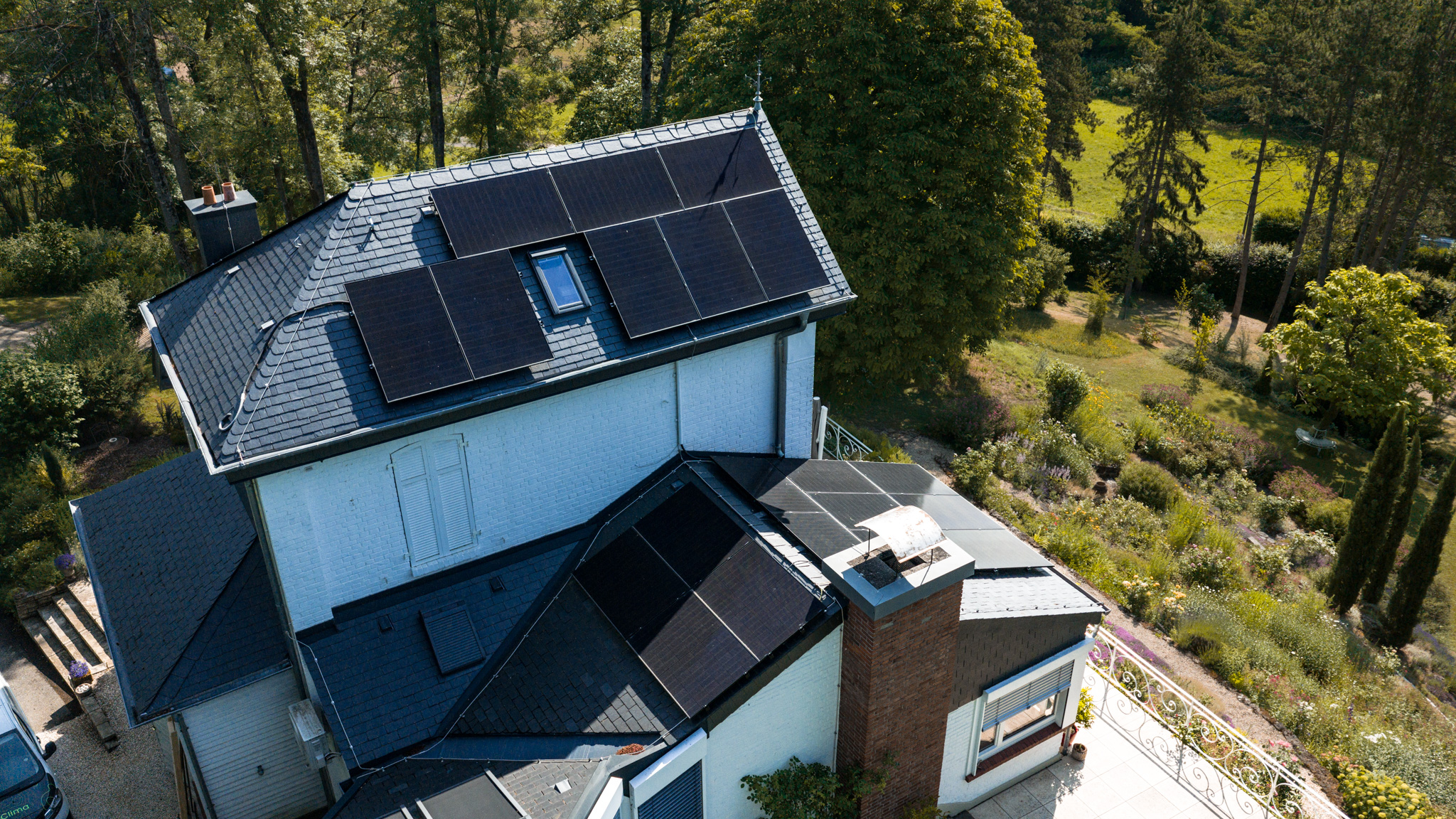
How many solar panels does a house need for its annual consumption?
The table below answers the most common question, but it should be read as a starting point. It uses 460 Wp panels and assumes annual generation of 950 to 1,050 kWh per kWp for a suitable, lightly shaded roof in Luxembourg.
| Annual consumption | Panel capacity | 460 Wp panels | Gross module area |
|---|---|---|---|
| 3,000 kWh | Approx. 3.2 to 3.7 kWp | 7 to 8 panels | Approx. 14 to 16 m² |
| 5,000 kWh | Approx. 5.1 to 5.5 kWp | 11 to 12 panels | Approx. 22 to 24 m² |
| 8,000 kWh | Approx. 7.8 to 8.7 kWp | 17 to 19 panels | Approx. 34 to 38 m² |
| 10,000 kWh | Approx. 9.7 to 10.6 kWp | 21 to 23 panels | Approx. 42 to 46 m² |
Do not confuse the two: kWp measures the system’s nominal capacity, whereas kWh measures an amount of energy generated or consumed. A 5 kWp system does not produce 5 kWh per year; it can generate several thousand kWh depending on the roof and the weather.
The estimate must then be compared with electricity use during daylight hours. A home occupied during the day, a charger controlled by solar surplus or a programmable hot-water cylinder can make better use of a larger system than a property where most electricity is used in the evening.
How do you calculate the number of solar panels?
The calculation has two stages. First estimate the useful photovoltaic capacity, then divide it by the rated output of the proposed modules.
The conversion formula
- Number of panels = target capacity in kWp × 1,000 ÷ output of one panel in Wp.
- For 9 kWp with 460 Wp panels: 9 × 1,000 ÷ 460 = 19.6, or approximately 20 panels.
- With 20 modules rated at 460 Wp, the installed capacity is 9.2 kWp.
Current residential panels do not all have the same output. An offer with 20 panels rated at 460 Wp represents 9.2 kWp; another with 20 panels rated at 485 Wp reaches 9.7 kWp. When comparing two quotations, look at the total capacity, the exact module reference and the simulated generation—not just the panel count.
Expected generation should be calculated for the project address. The European PVGIS tool and the Klima-Agence solar simulator provide an initial basis, which the technical study then refines using the proposed layout and system losses.
The four essential inputs for correctly sizing a photovoltaic system
Step 1
Actual consumption
Review at least twelve months of bills and set aside atypical periods, such as a vacant property, exceptional heating demand or building work.
Step 2
Hourly profile
Identify what uses electricity during the day, evening and night. The annual total alone is not enough to estimate self-consumption.
Step 3
Future uses
Include credible plans for the next three to five years: an electric car, heat pump, air conditioning, extension or controllable hot-water cylinder.
Step 4
Roof potential
Check the available roof sections, orientations, shading, obstacles, roof covering condition and electrical constraints.
The rule of “1 kWp for every 1,000 kWh consumed” can serve as a useful mental benchmark, but it cannot replace this analysis. A system may generate as much electricity as the house uses over twelve months while still exporting heavily in summer and drawing from the grid in the evening or winter.
To understand this distinction, read our guide to solar self-consumption in Luxembourg.
Should you add panels for an electric car or heat pump?
Yes, if these uses are genuinely planned, but their consumption and operating times must be estimated separately. Arbitrarily adding five or ten panels can oversize the project just as ignoring those future loads can leave it too small.
Electric car
Driving 15,000 km/year at 18 kWh/100 km represents 2,700 kWh delivered to the battery. Allowing for charging losses, approximately 3,000 kWh/year is a coherent working assumption.
Heat pump
A heating requirement of 15,000 kWh with a seasonal performance factor of 3.2 corresponds to approximately 4,700 kWh of electricity, before auxiliaries and subject to the building itself.
Load control
A charger supplied by daytime solar surplus makes better use of solar power than exclusively overnight charging. A battery shifts energy by a few hours, not from summer to winter.
Example: a house using 4,200 kWh/year that adds a vehicle requiring approximately 3,000 kWh/year reaches about 7,200 kWh. The study can then compare around 6.5 and 9 kWp depending on whether the vehicle is at home during the day, the roof, the battery and the export tariff.
For heating, the seasonal mismatch is decisive: the heat pump uses most electricity in winter, when photovoltaic generation is lower. Our guide to solar panels and heat pumps in Luxembourg explains this trade-off in detail.
Why the roof can change the number of panels
An estimate based on kWh gives a desirable capacity. The technical survey then confirms how much can actually be installed and how the modules should be distributed. Roof windows, chimneys, edges, access zones and persistently shaded areas must be deducted from the theoretical surface.
| Configuration | Effect on system sizing | Technical point to verify |
|---|---|---|
| Large uniform roof section | Simpler layout and more predictable capacity | String voltages, clearances and access |
| East–west roof | Generation spread more evenly from morning to afternoon | Yield of each roof section and the load profile |
| Several small surfaces | Panel count depends on each usable area | Orientations, MPPTs, optimisers or microinverters |
| Partial shading | Some positions may generate too little to be worthwhile | Seasonal simulation and electrical architecture |
The choice between a string inverter, optimisers and microinverters comes after analysing orientations and shading. No equipment can recover energy that shade prevents from reaching a panel. Read our comparison of central inverters and microinverters.
Do not size a system around the subsidy: Klima-Agence states that an undersized system limits savings, whereas an oversized system increases the electricity not consumed on site and may reduce profitability. The maximum photovoltaic subsidy of €10,000, reached at 15 kWp, therefore does not make 15 kWp a universal system size.
Two Ecoclima projects that show why every roof is different
Local projects are more useful than an isolated average: they show how the roof and the household’s energy uses change the technical answer.
Schuttrange
28 panels, approximately 13 kWp
This solar-panel installation in Schuttrange illustrates a higher-capacity project sized for the house rather than from a standard module count.
Helmdange
20 panels across several roof sections
In Helmdange, different orientations and shading led to 20 AIKO panels being distributed across the roof with microinverters, 10 kWh of storage and an integrated EV charger.
These two examples are not templates to copy. On the contrary, they demonstrate that a sound project combines the panel count, electrical architecture, optional storage and the household’s energy uses.
What a professional photovoltaic study should provide
A panel count announced without verifiable assumptions is not a system design. To compare two offers in Luxembourg, ask for at least the following information.
- The total capacity in kWp and the exact module reference.
- The simulated annual generation, system losses and assumed level of shading.
- A layout plan showing obstacles and the areas deliberately excluded.
- Current consumption, the hourly profile and the future uses included.
- The estimated self-consumption, energy-independence and export rates.
- Two capacity scenarios where several choices are technically defensible.
- The reasoning behind the inverter, battery and optional control strategy.
- Economic assumptions that distinguish self-consumed electricity from exported surplus.
Planning the electrical architecture from the outset also avoids an unnecessarily complex photovoltaic-system extension. For prices, subsidies and prefinancing, see Ecoclima’s 2026 photovoltaic guide; this article deliberately focuses on panel count and system sizing.
Get two scenarios tailored to your roof
Ecoclima analyses your consumption, usable roof areas, shading, a future heat pump or charger, and any planned battery. You can then see why a particular capacity is recommended, what it can generate and how the electricity will be used.
Sources and methodology
- Klima-Agence: solar simulator and photovoltaic system sizing
- Klima-Agence: stages of a self-consumption photovoltaic project
- European Commission, Joint Research Centre: PVGIS
- Klima-Agence: prefinancing and the photovoltaic subsidy ceiling
- AIKO: NEOSTAR 2P54 residential modules rated from 450 to 485 Wp
Methodology: calculations checked on 29 August 2026. The tables use a 460 Wp module and a prudent editorial assumption of 950 to 1,050 kWh/kWp/year. This range is used only for the initial calculation; a technical study must replace it with an address-specific simulation that includes orientation, pitch, shading and actual system losses.
The consumption, electric-car and heat-pump examples are educational. They are neither a generation guarantee nor a capacity recommendation for a specific property.
Photovoltaic FAQ
FAQ: how many solar panels does a house need in Luxembourg?
Six direct answers about panel count, the required roof area, batteries and the capacity to target.
How many solar panels are needed for 5,000 kWh per year?
Assuming generation of 950 to 1,050 kWh per kWp and 460 Wp panels, the initial rule-of-thumb estimate is 11 to 12 panels. This must then be adjusted for the roof, the hours when electricity is used and future loads.
How many solar panels are needed for 3,000 kWh per year?
Approximately 7 to 8 panels rated at 460 Wp provide around 3.2 to 3.7 kWp. This benchmark must be confirmed against the roof’s expected generation and the household’s self-consumption profile.
How many solar panels are needed for 10,000 kWh per year?
The rule-of-thumb estimate is approximately 21 to 23 panels rated at 460 Wp, or around 9.7 to 10.6 kWp. Consumption at this level should be broken down between domestic loads, the heat pump, the car and their operating times.
How much roof area is needed for 10 or 20 solar panels?
Allow approximately 20 m² of module area for 10 modern panels and around 40 m² for 20 panels. The roof needs more space for clearances, obstacles, mounting components and technical access routes.
Does a battery allow you to install more solar panels?
It can make better use of part of the daily surplus, but it does not automatically justify a larger system. Its usable capacity and output must be compared with the actual surplus and evening consumption.
Should you target 15 kWp to receive the maximum subsidy?
No. The subsidy ceiling is a financial parameter, not a technical target. A system close to 15 kWp must be justified by the roof, consumption, future equipment and the value of exported surplus.